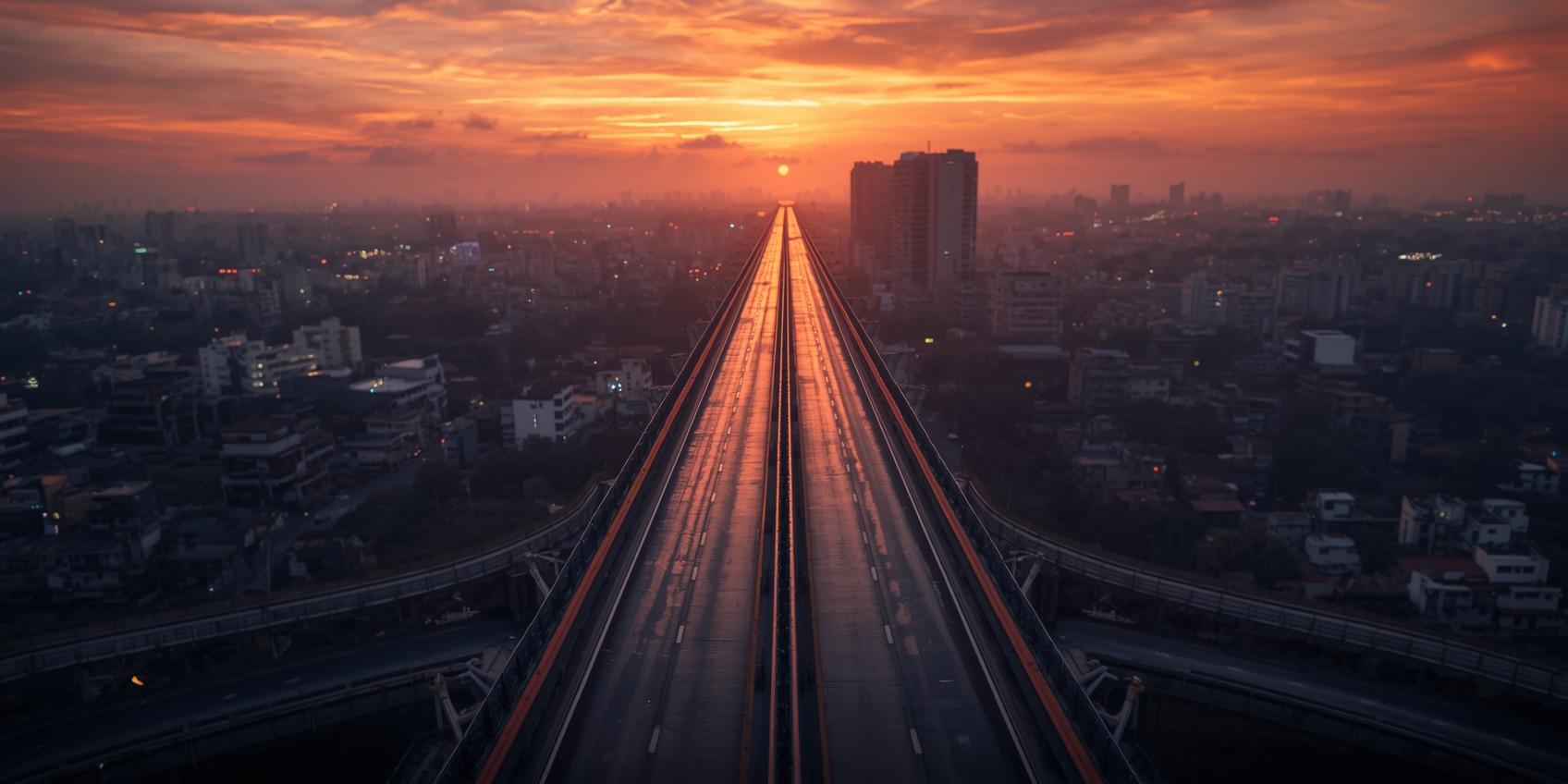

Daily travel between South Mumbai and Thane is set for a major transformation as the Mumbai Metropolitan Region Development Authority (MMRDA) has officially commenced construction of the 13.9 km fully elevated, 6-lane Eastern Freeway Extension. Designed as a high-speed, signal-free corridor, the project aims to slash travel time to just 25–30 minutes, while greatly reducing congestion on the Eastern Express Highway (EEH).
A High-Speed Corridor Connecting Thane to Mumbai’s Eastern Suburbs
The elevated freeway will stretch from Anand Nagar in Thane to Chheda Nagar in Ghatkopar, passing through key nodes including:
- Mulund
- Airoli
- JVLR
- Vikhroli
- Kanjurmarg
- Mankhurd
- Ghatkopar
At Thane, the corridor will integrate seamlessly with the Anand Nagar–Saket Elevated Road near the old Mulund Octroi Naka, creating a continuous high-speed chain of connectivity.
It will also enhance onward access to the Samruddhi Mahamarg, strengthening links between Mumbai and Maharashtra’s emerging growth corridors.
Designed for Faster, Cleaner, Greener Commutes
The freeway extension is expected to:
- Decongest the Eastern Express Highway, one of Mumbai’s busiest arterial roads
- Reduce vehicular emissions by cutting travel time and idling
- Boost economic activity across the MMR (Mumbai Metropolitan Region)
- Improve commute reliability for lakhs of daily travellers
The MMRDA has also emphasized sustainable planning—saving 127 Pink Trumpet trees after realigning the Vikhroli–Ghatkopar portion. Additionally, 4,175 new trees will be planted as compensatory green cover.
Engineering Highlights: First-of-its-Kind Design in MMR
The project features advanced engineering systems, including:
✔️ 2.5 m diameter monopiles
✔️ Robust piers and 40-metre spans
✔️ A 25-metre single-segment superstructure
✔️ Single-pile, single-pier system — the first for an elevated road in MMR
✔️ Up–down ramps near Mulund Check Naka, Airoli Junction, and Vikhroli Junction
✔️ 3+3 lane elevated toll plaza near Navghar Flyover
✔️ Fully signal-free, uninterrupted high-speed movement
Progress Report: What’s Done and What’s Next?
As per the official update:
- Preliminary survey works are completed
- Test piles have been cast
- Geotechnical investigations are mostly finished
- Utility mapping is substantially complete
- Working piles and pier construction are currently underway
With construction progressing pillar-by-pillar, the elevated corridor is expected to reshape mobility patterns across the eastern corridor of Mumbai.
A Faster, Greener MMR Is Taking Shape
The Eastern Freeway Extension marks a major step towards creating a future-ready, sustainable, and well-connected Mumbai Metropolitan Region. As work advances, millions of commuters stand to benefit from drastically reduced travel times, smoother traffic flow, and improved air quality.
Also Read: Thane, Navi Mumbai, SBD North preferred Office locations