
The Maharashtra government has introduced a standardised procedure for permitting rainwater harvesting and solid waste or bio-sludge management facilities in existing old buildings across the state.
The move, notified by the Urban Development Department through a Government Resolution dated August 10, 2026, is part of the state’s Ease of Doing Business (EoDB) and Ease of Living reform programme.
The new procedure will apply to existing old buildings located within the jurisdiction of all municipal corporations, municipalities and nagar panchayats in Maharashtra. This makes the decision particularly relevant to older residential and commercial buildings across Mumbai and the Mumbai Metropolitan Region (MMR), where many properties require upgrades to their water, drainage and waste-management infrastructure.
The Government Resolution is numbered REVOH-2025/Pr.Kr.20/NiVi-20 and carries government reference code 202608101152464325.
Old buildings can seek permission for rainwater harvesting and waste management
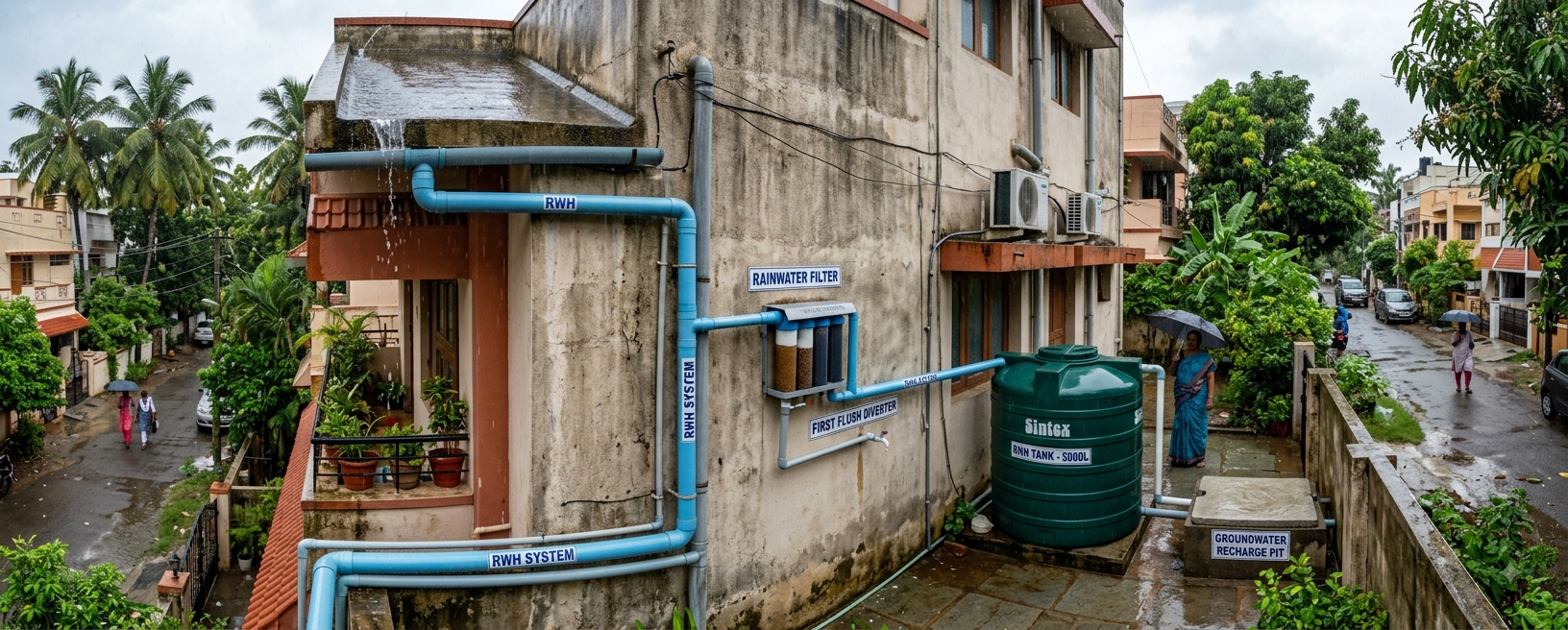
Under the new procedure, civic authorities are required to consider applications from existing old buildings seeking permission for facilities such as rainwater harvesting and solid waste management or bio-sludge management.
The government has, however, linked such permissions to compliance with the applicable provisions of the Maharashtra Regional and Town Planning Act (MRTP Act) and the Unified Development Control and Promotion Regulations (UDCPR).
The decision is aimed at reducing regulatory hurdles while ensuring that structural safety, planning requirements and the impact of such installations on existing utility connections are properly assessed.
Building approval and structural stability certificate mandatory
For applications involving new water connections, drainage connections or similar utility services in existing old buildings, the applicant will be required to submit the building’s construction permission along with a valid structural stability certificate.
This requirement is intended to establish that the existing structure is legally approved and structurally capable of accommodating the proposed work.
The civic authority’s engineer will then conduct a physical inspection of the building.
Mandatory spot inspection before permission
The concerned engineer of the municipal corporation, municipality or nagar panchayat will have to conduct a spot visit and prepare a feasibility report based on the documents submitted by the applicant and the findings of the site inspection.
The feasibility assessment will examine several issues, including:
- Whether the building’s construction permission is valid.
- Whether its structural stability certificate is valid.
- Whether adequate space is available for rainwater harvesting and solid waste or bio-sludge management.
- Whether the proposed facilities could create any danger to the existing building.
- Whether the work could pose a risk to neighbouring buildings.
- Whether the proposed work could damage existing water, drainage, electricity or gas connections.
- Any other matter prescribed by the government or considered necessary by the local authority.
Civic authorities can reject applications on safety grounds
The government has also clarified that permission will not be automatic.
If the engineer submits a negative report on any of the specified parameters, the competent authority can reject the application, while recording the reasons for the rejection.
On the other hand, if the engineer’s report is satisfactory, the applicant may be required to provide an undertaking accepting responsibility for any future difficulty arising from the work.
This creates a mechanism under which old buildings can undertake necessary environmental and utility-related improvements without bypassing structural and planning safeguards.
Second inspection after installation
The process does not end with permission.
Once rainwater harvesting or solid waste/bio-sludge management facilities have been installed, the applicant will have to submit a certificate confirming that the work has been completed.
The concerned engineer will then conduct another site inspection and submit a report confirming whether the facilities have been properly implemented.
Only after this report will the competent authority grant permission for new water connections, drainage connections or similar utility services, wherever applicable.
Why the decision matters for Mumbai and MMR
The resolution could have particular significance for Mumbai and the wider MMR because of the large stock of older buildings and redevelopment projects across established urban areas.
For older buildings, installing rainwater harvesting systems or modern waste and bio-sludge management facilities can often involve structural, planning and utility-related complications.
The new procedure attempts to create a defined pathway for such applications instead of leaving individual civic bodies to follow different processes.
For housing societies and owners of older buildings, the key takeaway is that the government has sought to make the process easier, but not without conditions. Applicants will still have to demonstrate building legality, structural stability, availability of space and the safety of the proposed installations.
EoDB and Ease of Living reforms
The government resolution forms part of a broader effort to reduce compliance burdens under the state’s Ease of Doing Business and Ease of Living reforms.
According to the resolution, the reforms are intended to address outdated or obsolete provisions in laws and regulations and reduce the compliance burden associated with urban development and civic services.
The new procedure therefore attempts to balance two objectives: making permissions more predictable for existing buildings while ensuring that safety and planning regulations remain applicable.
What old building owners need to know
For an existing old building seeking to undertake rainwater harvesting or solid waste/bio-sludge management, the process can broadly be understood as follows:
1. Application: The building owner or applicant submits the application for the required utility connection or related permission.
2. Documents: The construction permission and valid structural stability certificate must accompany the application.
3. Spot inspection: The concerned civic engineer visits the site.
4. Feasibility report: The engineer assesses structural safety, available space, neighbouring buildings and possible impact on existing utility connections.
5. Decision: The competent authority either rejects the application with reasons or proceeds with permission subject to the prescribed conditions.
6. Installation: The applicant carries out the rainwater harvesting or waste/bio-sludge management work.
7. Completion certificate: The applicant submits confirmation that the work has been completed.
8. Final inspection: The civic engineer conducts another site visit and submits a report.
9. Utility permission: Based on the satisfactory report, the competent authority can grant permission for new water, drainage or similar utility connections.
A procedural change, not a relaxation of safety norms
The most important aspect of the Maharashtra government’s decision is that it does not remove the requirement to comply with UDCPR or the MRTP Act.
Instead, it establishes a process through which existing buildings can seek permission for environmental and waste-management infrastructure while civic authorities assess the structural and planning implications.
For Mumbai and MMR’s ageing building stock, the new framework could make it easier for societies and building owners to pursue rainwater harvesting and modern waste-management solutions, provided they meet the prescribed structural, planning and safety requirements.
The Government Resolution has been digitally signed and issued by the Maharashtra Urban Development Department on August 10, 2026.
Also Read: BMC Water Curbs to Delay Mumbai Home Deliveries: 1.43 Lakh Units at Risk in 2026