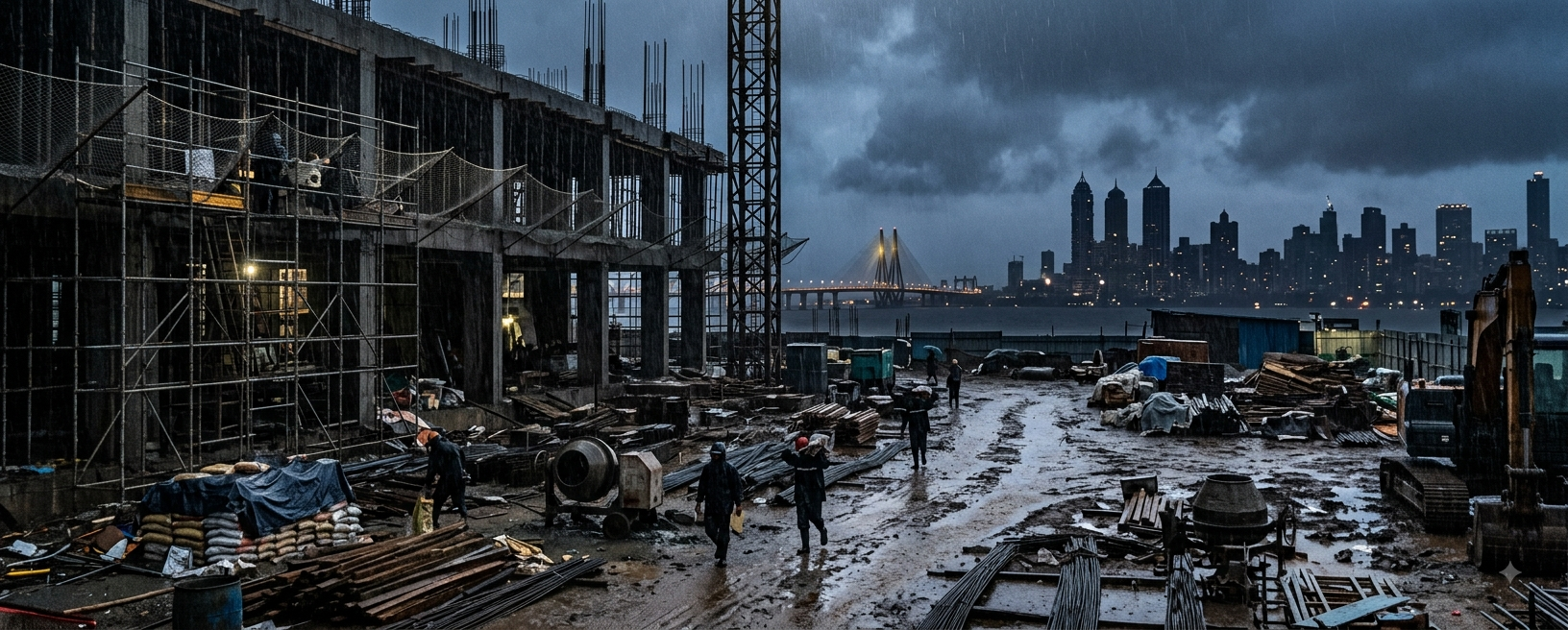

Widespread monsoon rains subdued construction activity across India in July 2026, weighing on dealer offtake and cement procurement. However, a sharp increase in government capital expenditure and resilient infrastructure activity are providing a more positive medium-term outlook for the building materials sector, according to Equirus Capital’s Building Material Monthly Update for July 2026.
Government capital expenditure by the Centre, states and central public sector enterprises (CPSEs) increased 19% year-on-year during April-May 2026. Equirus said the rise provides support to the medium-term cement demand outlook and could help drive a recovery in building-material consumption from FY27.
The report, however, expects cement volume growth to remain sluggish during the first half of FY27. Weak near-term demand, monsoon-related disruption and new cement capacities coming on stream are expected to limit pricing power.
Cement demand remains largely need-based
Cement procurement at the trade level remained largely need-based during July, reflecting subdued construction activity during the monsoon.
Cement prices were flat to slightly lower across several markets. Although cement manufacturers announced price increases in some regions, Equirus said these hikes were largely defensive and difficult to sustain in an environment of weak demand.
Regional performance remained mixed.
Cement prices declined by around ₹5 per bag across western and central markets, while Hyderabad recorded an increase of approximately ₹8 per bag. Prices remained broadly stable across northern and eastern markets.
The western and southern regions continued to report relatively healthier cement demand compared with several other markets.
Government spending could drive the next demand cycle
The 19% year-on-year increase in government capex during April-May 2026 is an important positive indicator for the construction and building-material sectors.
Higher spending by the Centre, states and CPSEs is expected to translate into greater activity across infrastructure and construction projects, supporting cement, steel and other building materials as weather-related disruptions ease.
Equirus expects the current monsoon-related weakness to be temporary, with construction activity likely to improve as project execution normalises.
Core infrastructure output grows 5%
Underlying infrastructure activity also remained resilient.
India’s core infrastructure output increased 5% year-on-year in June 2026, according to the Equirus report. This was the strongest growth recorded in five months.
The increase was led primarily by higher output in cement, electricity and iron ore, suggesting that upstream production of key construction inputs remained healthy despite weaker activity at the retail construction level.
The combination of higher infrastructure output and increased government capex could therefore provide a stronger base for building-material demand in the coming quarters.
Cement prices remain under pressure
Cement pricing continues to be a key concern for manufacturers.
Across major metros, cement prices remained in the range of approximately ₹380-430 per bag. Prices in the West and Central markets declined by around ₹5 per bag, while Hyderabad recorded an ₹8 per bag increase.
Equirus expects pricing power to remain constrained during H1 FY27 because of subdued demand and additional capacity entering the market.
For manufacturers, the focus is therefore likely to remain on protecting margins rather than implementing aggressive price increases.
Input costs remain broadly stable
The input-cost environment provided some relief to building-material companies during July.
Diesel prices remained broadly in the ₹95-105 per litre range, while TMT steel prices stood at approximately ₹60-66 per kg.
With cement prices also remaining relatively stable across most markets, Equirus expects overall building-material cost inflation in 2026 to remain in the low-single-digit range.
The relatively stable cost environment could help offset some of the pressure created by weaker volumes and limited pricing power.
Construction investment remains positive
Despite the seasonal slowdown, investment and order flows in the construction sector remained encouraging.
Schwing Stetter India is investing approximately ₹400 crore in capacity expansion and a new greenfield unit. The investment is aimed at addressing expected medium-term demand from India’s infrastructure and construction sectors.
NCC Ltd also reported fresh orders worth ₹1,052.71 crore in July.
Of this, ₹590.38 crore came from building projects, while ₹462.33 crore was accounted for by water-related projects.
The new orders indicate that infrastructure and construction activity continues to generate opportunities despite the temporary monsoon slowdown.
Building material investment activity remains muted
While operating activity showed signs of resilience, capital-market activity in the building-material sector remained subdued.
Equirus reported no mergers and acquisitions (M&A) transactions in the building-material space during July 2026. The number of M&A deals in the sector during CY26 remained nil at the time of the report.
The last major transaction cited by the report was Asian Paints’ acquisition of a 40% stake in Obgenix Software for ₹186.7 crore in CY25.
Private equity activity was also limited. Only three deals had been recorded across the broader building-material segment in CY26.
The largest private-equity transaction cited was AllHome’s ₹200-crore fundraise from Bessemer Venture Partners.
Equity fundraising also remains subdued
Equity capital-market activity in the building-material sector remained weak, with no ECM transactions recorded in CY26, according to Equirus.
The most recent ECM transaction cited in the report was the ₹451.3-crore Euro Pratik IPO. The report also identified KEI’s previous QIP as the most recent qualifying transaction in the segment.
The muted fundraising and M&A environment reflects the cautious approach among investors even as the underlying construction and infrastructure pipeline remains positive.
FY27 could mark a recovery for building-material demand
The near-term outlook for building materials remains challenging, particularly because of monsoon disruption, weak dealer demand and additional cement capacity.
However, the medium-term picture is more constructive.
Higher government capital expenditure, infrastructure investment, stronger core-sector output and fresh construction orders could support a recovery once weather-related disruptions ease.
For the cement industry, the key challenge will be translating this infrastructure pipeline into sustained volume growth while managing the impact of new capacity and limited pricing power.
Equirus therefore expects H1 FY27 to remain relatively sluggish, but the stronger infrastructure and government spending pipeline could create the conditions for improved building-material demand as FY27 progresses.
For India’s real estate and construction sector, the message from the July data is clear: the monsoon has delayed near-term activity, but higher public investment could provide the foundation for the next phase of construction demand.
Also Read: Realty Stocks: Focus Shifts to Demand Trends and Policy Signals