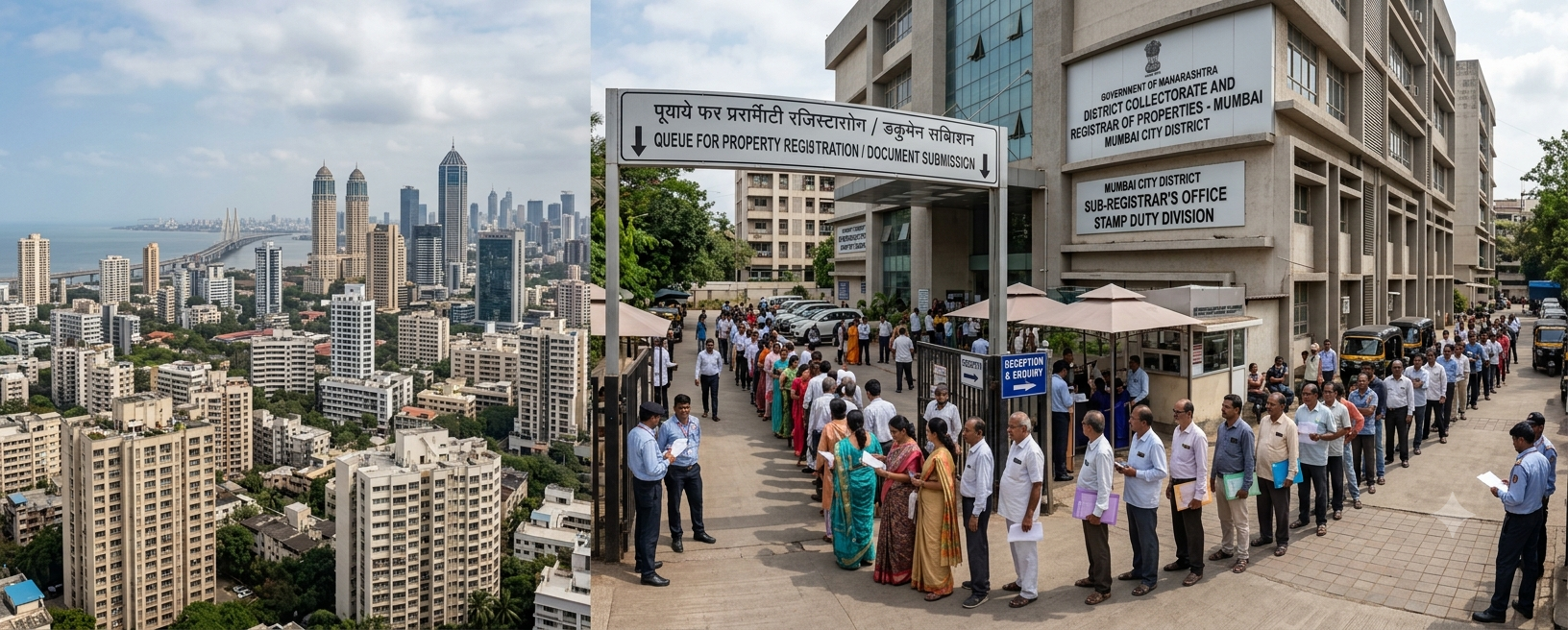
More Mumbai Property Registrations in September 2026, Lower Stamp Duty: What the Numbers Reveal
Mumbai recorded more property registrations in September 2026 than in September 2025, but the Maharashtra government collected less stamp duty. Data from the Inspector General of Registration (IGR) and Controller of Stamps, Maharashtra, analysed by Knight Frank India, shows 12,622 registrations in September 2026 against 12,070 a year earlier. Stamp duty collections, however, fell to ₹1,227 crore from ₹1,292 crore.
That combination is the story. More documents were registered. Less money reached the state exchequer. In a city where stamp duty is charged as a percentage of property value, that usually means the mix of homes changing hands has tilted toward lower-ticket transactions.
How September 2026 Compares With Last Month and Last Year
Year-on-year, September 2026 registrations rose about 4.6 per cent (rounded to 5 per cent in industry reports). Stamp duty revenue fell about 5 per cent.
Against August 2026 (12,580 registrations and ₹1,131 crore), volumes were almost flat (up about 0.3 per cent) while stamp duty rose about 8.5 per cent. July 2026 was stronger on volume: 13,630 registrations and ₹1,236 crore. June 2026, as per IGR figures cited for the month, stood at 13,413 registrations and ₹1,085 crore.
So September was not the busiest month of 2026 on volume. It was a high-volume September by historical standards — the strongest September in more than 14 years — but revenue did not keep pace with last September. Average duty per registered document works out lower than a year ago.
Ganesh Chaturthi (September 14–25) did lift activity: 5,379 registrations in that window, up 22 per cent year-on-year, and ₹640 crore in stamp duty, up 32 per cent. More than half of September’s duty came in those festive days. The month as a whole still underperformed last September on collections.
Why Stamp Duty Moves With the Price of the Home
Stamp duty in Mumbai is not a flat fee. It is a percentage of the higher of the agreement value or the government’s ready reckoner (annual statement of rates) value. For residential property in BMC limits, the effective rate is about 6 per cent for a male buyer and 5 per cent for a woman buying in her sole name (both figures include the 1 per cent metro cess). Registration fee is 1 per cent, capped at ₹30,000 above ₹30 lakh.
A ₹3 crore flat therefore yields far more duty than a ₹80 lakh flat. If 12,000-plus documents include more compact flats, resale units in mid-suburbs, or tickets that sit closer to ready-reckoner floors rather than luxury towers in South Mumbai or Bandra-Worli, total collections can fall even when the count of registrations rises.
Duty also depends on who is buying (women’s concession), whether ready reckoner was revised (rates were not hiked for 2026-27 after an earlier increase), and how many high-value commercial or large-ticket residential deals close in that month.
What Can Produce More Deals and Less Duty
Several factors can produce this pattern:
- Shift in ticket size. End-users stretching for first homes or smaller 1–2 BHK units in the suburbs can lift volumes without lifting average value.
- Festive and calendar clustering. Ganesh Chaturthi pulled registrations forward; luxury or large-ticket closings may have been thinner outside that window.
- Ready reckoner vs agreement value. If more deals are priced near or only modestly above the official floor, incremental duty is limited.
- Resale vs primary mix. Secondary-market compact homes often sit below new luxury inventory.
- Buyer selectivity. Industry commentary through 2026 has repeatedly noted buyers remaining selective even as registrations stay high — well-located, mid-market stock finding takers faster than ultra-luxury.
- Base effect. September 2025 was a high-revenue month (₹1,292 crore). Matching that on collections required a similar or richer mix, not just more documents.
None of this automatically means prices have crashed. It means the composition of what got registered in September was cheaper, on average, than a year ago.
What Lower Stamp Duty Collection Signals for Mumbai’s Market
For homebuyers, the message is mixed but useful. Demand is not vanishing. A 14-year September high in registrations shows people are still completing purchases. The softer duty figure suggests more of that activity is in reachable price bands rather than a handful of trophy deals.
For the state, Mumbai remains a large stamp-duty engine, but collections will lag volume whenever the market broadens downward. For developers, the data supports the mid-market and compact-home thesis that has run through 2026 Knight Frank readings of IGR numbers: registrations can keep rising while average transaction value moderates.
Changing dynamics look like this: Mumbai is no longer a market where only expensive homes move the needle. Volume is holding in the 12,500–13,600 monthly band through mid-2026. Revenue is more volatile because it tracks what is sold, not only how many documents are stamped. If mid-ticket and suburban stock continue to dominate closings, expect more months where registration counts look healthy and the treasury number does not rise in lockstep.
That is exactly what September 2026 showed: more properties registered, less stamp duty collected — consistent with a market where a larger share of homes changing hands are of lower value than last September.
Also Read: Mumbai Sees Decline In Home Sales