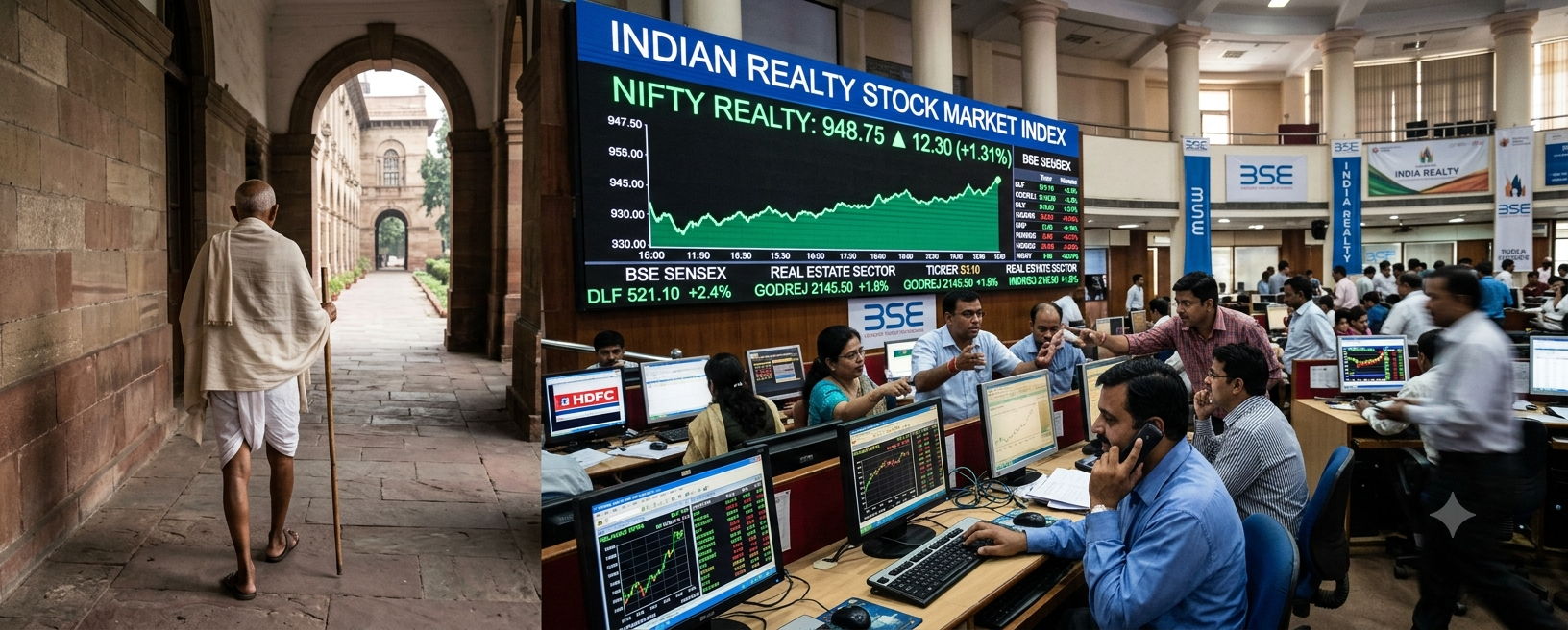

Thursday October 1 is the first trading day of Q3 FY27 — and the last trading day before a three-day break. October 2 is Gandhi Jayanti, a stock market holiday. Saturday and Sunday follow. When trading resumes on Monday October 6, the festive season will be nine days from beginning, Q2 FY27 presales disclosures will have begun arriving, and the macro environment will have had a long weekend to either worsen or improve without the safety valve of daily market adjustments. That combination — first day of a new quarter, last day before a three-day break — gives Thursday’s session a particular character: traders are cautious about the exposure they carry into a weekend that could bring fresh Iran developments, crude price movements, or diplomatic signals in any direction.
GIFT Nifty is at 22,576.50, down 79 points or 0.35% — signalling a weak opening below 22,600, the level that brokerages have flagged as significant near-term support. Asian markets have provided a mixed offset — Japan’s Nikkei surged 2.23% and Hong Kong’s Hang Seng gained 0.37%, which limits the downside pressure from GIFT Nifty’s negative signal. The previous session — Wednesday September 30, the quarter’s last day — ended with the Sensex at 72,480.29, down 48.78 points, and the Nifty at 22,620.45, down 95.75 points, as rising bond yields continued to weigh and intraday gains faded.
The Peg: A New Quarter Opens With Old Problems and a Long Weekend Ahead
The quarter that ended yesterday was, by any measure, the sector’s most difficult since the Iran conflict began. The Nifty Realty index lost more than 12% through Q2 FY27, driven by crude above $100, a Fed rate hike, US 10-year bond yields at 19-year highs, India’s CPI above the RBI’s target for two consecutive months, Maharashtra declaring drought, and seven consecutive weekly Nifty losses — the longest such streak in six years. None of those headwinds reflected a deterioration in the sector’s own demand story. They were entirely macro in origin.
The quarter that begins today — Q3 FY27 — carries a different set of forward-looking variables. Q2 FY27 presales disclosures from listed developers will begin arriving through the first two weeks of October. Navratri begins on October 11 — giving the festive season its first formal homebuying window ten days into the new quarter. Diwali follows on November 8, Dhanteras on November 7. The festive season demand cycle that the sector has been preparing through Q2 FY27’s macro turbulence is now within reach.
But between today’s cautious open and October 11’s Navratri start lies a three-day trading break — and a market that has been conditioned by seven months of Iran conflict to treat every long weekend as a potential source of fresh negative developments. That conditioning is rational. The most dramatic negative events of CY26 — the IRGC tanker interceptions, the US Kharg Island threats, the collapse of previous ceasefire frameworks — have repeatedly arrived over weekends and public holidays when markets are closed and cannot adjust. Traders carrying large positions into Thursday’s close are carrying those positions through a 72-hour window of geopolitical uncertainty. That awareness is reflected in GIFT Nifty’s 79-point pre-open decline.
How Realty Stocks Are Opening
GIFT Nifty at 22,576.50 — below the 22,600 support level — signals a gap-down open for the broader market. The Nifty50 had closed Wednesday at 22,620.45, meaning any open below 22,600 would immediately test the support zone that brokerages have specifically flagged as the key near-term floor.
The Nifty Realty index opens Thursday at its lowest level in approximately six months. The sector’s ten constituents — DLF, Godrej Properties, Lodha Developers, Prestige Estates Projects, Oberoi Realty, Sobha, Phoenix Mills, Brigade Enterprises, Anant Raj, and Aditya Birla Real Estate — open Thursday with the caution that precedes a long weekend in an unresolved geopolitical environment.
DLF, the index’s largest constituent at a 26.86% weight, opens Thursday at its lowest CY26 level — a price point that analysts across every major broking house have flagged as a deep discount to fair value. The fundamental case for DLF remains the most mathematically compelling it has been in CY26 — the gap between current price and analyst targets is wider than at any previous point in the correction cycle. But Thursday’s session is not one where fundamental buyers are likely to step in aggressively. A three-day trading break ahead of a long weekend, with GIFT Nifty below 22,600 at the open, is a session for holding ground rather than building new positions.
Godrej Properties, Lodha Developers, Prestige Estates Projects, Sobha, Phoenix Mills, Brigade Enterprises, Anant Raj, Aditya Birla Real Estate, and Oberoi Realty all open Thursday with a cautious to mildly negative bias — the sector entering the long weekend from the most depressed price levels of Q2 FY27.
NSE shares — which had debuted at ₹1,841 on September 24 before trading at ₹1,763.05 on Wednesday — are in focus again today after SEBI granted the exchange a no-objection certificate for its proposed corporate bond index futures. That development gives NSE shares a company-specific positive catalyst at Thursday’s open that is entirely independent of the broader market’s cautious mood.
What Is Working
Asian markets rising — Nikkei up 2.23%, Hang Seng up 0.37% — is the most constructive regional signal Thursday has received. Japan’s Nikkei surging 2.23% in a single morning session is a significant positive — and it signals that Asian institutional investors are positioning for a macro improvement rather than extending the defensive posturing that has defined September’s market behaviour. That regional positive partially offsets the GIFT Nifty’s negative signal and limits the downside pressure on India’s market open.
The new quarter beginning today gives institutional investors a psychological and portfolio management reset. Q2 FY27’s losses are now in the rear-view mirror from a quarterly performance perspective. Fund managers who had been holding off on deploying fresh capital through Q2 FY27’s sustained losses — waiting for quarter-end to pass before making fresh allocation decisions — enter Q3 FY27 with a clean slate. That new quarter psychology, while not a data point, is a real market participant behaviour that has historically been associated with Q1 buying across beaten-down sectors.
Q2 FY27 presales disclosures beginning to arrive through October are the sector’s most powerful near-term fundamental catalyst. Every major listed developer — Lodha Developers, DLF, Godrej Properties, Prestige Estates, Sobha, and Brigade Enterprises — will disclose Q2 FY27 presales figures in the coming days and weeks. Those figures will tell the market whether the residential demand cycle that drove record Q1 FY27 presales has been sustained through Q2 FY27’s macro turbulence — or whether high construction costs and macro uncertainty have begun dampening absorption. Given India’s 7.8% GDP growth and the structural housing shortage that underpins demand, the expectation is for continued strong presales.
The three-day break itself — while creating pre-weekend caution — also creates the condition for a post-break relief rally if no negative development arrives over the long weekend. A market that has been conditioned to fear long weekends by the Iran conflict’s pattern of weekend escalations will recover sharply on Monday October 6 if the weekend passes without a new negative trigger. That asymmetry — the potential for a sharp Monday recovery versus the more contained downside given how much has already been sold — is the risk-reward that some institutional investors will factor into their Thursday positioning decisions.
What Isn’t Working
GIFT Nifty at 22,576.50 — 43 points below the 22,600 support level — is Thursday’s most immediate domestic negative. The Nifty opening below 22,600 would be the most significant technical breakdown of Q3 FY27’s first session and would signal that the support level brokerages have been watching has been breached at the quarter’s very first open. A clean break below 22,600 on a closing basis would expose support at 22,400-22,500 and potentially extend the selling into Monday’s session after the long weekend.
The three-day trading break creates specific position management anxiety that is amplified by the Iran conflict’s history. Every major negative surprise of CY26 — from the initial war declaration in February to the IRGC tanker interceptions of late August to Monday September 28’s Maharashtra drought declaration — has arrived when markets were either closed or entering a holiday period. Traders who lived through those experiences cannot approach a three-day break with equanimity — and that rational caution will express itself in reduced buying through Thursday’s session and potential selling by those who want to reduce overnight exposure.
Crude oil remaining elevated — despite recent Saudi supply increases — is the sector’s persistent input cost headwind that does not resolve over a long weekend. Until the US-Iran diplomatic framework produces a formal, implemented, and verified Strait of Hormuz reopening, crude’s elevated level will continue to compress Q2 and Q3 FY27 developer margins relative to pre-war assumptions.
The broader market’s technical picture remains fragile. Rising bond yields — both US at 5.27% and Indian at above 7% — continue to be the external and domestic rate signals that keep institutional investors from aggressively adding to rate-sensitive sector positions. A 10-year yield that is at a 19-year high globally and a three-month high domestically is not a backdrop that invites leveraged long positions in real estate stocks going into a long weekend.
What to Watch Through the Day
The Nifty50’s behaviour around the 22,600 support level through Thursday’s session is the day’s primary technical checkpoint. A Nifty that opens below 22,600 but recovers above it through the morning session — on Asian market support and value buying — would signal that the support level is holding despite the GIFT Nifty’s negative pre-open signal. A Nifty that opens below 22,600 and stays below it through the afternoon would signal a genuine technical breakdown that extends the Q2 FY27 correction into Q3 FY27’s opening sessions.
Any Iran diplomatic development that arrives during Thursday’s Indian trading hours would be the session’s most powerful potential positive catalyst. An Oman mediation team update, a US State Department statement on the Iran phased truce framework, or any signal that the Hormuz joint working group has convened for implementation talks would ease crude and lift the broader market — with realty stocks, as the most crude-sensitive sector, benefiting most directly.
Q2 FY27 presales disclosures from any listed developer — arriving during Thursday’s session or over the long weekend and processed by Monday’s open — are the fundamental data catalysts to watch through early October. Watch for regulatory filings and company press releases from Lodha Developers, DLF, and Godrej Properties through Thursday and Friday.
The Indian residential market’s festive season begins Navratri on October 11 — ten days after today’s trading session. The demand that will express itself through those ten days has been building through six months of macro turbulence, record quarterly presales, and a structural housing shortage that 7.8% GDP growth is filling with a speed that no single quarter of macro headwinds can reverse. Thursday’s cautious session — the first of Q3 FY27 — is the last quiet day before that demand story begins taking centre stage.
Also Read: Realty Stocks Face Fed Headwind After Four-Day Rally