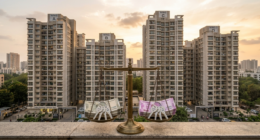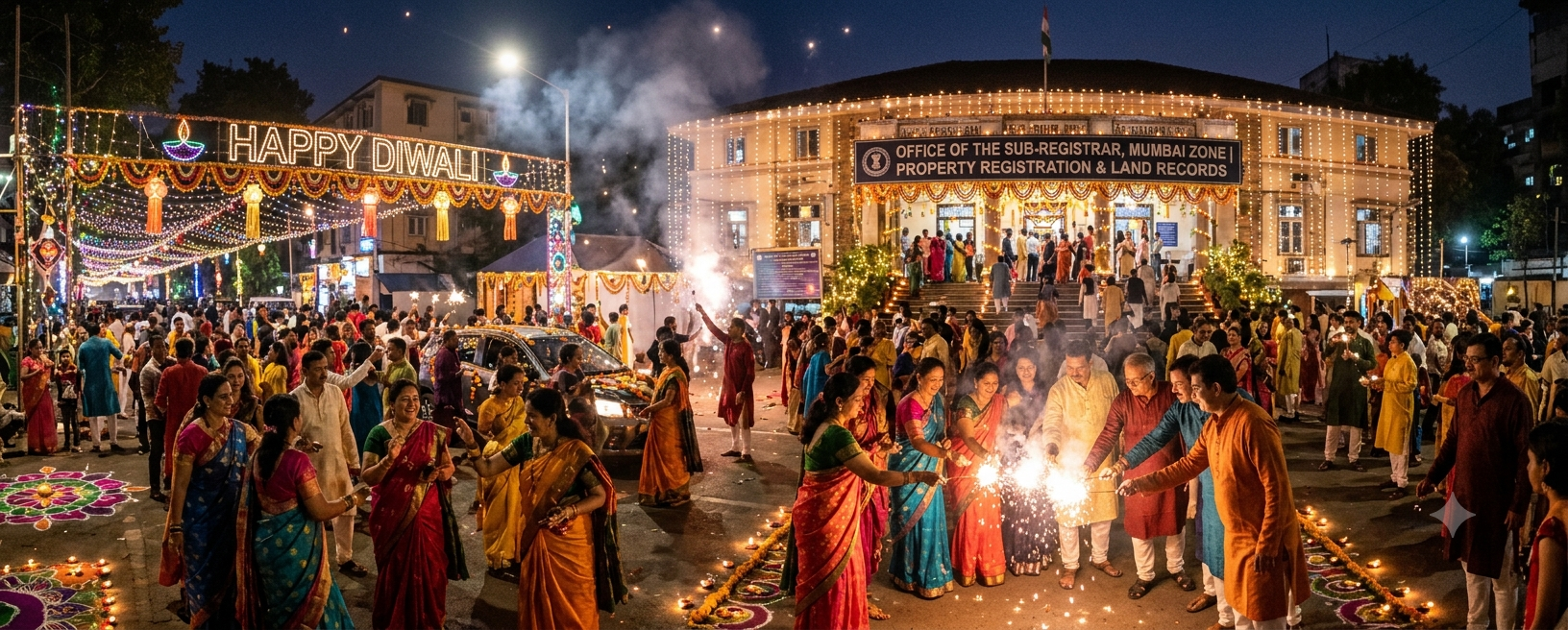
Mumbai’s residential property market recorded its strongest Diwali-period performance in four years, with 3,683 property registrations generating ₹384 crore in stamp duty revenue during the 11-day festive window in 2026. While registrations increased marginally by 0.4% compared with 3,668 units during the corresponding period last year, revenue collections rose by a significantly higher 13%, indicating stronger activity in higher-value housing segments.
The data from the Maharashtra Department of Registration and Stamps (IGR), analysed by Knight Frank India, highlights the resilience of Mumbai’s residential property market despite a relatively high base in the previous year. The increase in revenue collections, despite almost stagnant transaction volumes, also points towards a shift in the value composition of homes being purchased.
The festive period has traditionally been an important phase for Mumbai’s property market, with buyers considering auspicious occasions such as Shraddh, Navratri and Diwali to finalise property purchases. However, the latest numbers suggest that buying activity is no longer restricted to a single festive occasion, with demand continuing across multiple periods.
Property Registrations Rise Marginally, But Revenue Jumps 13%
Mumbai recorded 3,683 property registrations during the 11-day Diwali period in 2026, compared with 3,668 registrations in the corresponding period of 2025.
This represents a marginal year-on-year increase of 0.4%.
The more significant development was the increase in stamp duty revenue. Collections rose from ₹339 crore in 2025 to ₹384 crore in 2026, representing a 13% increase.
The difference between the growth in registration volumes and revenue collections is particularly noteworthy.
If property registrations had increased at a similar pace to revenue collections, it would have indicated a substantial expansion in transaction volumes. Instead, the relatively flat registration numbers, alongside higher revenue, suggest that the average stamp duty revenue generated per registered property increased.
Based on the reported figures, the average revenue collection per registration increased from approximately ₹9.24 lakh in 2025 to ₹10.43 lakh in 2026.
This does not establish that property prices increased by 13%. Stamp duty collections are influenced by several factors, including property values, transaction composition and applicable charges. Nevertheless, the numbers indicate that higher-value transactions contributed more significantly to overall revenue during the festive period.
Higher-Value Homes Drive Revenue Growth
One of the key takeaways from the Diwali registration figures is the disproportionate growth in revenue compared with the number of transactions.
Industry representatives believe that this reflects growing demand for mid-premium and luxury housing, with buyers increasingly prioritising larger homes, better amenities, improved connectivity and established developers.
Ram Naik, Co-founder and CEO of The Guardians Real Estate Advisory, said the figures reflected a mature and value-driven housing market.
According to Naik, registrations remained steady despite a high base in the previous year, while the 13% increase in stamp duty collections demonstrated stronger traction in the mid-premium and luxury segments.
He also pointed to continued buying activity across Shraddh, Navratri and Diwali, suggesting that demand has remained consistent throughout the festive season.
Attractive developer schemes, stable interest rates and stronger conversion rates on the ground were among the factors he identified as supporting the market.
The distinction is important for understanding Mumbai’s housing market. A rise in transaction value does not necessarily mean that more people are purchasing homes. It can also indicate that buyers who are entering the market are committing larger amounts towards their property purchases.
Festive Demand Continues Beyond Diwali
Another important trend emerging from the industry commentary is the continuity of buying activity across different festive periods.
Traditionally, many Indian homebuyers prefer to register properties during auspicious occasions. However, the latest festive performance suggests that buyers are increasingly spreading their purchasing decisions across Shraddh, Navratri and Diwali rather than waiting for one particular occasion.
Vedanshu Kedia, Director of Prescon Group, said Mumbai’s residential property market had demonstrated resilience by recording a four-year high in Diwali registrations and a 13% increase in revenue collections.
He observed that demand had continued from Shraddh and Navratri through Diwali, indicating that buyer sentiment remained relatively insulated from short-term market fluctuations.
Kedia also highlighted the growing importance of thoughtfully designed homes, connectivity and lifestyle features in purchasing decisions.
He expects this demand momentum to continue into 2027.
For developers, this continuity is significant because it provides a more consistent demand environment rather than concentrating sales around a few auspicious dates.
January-October Registrations Also Show Growth
The Diwali performance comes against the backdrop of a broader increase in Mumbai’s residential property registrations.
Navin Makhija, Managing Director of The Wadhwa Group, highlighted a 7% increase in cumulative registrations between January and October 2026.
According to Makhija, the increase in revenue collections during Diwali, combined with the growth in cumulative registrations, reflects continued confidence among affluent and aspirational homebuyers.
He attributed the market’s performance to genuine end-user demand and improving urban infrastructure.
The January-October growth is particularly relevant because it provides a wider picture of market activity beyond the festive window.
While an 11-day period can be influenced by the timing of auspicious dates and registration activity, cumulative registrations over ten months offer a broader indication of the market’s underlying performance.
However, the 7% growth figure also needs to be viewed in the context of the total number of registrations and the value of properties being transacted.
Buyers Increasingly Prioritise Larger Homes and Better Amenities
The increase in revenue collections has also prompted industry representatives to highlight a possible shift in homebuyer preferences.
Shilpin Tater, Managing Director of Superb Realty, said the four-year festive high reaffirmed the strength of Mumbai’s residential property market.
He pointed out that revenue growth outpacing transaction volume growth indicated a consumer preference for larger configurations, superior amenities and established developers.
Tater said end-user demand continued to anchor the market and could support sales activity through the final quarter of 2026.
This trend is significant for developers because the profile of housing demand influences the type of projects they choose to launch.
If buyers increasingly prefer larger configurations and better amenities, developers may focus more on premium offerings and integrated residential developments.
However, whether this trend is equally strong across all income categories and geographical markets cannot be established from the Diwali registration figures alone.
Prime and Emerging Suburban Markets Attract Buyers
Shraddha Kedia-Agarwal, Director of Transcon Developers, said the festive performance reflected changing homebuyer aspirations, with lifestyle upgrades and long-term value creation becoming important considerations.
She highlighted the 13% increase in revenue collections to ₹384 crore as evidence of demand for well-planned and spacious residences in prime and emerging suburban micro-markets.
She also emphasised the continued buying activity during Shraddh and Navratri, suggesting that project quality, timely delivery and connectivity remain important considerations for modern homebuyers.
Dhruman Shah, Promoter of Ariha Group, similarly said the four-year festive peak highlighted the consistency of Mumbai’s housing demand.
According to Shah, buyers continued to invest in upgraded living spaces despite the high base recorded in the previous year.
He also pointed to continued traction across suburban growth corridors and redeveloped locations as contributing factors to the festive performance.
What the Diwali Numbers Mean for Mumbai’s Property Market
The latest figures offer three important takeaways for Mumbai’s residential real estate sector.
First, transaction volumes have remained relatively stable. The 0.4% increase in registrations indicates that the market did not witness a significant expansion in the number of transactions during the 11-day Diwali window.
Second, revenue collections have increased considerably faster than registrations. The 13% rise to ₹384 crore suggests that the value composition of registered transactions has shifted towards higher-value properties.
Third, the increase in cumulative registrations between January and October indicates that the festive performance is taking place against a broader backdrop of market growth.
However, the figures should not be interpreted as evidence that every segment of Mumbai’s property market is experiencing similar growth. Premium housing demand, affordable housing demand and activity across different suburban markets can follow different trajectories.
For homebuyers, the numbers indicate continued activity and competition in Mumbai’s residential market. But buyers should assess affordability, project delivery records, connectivity, maintenance costs and the actual value offered by a property rather than relying solely on broader market growth figures.
For developers, the festive performance provides encouraging evidence of demand resilience, particularly in the mid-premium and luxury segments.
Mumbai’s Diwali 2026 performance ultimately highlights a market where transaction numbers are growing slowly, but the money flowing through property registrations is increasing at a considerably faster rate.
Also Read: Mumbai Sees Record Property Registration Revenue During Diwali Boom