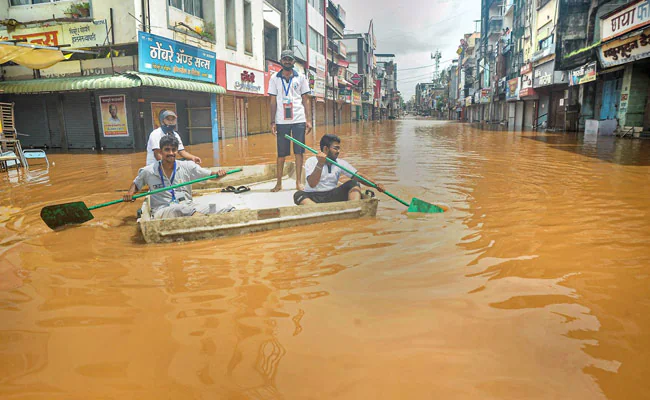

In the aftermath of the devastating floods that hit Maharashtra between May and September 2025, the state government has initiated a Post Disaster Needs Assessment (PDNA)—a critical exercise that will determine how much damage was caused, how much money is needed, and how Maharashtra will rebuild over the long term.
The Government Resolution (GR), issued by the Revenue and Forest Department (Disaster Management, Relief & Rehabilitation), marks the formal start of a state-led, NDMA-supported recovery and reconstruction planning process.
Why this matters to every citizen
The floods of 2025 were not just another monsoon disruption. According to the GR:
- 432 people lost their lives
- Over 1.73 lakh livestock perished
- Roads, bridges, power supply, water schemes, farms, homes, schools, hospitals, and businesses suffered massive damage
- Essential services like healthcare, education, electricity and drinking water were severely disrupted
The PDNA will now decide what gets rebuilt first, where funds will come from, and how the state can reduce future disaster risks.
What is PDNA and why is it important?
A Post Disaster Needs Assessment (PDNA) is an internationally accepted framework used after large disasters to:
- Assess physical damage and economic losses
- Estimate recovery and reconstruction costs
- Prepare a time-bound recovery roadmap
- Apply the principle of “Build Back Better”, instead of restoring weak infrastructure
The Maharashtra PDNA will be conducted with technical support from the National Disaster Management Authority (NDMA) and other national institutions.
Timeline and coordination
- The PDNA exercise will be conducted from 9 February to 27 February 2026
- It will be carried out in close coordination with sectoral departments and district administrations
- The State Disaster Management Authority (SDMA) will coordinate and compile the final report
Who will lead the assessment
The overall PDNA process and final report preparation will be led by:
- Vinita Vaid Singal, IAS – Principal Secretary
- Dr. Bhalchandra Chavan, IAS – Director
Specialised teams have been constituted for each affected sector, combining officers from state departments, NDMA-nominated experts, and technical consultants.
Sectors covered under the PDNA
The assessment will cover every major area of daily life and the economy, divided into four broad groups:
A. Social Sectors
- Housing and settlements
- Education
- Health and nutrition
- Public and community buildings, civic amenities
B. Infrastructure
- Drinking water and sanitation
- Roads and bridges (district and village roads)
- Power supply
- Other critical infrastructure
C. Productive Sectors
- Agriculture and horticulture
- Animal husbandry, livestock and fisheries
- Livelihoods and local industries
D. Cross-Cutting Areas
- Disaster risk reduction
- Climate change resilience
- Gender and social inclusion
- Environment, forests, tourism and cultural heritage
Role of districts and local administration
At the district level:
- District Collectors and Deputy Commissioners will lead the PDNA teams
- District Disaster Management Authorities (DDMAs) and heads of line departments will support data collection
- Field-level information such as damage data, photographs, GPS locations and loss estimates will be compiled
This ensures that local realities shape the final recovery plan, not just paperwork from Mumbai.
How the PDNA will be conducted
The GR outlines a structured, step-by-step process:
- Team formation and coordination
Clear roles, responsibilities and timelines for each sector. - Training
NDMA and NIDM will train teams in data collection, assessment and report writing. - Sector-wise assessments
Detailed evaluation of damage, losses and recovery needs. - Draft PDNA report
Sector-wise cost estimates with transparent calculation methods. - Sector Expert Group (SEG) review
Expert validation, recovery prioritisation and strategy development. - Final submission
The completed PDNA report will be submitted to the Ministry of Home Affairs (MHA) for approval.
What the final PDNA will deliver
The final PDNA report will:
- Estimate total financial requirements for recovery and reconstruction
- Define short, medium and long-term rebuilding priorities
- Recommend policy changes and institutional mechanisms
- Integrate climate resilience, gender sensitivity and environmental safeguards
- Help unlock funding through SDRF, NDRF and other recovery windows
A roadmap for rebuilding Maharashtra
Officials say this exercise is not just about repairing damage, but about making Maharashtra safer against future floods.
By combining ground-level data, expert analysis and policy planning, the PDNA will become the foundation document guiding how the state rebuilds homes, infrastructure, livelihoods and public services after one of its worst flood disasters in recent years.
In simple words
This assessment will decide how Maharashtra recovers, how much it will cost, and how future flood damage can be reduced—making it one of the most important post-disaster exercises for citizens across the state.
Also Read: What and Who Failed Mumbai?