- Grade A industrial and warehousing leasing across India’s top eight cities rose 26% year-on-year to 33.3 million sq ft during January–September 2026.
- Delhi NCR and Chennai together accounted for 47% of the total leasing demand.
- Third-party logistics (3PL) companies contributed nearly one-third of demand, while automobile companies increased space uptake by 70%.
- New supply increased 19% to 34.5 million sq ft, pushing vacancy levels to around 16% by the end of September.
India’s industrial and warehousing real estate market recorded a strong increase in leasing during the first nine months of 2026, with demand rising faster than a year earlier across most major cities. According to Colliers India, occupiers leased 33.3 million sq ft of Grade A industrial and warehousing space between January and September, up 26% from 26.5 million sq ft in the corresponding period of 2025.
Delhi NCR and Chennai remained the two largest demand centres, together accounting for nearly 47% of total leasing. Bengaluru and Pune also recorded substantial growth, highlighting the expansion of industrial and logistics activity beyond the country’s traditional leading markets.
The figures indicate continued demand from logistics operators, manufacturers and e-commerce businesses. However, new supply grew even faster than leasing in absolute terms, with 34.5 million sq ft of space completed during the nine-month period. This contributed to vacancy levels rising to around 16% by the end of the third quarter.
Delhi NCR and Chennai Account for Nearly Half of Leasing
Delhi NCR led the eight major markets with 9.3 million sq ft of leasing during January–September 2026, a 26% increase from 7.4 million sq ft a year earlier.
Chennai ranked second, recording 6.4 million sq ft, up 25% from 5.1 million sq ft in the year-ago period. Together, the two markets accounted for 15.7 million sq ft of leasing, or approximately 47% of the national total across the eight cities tracked.
Bengaluru and Pune were among the fastest-growing markets. Bengaluru recorded 4.5 million sq ft of leasing, a 61% annual increase, while Pune reached 3.4 million sq ft, up 70%.
Other markets also registered growth. Ahmedabad recorded 2.2 million sq ft, up 29%, while Kolkata reached 2.1 million sq ft, a 31% increase. Hyderabad saw a more modest rise of 6% to 1.8 million sq ft.
Mumbai was the only market among the eight to record a decline in year-to-date leasing. Demand fell 14% to 3.6 million sq ft, from 4.2 million sq ft during January–September 2025.
Industrial and warehousing leasing by city
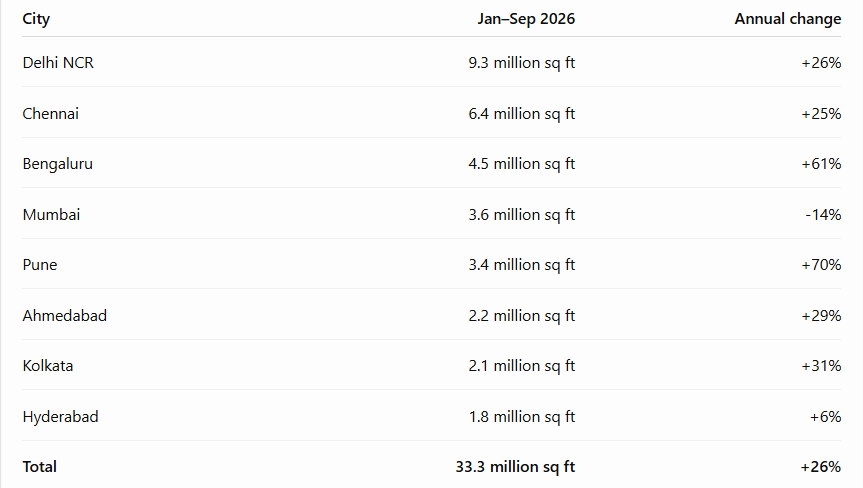
Source: Colliers India. Figures relate to Grade A buildings and exclude lease renewals, pre-commitments and deals where only a letter of intent has been signed.
Third-Party Logistics Companies Remain the Biggest Occupiers
Third-party logistics companies continued to drive demand, leasing more than 11 million sq ft during the first nine months of 2026. Their share stood at nearly one-third of total leasing across the eight markets.
Engineering companies were the second-largest occupier segment, accounting for approximately 20% of demand, equivalent to 6.6 million sq ft.
The automobile sector recorded a particularly sharp increase, with its Grade A industrial and warehousing space uptake rising 70% year-on-year. E-commerce, electronics and engineering also recorded annual growth of close to 30% each, according to Colliers.
The mix of occupiers suggests that demand is not being driven solely by warehouse operators. Manufacturing-related requirements and distribution networks are also contributing to leasing activity.
For the property market, this diversification is significant because demand from several industries can reduce dependence on any single occupier category. However, the pace of future leasing will also depend on manufacturers’ expansion plans, consumer demand and the evolution of supply chains.
Large Deals Account for 37% of Demand
Leases covering more than 200,000 sq ft accounted for around 37% of total industrial and warehousing demand during January–September 2026.
E-commerce and third-party logistics companies together represented approximately 58% of these large transactions. Delhi NCR recorded the highest number of large-sized deals, followed by Chennai.
Such transactions are important for developers and investors because large occupiers can absorb substantial amounts of space in a single deal. At the same time, the concentration of leasing in large transactions means headline demand figures may not fully reflect activity among smaller businesses.
Third Quarter Records Highest Leasing in Recent Quarters
During July–September 2026, leasing reached 11.4 million sq ft, compared with 7 million sq ft in the third quarter of 2025. This represented year-on-year growth of 63%.
Delhi NCR recorded 3.4 million sq ft of leasing in the quarter, followed by Chennai at 2.3 million sq ft and Bengaluru at 2 million sq ft.
Bengaluru’s quarterly leasing rose 150% year-on-year, while Pune recorded a 350% increase. These high growth rates partly reflect the lower leasing bases in the corresponding quarter of 2025.
According to Vijay Ganesh, Managing Director, Industrial and Logistics Services, Colliers India, demand remained strong despite renewed tensions in West Asia, supply-chain disruptions and trade realignments. The company expects the sector to record 40–45 million sq ft of leasing during 2026.
With 33.3 million sq ft already leased in the first nine months, the market would need another 6.7–11.7 million sq ft during the final quarter to reach that forecast range.
New Supply Rises 19%, Outpacing Demand
Developers completed 34.5 million sq ft of Grade A industrial and warehousing space across the eight markets during January–September 2026, compared with 29 million sq ft in the corresponding period of 2025.
Delhi NCR, Chennai and Mumbai together accounted for 55% of new supply during the period.
Pune recorded a 105% increase in completions to 4.5 million sq ft, while Ahmedabad’s supply rose 160% to 3.9 million sq ft. Bengaluru added 4.4 million sq ft, an 83% annual increase, and Mumbai’s completions rose 41% to 6.2 million sq ft.
Delhi NCR, despite leading demand, recorded a 27% decline in new supply to 6.6 million sq ft. Kolkata’s completions fell 60% to 0.8 million sq ft.
The rise in supply is a sign that developers continue to invest in the sector. However, it also means that new buildings must compete for tenants as they enter the market.
Vacancy Reaches Around 16% as Supply Exceeds Demand
Colliers reported that vacancy across the eight major markets rose marginally to around 16% at the end of the third quarter of 2026, as additions to supply outpaced cumulative leasing during the first nine months.
Average rentals remained broadly stable across the markets, although select high-activity locations continued to see rental appreciation, supported by demand for premium developments.
For developers, investors and occupiers, the next phase will depend on how quickly the newly completed space is absorbed. Strong leasing growth is encouraging, but rising vacancy suggests that demand growth alone does not guarantee that every new warehouse or industrial facility will be occupied quickly.
The market’s performance in the final quarter will therefore be important in determining whether India reaches Colliers’ full-year leasing forecast and whether demand can absorb the substantial new supply entering the sector.
Also read: The India growth story: Office, Residential, and warehousing sectors outperform the industry