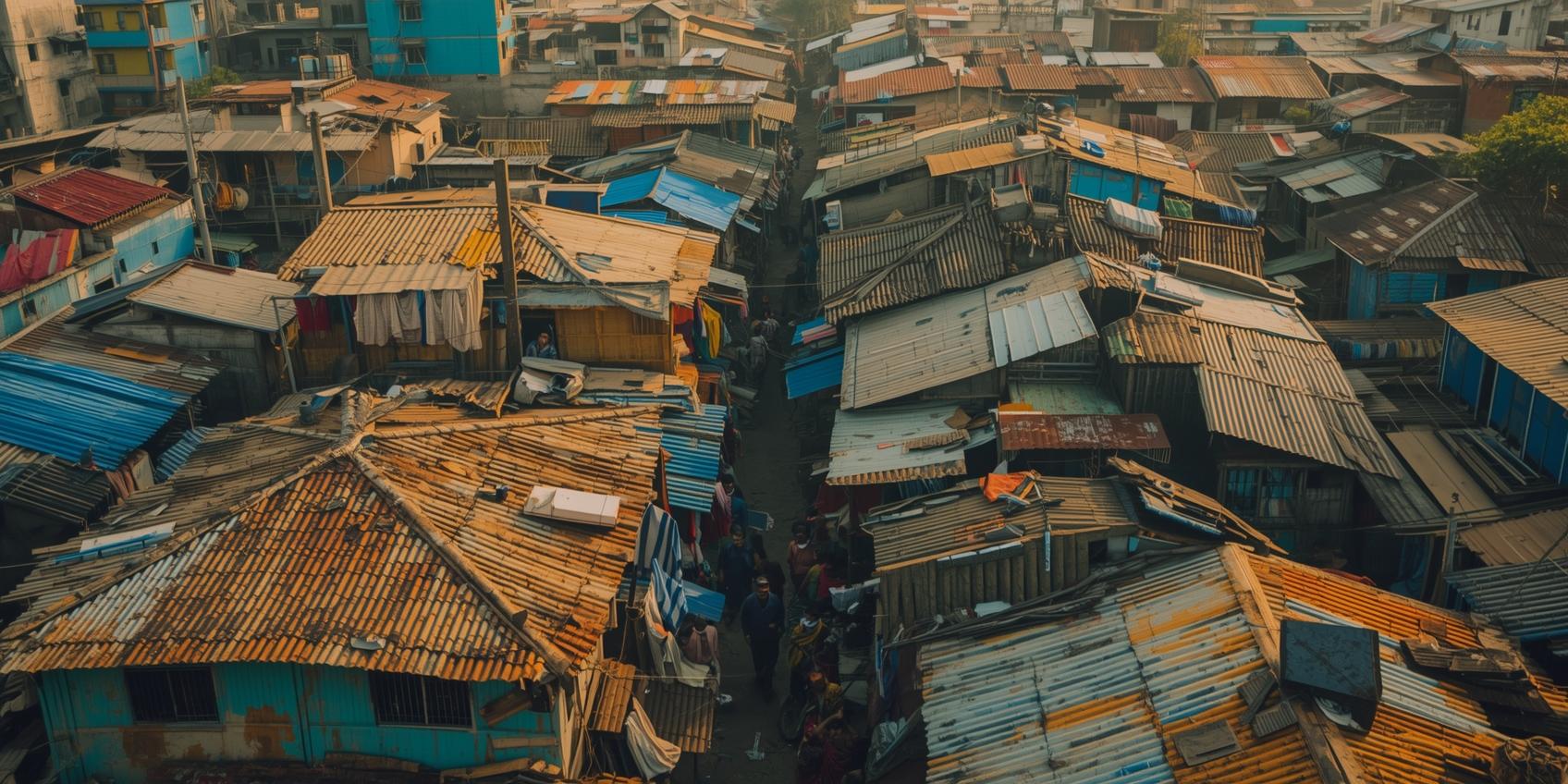

In a major push towards creating a “Slum-Free Mumbai,” the Maharashtra Government has formally notified the Slum Cluster Redevelopment Scheme, paving the way for large-scale rehabilitation and integrated redevelopment of slum-dominated areas under the Slum Rehabilitation Authority (SRA).
The move follows approval by the state cabinet and Chief Minister on October 14, 2025, and the official government order issued by Chandrashekhar Taware, Deputy Secretary, Housing Department, on November 13, 2025.
A Step Toward a Slum-Free Mumbai
The new scheme aims to bring all contiguous slum areas exceeding 50 acres under a single redevelopment plan, thereby addressing fragmented and delayed rehabilitation efforts that have plagued Mumbai’s slum redevelopment model for years.
According to the government resolution, these clusters may include slum pockets, old chawls, unsafe tenanted buildings, and even government or institutional lands — without restrictions on land ownership type.
SRA to Act as Nodal Agency
The Slum Rehabilitation Authority (SRA), Mumbai, will serve as the nodal agency for identifying, demarcating, and executing cluster projects.
Each cluster must have at least 51% slum occupation within the total area.
Once the cluster is approved, no separate NOC (No Objection Certificate) will be required from land-owning authorities, significantly cutting red tape and accelerating project initiation.
High-Power Committee to Vet Projects
A High-Power Committee (HPC) will vet and approve proposed clusters before they are sanctioned under Section 3K of the Maharashtra Slum Areas (Improvement, Clearance and Redevelopment) Act, 1971.
Committee Composition:
- Additional Chief Secretary / Principal Secretary (Housing) – Chairperson
- Additional Chief Secretary / Principal Secretary (Urban Development-I) – Member
- Commissioner, BMC – Member
- CEO, SRA – Member Secretary
- Representative of concerned land-owning authority – Member
Phase-Wise Redevelopment and Tenant Protections
The scheme allows phase-wise redevelopment, ensuring that rehabilitation, rent payment, and construction progress occur simultaneously.
Developers will be required to provide rent compensation with post-dated cheques to eligible slum dwellers during construction.
Every rehabilitation building must include a Community Hall of 2% built-up area or 200 sq. ft. per building, whichever is higher, while at least 12% of total slum area must be kept as open space — reducible to 8% in constrained plots with HPC approval.
Inclusion of CRZ and Non-Slum Structures
In a notable inclusion, slums in Coastal Regulation Zone (CRZ-I and CRZ-II) will also be eligible for redevelopment under this scheme, subject to environmental clearance.
Rehabilitation may take place in-situ or within a 5 km radius.
The cluster may also include non-slum structures like industrial or commercial units. Such structures can be redeveloped proportionately, and private developers can be appointed through joint ventures, tenders, or direct nomination if they already control over 40% of the land in the cluster.
Flexibility for Landowners and Government Lands
Private landowners may voluntarily join the scheme and will receive compensatory FSI or TDR in return.
If they refuse participation, land acquisition under the Right to Fair Compensation and Transparency in Land Acquisition, Rehabilitation and Resettlement Act, 2013 can be undertaken, with costs borne by the developer.
Government and institutional leasehold lands will automatically be included, ensuring rehabilitation for lessees and occupants.
FSI and Development Incentives
Developers will receive global FSI on a pro-rata basis depending on project composition.
Additional saleable FSI may be granted for constructing extra tenements for Project Affected Persons (PAPs).
If reserved plots are utilized for redevelopment, the landowner will be compensated with 4 FSI as TDR or equivalent in-situ FSI as per SRA rules.
Implementation and Oversight
All cluster projects will undergo phase-wise scrutiny by the HPC, and the SRA CEO will have powers to levy penalties for project delays.
The state government will amend DCPR 2034 regulations as required to integrate this new framework.
A Systemic Reform for Mumbai’s Urban Landscape
Officials said the new framework is expected to replace fragmented SRA projects with integrated urban redevelopment, helping prevent project delays and ensuring livable, planned communities.
“This is the most ambitious step in three decades of slum rehabilitation policy,” said a senior housing department official. “By focusing on large clusters, the scheme ensures faster clearance of unsafe zones and better infrastructure outcomes.”
Also Read: Supreme Court Clears Redevelopment of Bharat Nagar Slum in Bandra