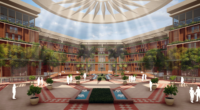
Managed Office Spaces (MOS) are rapidly emerging as the preferred workplace model for enterprises, Global Capability Centres (GCCs), and high-growth companies across India, spanning Tier I, II and III cities. This shift is highlighted in “India Rising – Charting the Managed Office Growth Trajectory,” a comprehensive industry report released by Awfis Space Solutions Limited in collaboration with ANAROCK Research & Advisory.
The report positions Managed Offices as a strategic alternative to traditional leasing models at a time when occupiers are re-evaluating real estate decisions amid hybrid work adoption, expansion into emerging markets, and the growing need for operational agility.
From Flexible Offices to Enterprise-Grade Infrastructure
Unlike earlier flexible workspace models, today’s Managed Offices are designed as fully customised, enterprise-grade environments. They offer bespoke layouts, integrated technology infrastructure, ESG-compliant design, and end-to-end facility management under a single operating framework.
According to the report, enterprises are increasingly favouring MOS for their ability to deliver speed-to-market, cost efficiency, and scalability—while maintaining brand identity, security standards, and regulatory compliance.
Amit Ramani, Chairman and Managing Director, Awfis Space Solutions Limited, said that workplace transformation in India is no longer limited to flexible leasing. “Enterprises are fundamentally rethinking how workspace strategy supports business agility, talent attraction, and operational excellence. Managed Office Spaces have evolved into a comprehensive ecosystem that delivers design, technology integration, sustainability and full-service operations through one unified platform,” he said.
Hybrid Work, GCC Expansion and ESG Push Drive Adoption
The report identifies four structural shifts shaping India’s workplace future: the permanence of hybrid work models, geographic expansion into Tier II and III markets, heightened focus on employee experience, and increasing ESG accountability.
Managed Offices, the study notes, are particularly well-suited for GCCs, which require rapid deployment, secure infrastructure, and globally aligned operational standards. As GCCs move beyond cost arbitrage to higher-value functions such as engineering, analytics, artificial intelligence and R&D, demand for purpose-built, compliant and scalable workspaces is rising sharply.
The report outlines eight key growth drivers for Managed Offices, including flexible workspace adoption, the rise of startups and SMEs, urbanisation and talent mobility, cost optimisation, technological advancement, supportive real estate market dynamics, government support for entrepreneurship, and growing foreign investment.
Tier II and III Cities Gain Strategic Importance
While Tier I cities continue to anchor demand, the report highlights increasing enterprise confidence in Tier II and III markets such as Jaipur, Noida and other emerging locations. Improved infrastructure, availability of skilled talent, lower operating costs, and normalisation of hybrid work models are enabling companies to expand beyond traditional metros.
Managed Office Spaces are playing a critical role in this decentralisation, allowing enterprises to enter new cities quickly without long-term capital commitments or operational complexity.
Case Studies Demonstrate Scale and Speed
The report features multiple case studies from the Awfis ecosystem that demonstrate the scalability and execution capability of Managed Offices.
In Mumbai, a 165,000 sq. ft. managed workspace was delivered for the National Stock Exchange within 50 days, integrating stringent confidentiality requirements with collaborative design through advanced acoustic engineering and smart building systems.
In Jaipur, a Fortune 500 IT company established an 83,000 sq. ft. Managed Office that combined global workplace standards with local cultural elements, highlighting the viability of Tier II cities for large-scale enterprise operations.
In Noida, Insurity commissioned an 18,000 sq. ft. post-pandemic office in just 12 weeks, blending global brand identity with biophilic design and advanced collaboration infrastructure.
Technology, Sustainability and Community at the Core
Looking ahead, the report forecasts deeper integration of IoT, AI and analytics to optimise space utilisation, enhance employee experience and support data-driven decision-making. Sustainability is also becoming a non-negotiable component, with Managed Offices increasingly aligned to global ESG benchmarks through green design, energy efficiency and responsible operations.
Beyond physical infrastructure, Managed Offices are also evolving as community-centric environments that balance secure, private workspaces with opportunities for collaboration and engagement.
A Structural Shift in Corporate Real Estate Strategy
As enterprises increasingly move from asset-heavy ownership models to outcome-driven real estate strategies, Managed Office Spaces are fast transitioning from an alternative solution to a core component of corporate portfolios.
The report concludes that as GCCs accelerate expansion and companies reassess long-term workspace strategies, Managed Offices are becoming the blueprint for creating secure, brand-aligned and future-ready workplaces across India. The focus now, it notes, is on how swiftly organisations can leverage this model to gain a competitive edge.
Also Read: 📰 Working in Mumbai Just Got Costlier: Office Rents Jump 11%