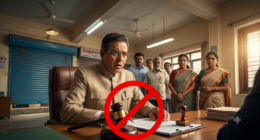

In a significant ruling reinforcing property rights and clarifying the legal position on caretaker and servant occupation, the Bombay City Civil Court has ordered the eviction of a long-serving servant and her son from a servant quarter located within a bungalow property at Madh Island, Malad, holding that permissive possession can never mature into ownership, irrespective of the duration of stay.
The court ruled in favour of Daryus Soley Panthakey, the legal owner of the property, and rejected the defendants’ claim of adverse possession, observing that documents such as ration cards, Aadhaar cards, and voter IDs do not confer ownership rights.
Background of the Property and Parties
The dispute relates to a servant quarter measuring approximately 8 ft × 8 ft, situated within CTS No. 1719/9, Plot No. 3, at Village Erangal, Madh Island, Malad, Mumbai. The property forms part of a bungalow known as “Samrosh”.
The plaintiff, Daryus Soley Panthakey, became the owner of the property under the wills of Dr. Sam Dastoor and Roshan Sam Dastoor, the previous owners. The defendant, Smt. Zingubai Haribhau Galande, had been working as a gardener on the property, initially under the original owners, and was permitted to occupy the servant quarter purely in her capacity as an employee. Her son, Arvind Haribhau Galande, was also residing with her.
Events Leading to the Dispute
According to the plaintiff, in 2009–2010, he discovered that the defendants had attempted to get the property transferred in their names. Upon confronting them on 23 March 2010, the defendants allegedly admitted their illegal attempt.
On 24 March 2010, the defendants tendered a written apology, resignation letter, and possession letter, acknowledging their wrongdoing, resigning from service, and handing over vacant possession of the servant quarter. The plaintiff also paid ₹20,000 as a full and final settlement, which was acknowledged by the defendants.
The plaintiff stated that he took possession of the servant quarter on the same day and appointed security guards at the property. However, on 27 March 2010, the defendants, along with family members and alleged anti-social elements, forcibly re-entered the premises after manhandling the security guards. Police complaints were lodged following repeated attempts by the defendants to trespass into the bungalow.
Suit Filed Under Specific Relief Act
The plaintiff filed Suit No. 3146 of 2011 under Section 6 of the Specific Relief Act, which provides a summary remedy for restoration of possession when a person is dispossessed without due process of law. Importantly, such suits do not examine ownership or title but focus only on prior possession and illegal dispossession within six months.
Defendants’ Claims and Defence
The defendants denied vacating the servant quarter and alleged that the apology and resignation letters were fabricated using signatures obtained on blank papers or through coercion. They claimed to have been in possession of the property for over 40 years, asserting that after the death of Dr. Sam Dastoor in 1981, the property was effectively under their control.
To support their claim, the defendants relied on documents such as ration cards, voter identity cards, Aadhaar cards, bank records, and utility bills reflecting the address of the suit premises. They also claimed ownership by adverse possession, arguing uninterrupted and long-standing occupation.
Court’s Analysis and Findings
The court, presided over by Judge R.R. Patare, examined oral and documentary evidence from both sides. It noted that even the defendants admitted in their evidence that their occupation of the servant quarter was with the permission of the employer and arose out of their role as servants and caretakers.
The court held that:
- Servant or caretaker possession is purely permissive and is deemed to be on behalf of the owner.
- Such permissive possession cannot be converted into adverse possession, regardless of how long the servant or caretaker occupies the premises.
- Identity documents like Aadhaar cards, ration cards, or voter IDs do not create or prove ownership rights.
- The defendants failed to prove that the apology and resignation letters were forged or obtained by force, especially as no police complaint or legal challenge was initiated against the plaintiff.
Based on the evidence, the court concluded that the plaintiff lawfully regained possession on 24 March 2010 and was forcibly dispossessed on 27 March 2010 without due process of law.
Suit Filed Within Limitation
The court further noted that the suit was filed on 9 July 2010, well within the six-month limitation period prescribed under Section 6 of the Specific Relief Act, counting from the date of dispossession.
Final Order
Allowing the suit, the court directed the defendants to hand over possession of the servant quarter to the plaintiff. The court also ordered the Court Receiver of the Bombay High Court to restore possession to the plaintiff in terms of the decree and discharged the receiver thereafter.
The suit was decreed with costs, conclusively rejecting the defendants’ claim of adverse possession.
Significance of the Judgment
The ruling serves as a strong reminder that long occupation does not confer ownership, particularly where possession originates from employment or trust. The judgment reinforces the principle that disputes involving forceful dispossession must be resolved strictly through legal process and not through self-help or coercion.
Also Read: Warehousing Rentals Stay Largely Stable in H1 2025 Despite Market Fluctuations