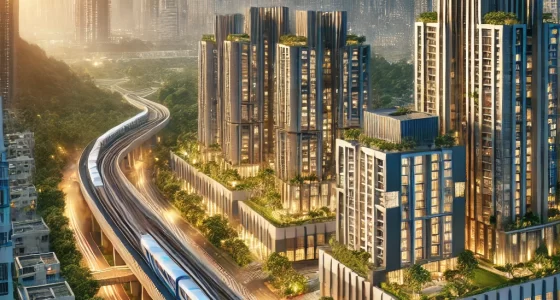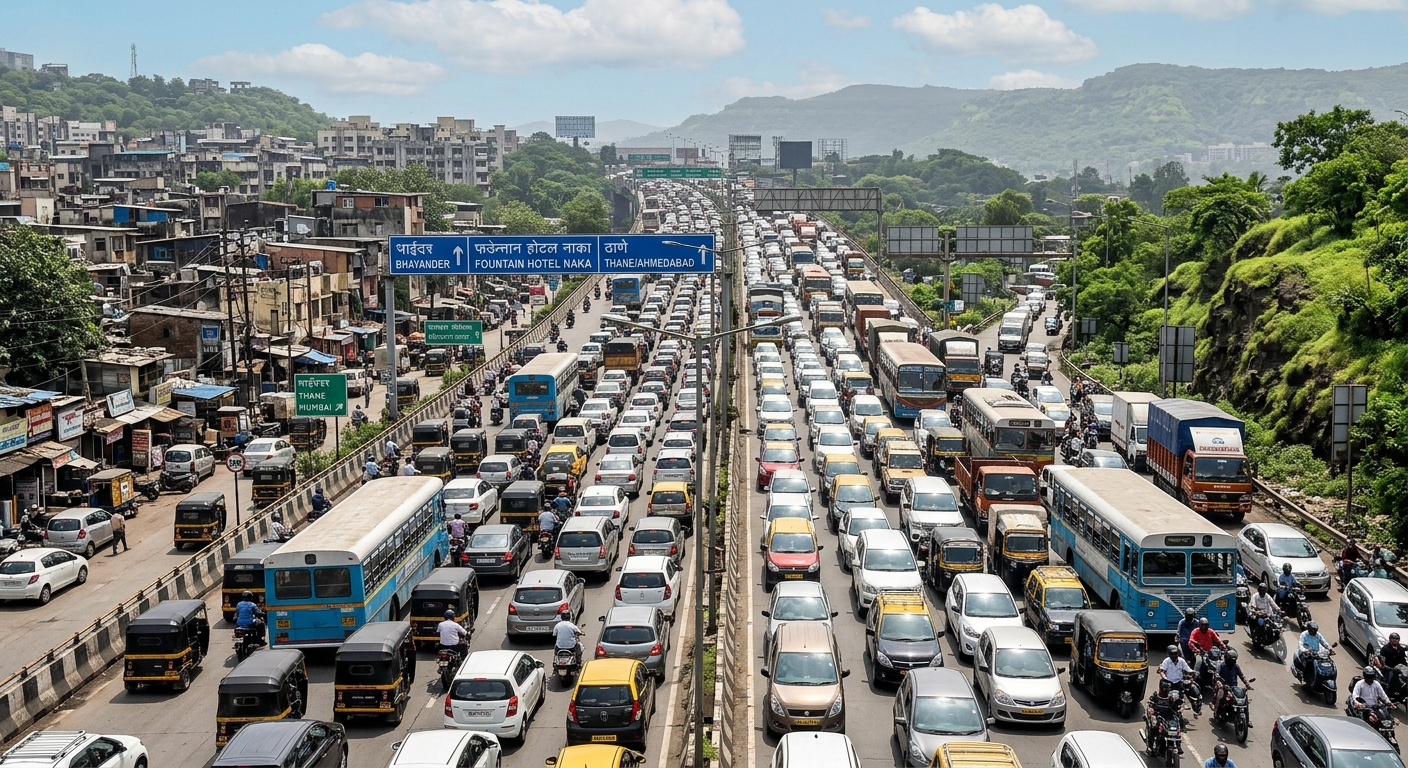

If you have ever been stuck in crawling traffic on the Western Express Highway near Bhayandar — whether you were heading to Vasai, Virar, Palghar, or trying to cut across to Thane and Ghodbunder Road — you already understand the problem this project is trying to solve. The Maharashtra government on June 22, 2026 approved a massive ₹17,306 crore infrastructure project that combines a 9.58 km elevated creek bridge from Bhayandar to Fountain Hotel Junction and a 5.86 km twin tunnel from Fountain Hotel Junction to Gaimukh — a total corridor of 15.44 km that will create an entirely new road connection parallel to the saturated Western Express Highway.
The government order, issued under GR No. MRD-3326/PR.No.63/NV-7 and signed by Joint Secretary Vijay Chaudhary, follows a decision taken at the Cabinet Infrastructure Committee meeting chaired by the Chief Minister on June 9, 2026. The project will be implemented by the Mumbai Metropolitan Region Development Authority (MMRDA) on a Build-Operate-Transfer (BOT) basis under a Public-Private Partnership model with Viability Gap Funding (VGF) support.
Why This Project Exists
The Western Express Highway (WEH) is the single most important north-south arterial road connecting Mumbai to Gujarat via National Highway 48. It handles three very different categories of traffic simultaneously — long-distance regional vehicles headed to Palghar, Vasai, Virar and beyond; cross-traffic moving toward Thane, Kalyan-Dombivli, Nashik and Panvel via the Mumbra Bypass; and purely local traffic within Bhayandar and its surrounding areas. These flows compete for the same road space, and the result is a highway that routinely operates beyond its designed capacity.
During peak hours, average speeds on the WEH near Bhayandar have dropped below 20 km per hour. Widening the highway is not a realistic option given the limited right-of-way available on either side. The government has therefore concluded that an alternative parallel corridor — one that can separate regional through-traffic from local movements — is the only sustainable solution.
The Mumbai North Coastal Road Project, which already terminates near Uttan Road Junction, feeds most of its traffic into Ghodbunder Junction, further concentrating pressure at this chokepoint. The proposed elevated bridge and tunnel project directly addresses this by creating a new connection between Bhayandar and Ghodbunder that bypasses the congested surface road network entirely.
What Is Being Built and Where
The project has two distinct physical components that together form a continuous 15.44 km corridor.
The first is a 9.58 km elevated creek bridge from Bhayandar to Fountain Hotel Junction, configured as a 3+3 lane structure — three lanes in each direction. This elevated section will cross the Bhayandar creek, one of the geographic barriers that has historically made east-west connectivity in this zone difficult and expensive to build.
The second component is a 5.86 km twin tunnel from Fountain Hotel Junction to Gaimukh — a 3+3 double-bore tunnel running underground through the stretch leading into Ghodbunder. This tunnel section allows the road to avoid the densely developed surface areas between Fountain Hotel Junction and Ghodbunder without requiring demolition of existing structures or displacement of large settled populations.
Together, the two components create a seamless elevated-then-underground corridor that will allow vehicles to travel between Bhayandar and Gaimukh — and by extension between the Western Express Highway and Ghodbunder Road — without touching a single surface junction in between.
The project will be built over five years. Private land required for construction is approximately 57.76 hectares, which MMRDA is directed to acquire under applicable land acquisition laws including the 2013 Central Land Acquisition Act and Transfer of Development Rights mechanisms where appropriate.
The Financial Structure
The total project completion cost is ₹17,036.03 crore, with an additional ₹713.94 crore for land acquisition and rehabilitation — bringing the total to ₹17,306 crore as sanctioned.
The base construction cost is ₹9,927 crore, which after applying price escalation of 4% over three years, engineering and design fees at 2%, tunnel royalty charges, GST at 18%, and labour welfare cess comes to ₹12,947 crore. Adding contingency, pre-operative costs, insurance, escalation during construction, interest during construction of ₹1,545 crore, and financing charges of ₹52 crore brings the total project cost to ₹17,036 crore.
The funding is structured across four sources. The central government will contribute ₹3,407.21 crore as VGF — 20% of the project cost. The state government will match this with another ₹3,407.21 crore as its VGF share — another 20%. The private concessionaire will raise debt of ₹6,814.41 crore — 40% — on its own account, with no state guarantee. The concessionaire’s equity contribution will be ₹3,407.21 crore — the remaining 20%. Land acquisition and rehabilitation costs of ₹713.94 crore are entirely MMRDA’s responsibility and sit outside the main project cost.
The project’s financial internal rate of return (FIRR) is assessed at 11.78% and the economic internal rate of return (EIRR) at 14.02% — indicating the project is viable both commercially and in terms of broader social and economic returns.
Dedicated access-controlled tolling will apply to the corridor under MMRDA Act provisions, and additional revenue will be generated through advertising and utility corridor charges — all of which will flow into the state’s Urban Transport Fund.
Who Benefits and How
For residents of Mira-Bhayandar, Vasai-Virar, and Palghar, the most immediate benefit is the creation of a fast, uninterrupted road link into Mumbai that does not depend on the surface WEH during peak hours. Today, a journey from Bhayandar to Ghodbunder Road — a distance of roughly 15 km — can easily take 45 minutes to over an hour in traffic. A dedicated elevated-plus-tunnel corridor with no surface junctions has the potential to reduce that to under 20 minutes.
For commuters who use Ghodbunder Road to access Thane, or who travel from the Western suburbs toward Nashik and Pune via Thane, the relief at Ghodbunder Junction itself will be significant. Much of the congestion at that junction today is caused by vehicles that have no real business being there — they are simply using it as a forced transit point because no better option exists. Once this corridor opens, regional through-traffic from the north will be able to bypass the surface network almost entirely.
For residents of areas along the Ghodbunder corridor — Hiranandani Estate, Majiwada, Pokhran Road, and the rapidly developing residential belts of Thane West — the downstream benefit is reduced pressure on Ghodbunder Road itself, which has been struggling with its own capacity issues as residential density along the corridor has grown sharply.
The project has also been granted in-principle approval for Transit-Oriented Development under the MRTP Act, 1966, which means the government is already thinking about how to leverage the corridor’s new accessibility to enable residential and commercial development along its influence zone — potentially creating a new real estate corridor connecting Bhayandar and Ghodbunder in the years after the project opens.
MMRDA has been directed to submit a time-bound implementation schedule within 15 days and to apply for Urban Challenge Fund support from the central government — though implementation is approved to proceed without waiting for that clearance.
Also Read: Maharashtra Clears ₹220 Cr for Affordable Housing Under PMAY (Urban)