
India’s rapidly expanding data centre industry could become a major new driver of residential real estate demand, with Maharashtra alone projected to generate more than 54 million sq. ft. of housing demand by 2030, according to a new report by proptech company Square Yards.
The report estimates that India’s proposed data centre pipeline of approximately 9,030 MW could generate nearly 4.33 lakh ecosystem jobs, translating into an estimated 195 million sq. ft. of residential demand across the country by 2030.
For Maharashtra, the projected residential demand of more than 54 million sq. ft. makes it the largest beneficiary among the states analysed.
The findings point to a potential shift in the drivers of India’s residential real estate market, with digital infrastructure emerging alongside traditional catalysts such as IT parks, highways, industrial corridors and airports.
Maharashtra could see the biggest housing impact
Maharashtra is projected to generate more than 54 million sq. ft. of residential demand from India’s expanding data centre ecosystem.
Karnataka follows with nearly 28 million sq. ft., while Andhra Pradesh is projected to generate more than 23 million sq. ft. of demand.
Uttar Pradesh is expected to account for approximately 22.7 million sq. ft., followed by Telangana at 21.6 million sq. ft. and Tamil Nadu at 19.4 million sq. ft.
The projections suggest that the residential impact of data centre investments could extend well beyond the locations where the facilities themselves are built.
The ‘Golden Ring’ around data centres
According to Square Yards, the biggest residential impact is unlikely to be concentrated within data centre campuses.
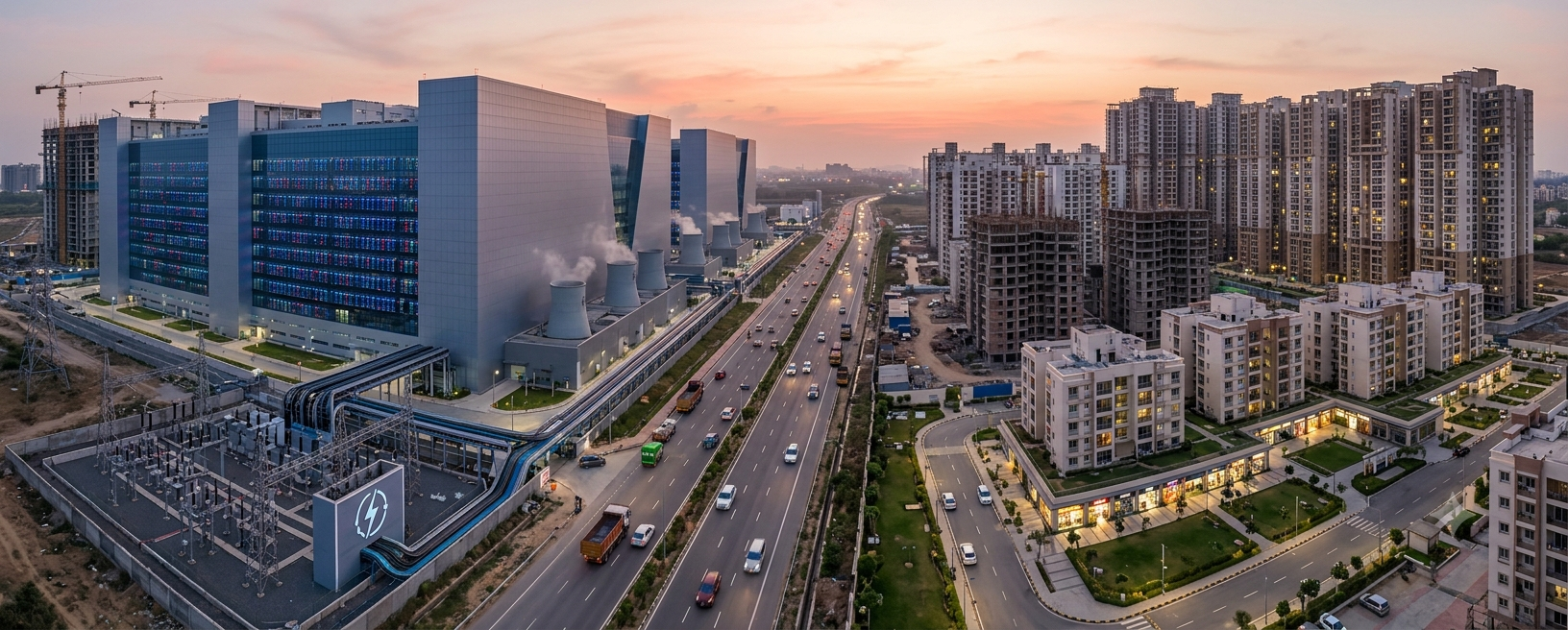
Instead, the report identifies a 5-15 km ‘Golden Ring’ around major data centre facilities as the zone that could see the strongest urban development activity.
Infrastructure upgrades, mixed-use developments, residential townships, retail centres and civic amenities are expected to emerge around these digital infrastructure hubs.
The resulting housing demand would be driven not only by people directly employed by data centres but also by ancillary employment, logistics, commercial activity and supporting services that develop around these facilities.
This could create new residential growth corridors in areas that may not traditionally have been viewed as major IT or technology hubs.
Why data centres could reshape real estate
India currently generates nearly 20% of the world’s digital data but accounts for only about 4% of global data centre capacity, according to the report.
The gap indicates significant potential for further data centre infrastructure expansion.
The growth of artificial intelligence, cloud computing and enterprise digitisation is expected to accelerate investment in data centres, which in turn can drive spending on power infrastructure, fibre connectivity, logistics and other supporting infrastructure.
Unlike conventional commercial developments, data centres can therefore have a broader economic impact on surrounding locations, according to Square Yards.
Vivek Agarwal, Co-Founder and Chief Technology Officer, Square Yards, said data centres could represent the next stage in India’s infrastructure-led urban expansion, attracting investments in power, fibre connectivity and logistics that can eventually drive residential and commercial development around emerging digital corridors.
Impact could extend beyond Mumbai and other metros
The report suggests that the next wave of residential growth linked to digital infrastructure will not necessarily be confined to India’s largest metropolitan markets.
Emerging destinations such as Visakhapatnam, Noida and GIFT City are among the locations identified as potential beneficiaries of increased data centre-led economic activity, connectivity improvements and institutional investment.
For Maharashtra, the projected 54 million sq. ft. housing demand highlights the potential scale of the opportunity for the state’s residential real estate market.
The impact could also extend to Tier-II and Tier-III locations as data centre investments create demand for supporting infrastructure and services.
Sunita Mishra, Vice President – Research & Insights, Square Yards, said housing demand consistently follows areas with strong employment potential and that data centres could increasingly influence the future development of residential markets across India.
From data centres to housing demand
The proposed 9,030 MW data centre pipeline could therefore have implications extending well beyond the technology sector.
Square Yards estimates that nearly 4.33 lakh ecosystem jobs could emerge from the pipeline, supporting approximately 195 million sq. ft. of residential demand by 2030.
The report argues that the real estate impact will be generated through an interconnected ecosystem: data centres attract power and connectivity investments; infrastructure attracts businesses and supporting services; and growing economic activity creates demand for housing, retail and other urban amenities.
For Maharashtra, with more than 54 million sq. ft. of projected residential demand, data centre investments could become an important additional catalyst for housing growth and the expansion of emerging urban corridors over the next few years.
Also Read: Western Suburbs Lead Mumbai’s Redevelopment Surge, Reshaping the City’s Skyline