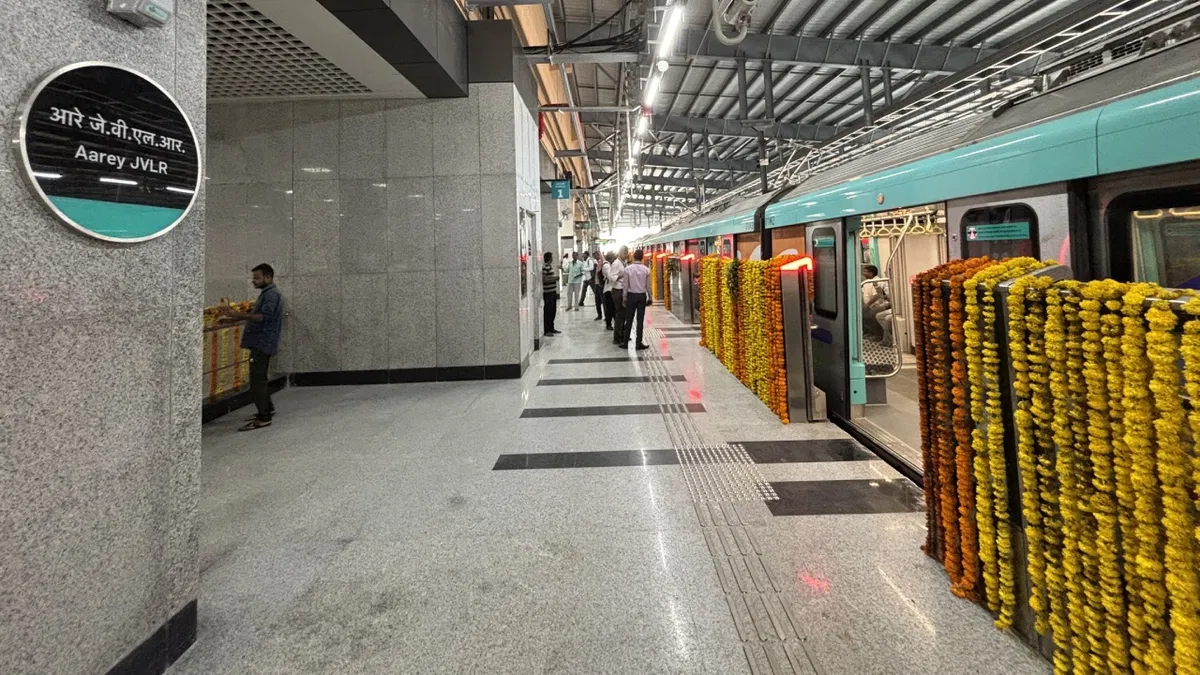

Mumbai’s real estate sector is set for a significant transformation with the launch of the first phase of the Mumbai Metro Line-3. During a recent visit to the city, Prime Minister Narendra Modi inaugurated this infrastructure project, marking a new era of connectivity for India’s financial capital. The first phase of the ₹14,120 crore Metro Line-3 connects Bandra Kurla Complex (BKC) to Aarey, spanning the JVLR section. As Mumbai’s first underground metro, the Aqua Line will revolutionize travel in the city, featuring 10 new stations, including key transit hubs such as T2 and Santacruz, thereby easing congestion and reducing travel times.
The full 33.5 km route of the Aqua Line connects Aarey to Cuffe Parade, incorporating 27 stations along its path. The recently launched first phase spans 12.5 km between Aarey and BKC, offering an important boost to the city’s transport network. Moreover, this metro line will integrate with Mumbai Metro Line 1 at Marol Naka, improving connectivity across Mumbai’s key regions.
Anil Mutha, Chief Visionary & Co-Founder, Nandivardhan Group, highlighted the nature of these developments, stating, “The government’s commitment to improving Mumbai’s infrastructure is commendable. The launch of Mumbai Metro Line-3 is a transformative milestone for urban transportation. This will improve connectivity and help ease congestion in vital corridors. Once Metro 3 is fully operational, it will enhance accessibility for residents commuting between Dadar in south-central Mumbai and the northern suburbs, benefiting daily commuters. Additionally, the operational metro corridor is expected to stimulate development in the South Mumbai real estate market, particularly around Dadar, by improving connectivity to areas like BKC, Worli, and Marine Lines.”
On the benefits to South Mumbai residents, Vedanshu Kedia, Director of Prescon Group, stated, “South Mumbai is back on the real estate map with high-impact infrastructure projects like the Coastal Road, Bandra-Worli Sea Link Extension, Sewri-Worli Elevated Corridor, and Metro Line 3. There will be significant advantages for residents of Mahim, Dadar, and Worli, who will benefit from enhanced connectivity to the rest of Mumbai and Navi Mumbai. These micro markets have redevelopment potential due to their large stock of ageing real estate. Once these initiatives are operational, property values and volumes are anticipated to increase significantly. The market share for these micro-markets will improve in the residential and commercial property transactions in the MMR region.”
Commenting on the impact on the region, Rohan Khatau, Director, CCI Projects, added, “Metro 3 and Metro 7 along with the Western Express Highway will ease connectivity in the Kandivali-Borivali belt. This will lead to a surge in housing demand, as the area becomes more accessible for potential homebuyers seeking well-connected residential options.”
Reflecting on the benefits for homebuyers, Umesh Jandial, Chief Business Officer, Omkar Realtors & Developers, shared, “There is already significant demand for housing in the western suburbs, especially in the Malad-Goregaon belt. The convergence of Metro Line 3 with existing Metro lines 1 and 7 will further fuel housing demand in this region. Improved connectivity, lifestyle amenities, and the convenience offered by projects in the western suburbs will enhance the lifestyle for homebuyers along this metro corridor.”
Shraddha Kedia-Agarwal, Director, Transcon Developers, emphasized the importance of these developments, stating, “These infrastructure initiatives are pivotal for Mumbai’s future. The focus on underground metro systems and freeway extensions represents a forward-thinking approach to urban planning. Areas like Santacruz, Andheri, and Malad along the western line will see heightened demand, with improved mobility expected to stimulate both residential and commercial growth, making Mumbai a more competitive global city.”
Himanshu Jain, VP – Sales, Marketing & CRM, Satellite Developers Pvt. Ltd., highlighted the Malad-Goregaon region’s growth potential, noting, “The combined impact of Metro 3 and Metro 7 will drive residential and commercial development in the Malad-Goregaon region. For millennial homebuyers, the proximity of their homes to workplaces is a crucial factor. Compact homes and studio apartments near their workspace allow them to maintain a balanced lifestyle, offering more quality time with their families.”
Looking ahead, additional infrastructure projects like the extension of the Santacruz-Chembur Link Road (SCLR) and the forthcoming Phase II of Metro Line-3 are set to further enhance Mumbai’s transport network. These initiatives are critical for alleviating congestion and meeting the needs of the city’s growing population and economic aspirations.
As Mumbai embraces these changes, the impact on daily commuting and the city’s global standing will be profound. By 2025, the integration of air, road, and metro networks is expected to position Mumbai as a world-class urban center, prepared to tackle the challenges of its expanding population and dynamic economy.
Also Read: Vidhan Bhawan Metro: 4.2 Acres of Prime Land in Nariman Point to Be Auctioned by MMRCL