
The Mumbai Metropolitan Region Development Authority (MMRDA) has initiated the preparation of the Detailed Project Report (DPR) for the proposed Integrated Tunnel Road Network, a pioneering project that will introduce a third mode of urban travel beneath Mumbai — complementing the city’s expanding road and metro networks.
This ambitious initiative aims to create a high-capacity underground mobility corridor that connects the Mumbai Coastal Road, Bandra-Kurla Complex (BKC), the Mumbai–Ahmedabad High-Speed Rail Station, and the Chhatrapati Shivaji Maharaj International Airport (CSMIA), while helping decongest the Western Express Highway and SV Road.
Once operational, the tunnel system will not only reduce congestion but also reclaim valuable urban space for citizens and improve overall travel efficiency across the city.
🚇 A Strategic Step Towards “Mumbai in Minutes”
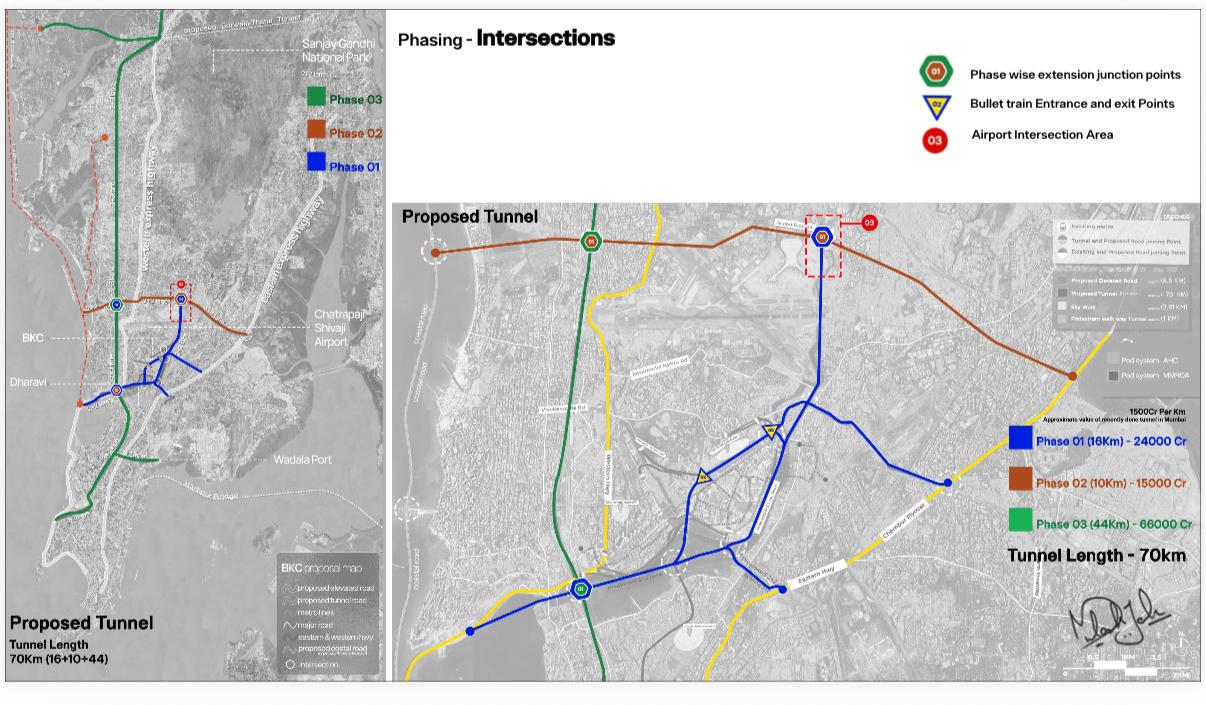
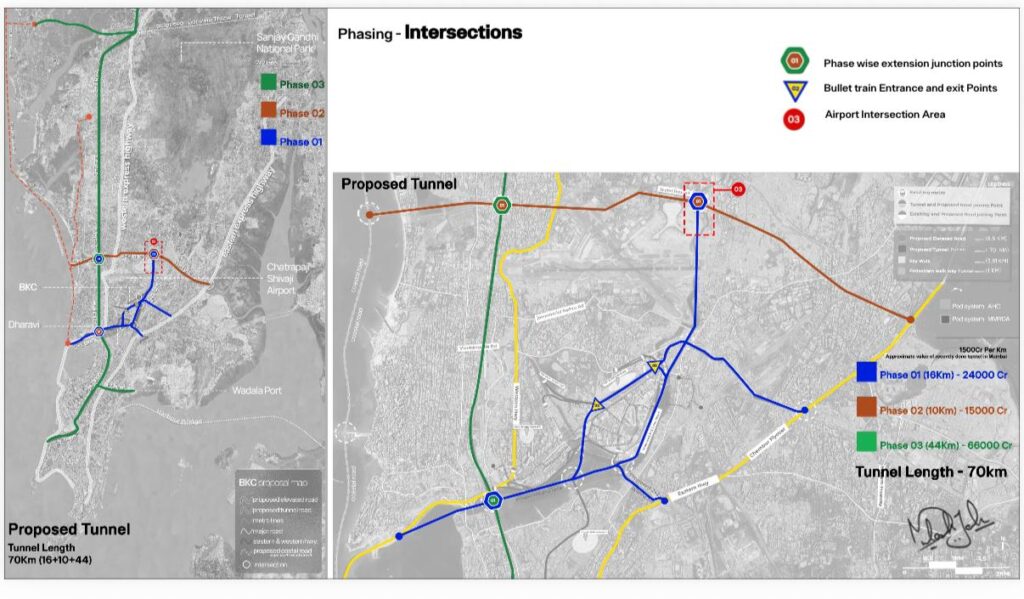
Spanning over 70 km across three phases, the Integrated Tunnel Network will complement surface and metro systems to form a multi-layered transport grid. The project will be implemented in a phased manner, based on traffic requirements and future mobility demand.
Given Mumbai’s high density and limited land availability, underground mobility offers a sustainable way to expand capacity without disturbing existing surface infrastructure.
📍 Project Implementation in Phases
Phase I: Worli Sea Link – BKC – Airport Loop (Approx. 16 km)
- Connects the Mumbai Coastal Road to BKC and CSMIA
- Integrates with the Mumbai–Ahmedabad Bullet Train Corridor
- Aims to ease congestion along WEH and SV Road
Phase II: East–West Connectivity (Approx. 10 km)
- Links Eastern Express Highway (EEH) and Western Express Highway (WEH)
- Designed to reduce cross-city congestion
Phase III: North–South Corridor (Approx. 44 km)
- Provides continuous underground connectivity across Mumbai
- Supports both passenger and freight movement
The Techno-Economic Feasibility Study and DPR for Phase I were approved by the Hon’ble Deputy Chief Minister and MMRDA Chairman on September 30, 2025. The tender process was initiated on October 10, with bids scheduled for opening on November 17, 2025.
💬 Leaders Speak
Chief Minister, Devendra Fadnavis, said:
“Mumbai’s transformation into a global economic powerhouse depends on its ability to move people and goods efficiently. The tunnel network represents a major leap in that direction — integrating roads, metro, coastal, and underground systems. It will decongest key routes and make commuting across the city faster, safer, and smoother.”
Deputy Chief Minister & MMRDA Chairman, Eknath Shinde, added:
“This will be Mumbai’s third mode of mobility — beneath the surface. It marks our shift from linear to multi-layered transport planning. Integration with the Coastal Road, Metro, and Bullet Train will make ‘Mumbai in Minutes’ a reality.”
Dr. Sanjay Mukherjee, IAS, Metropolitan Commissioner, MMRDA, said:
“The tunnel network will redefine how Mumbai moves. It will ease surface congestion, improve east–west and north–south connectivity, and unlock space for citizens. The DPR will assess technical feasibility, environmental impact, and economic viability before phased execution begins.”
🌍 Towards a Smarter, Sustainable Mumbai
Once implemented, the Integrated Tunnel Road Network will function as Mumbai’s subterranean expressway, easing surface-level pressure, cutting emissions, and reducing travel time between major business and residential hubs — from South Mumbai to BKC to the Airport.
Together with the Coastal Road, Metro Network, and surface expressways, this project completes MMRDA’s tri-layered mobility vision — building a smarter, sustainable, and seamlessly connected Mumbai where every destination is just minutes away.
Also Read: MMRDA Sets Reserve Price at ₹1,629 Crore for 10 FSI Wadala Plot Lease Auction