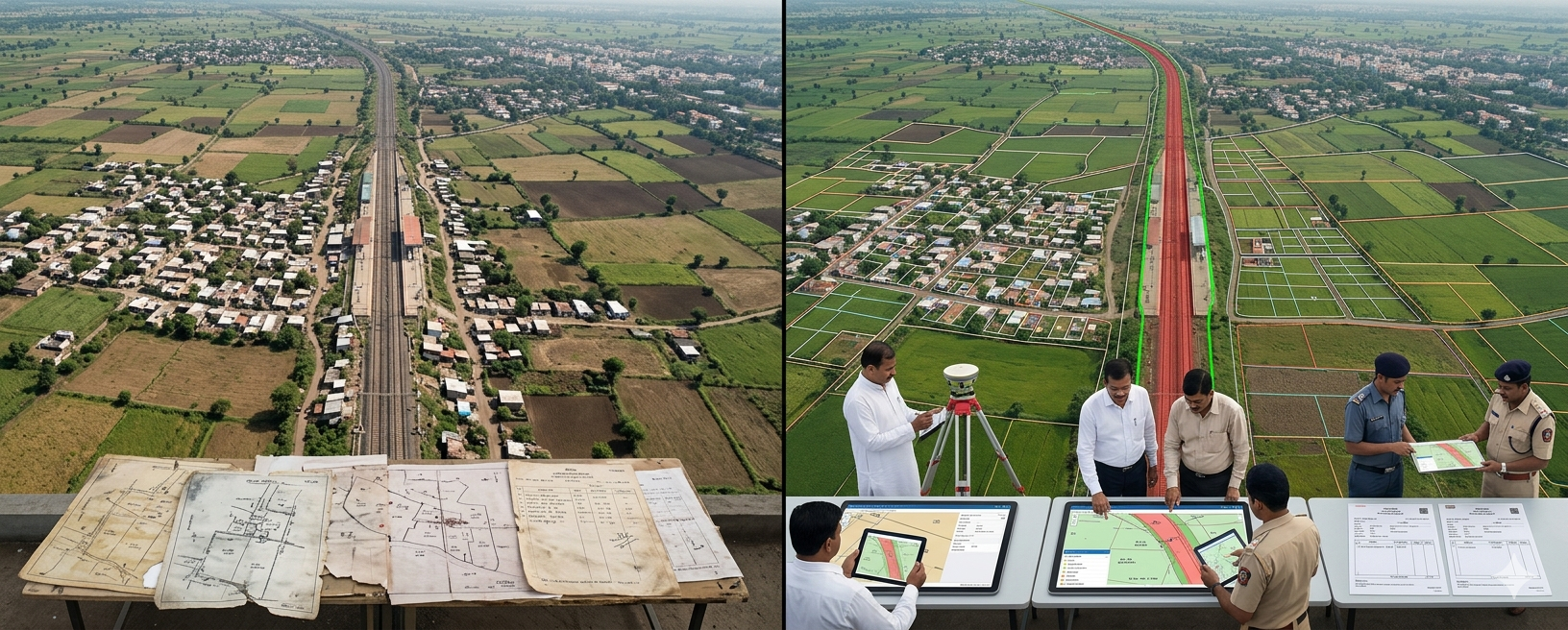

In a significant move to resolve long-standing land ownership ambiguities, the Maharashtra government has directed that all railway-owned lands be formally recorded in revenue records such as 7/12 extracts and property registers, with ownership clearly marked as “Government of India – Railways.”
The Government Resolution (GR) issued by the Revenue and Forest Department addresses a historical gap where railway land existed on maps but ownership was never properly recorded in land documents, leading to disputes, encroachments, and litigation.
🔍 What was the problem?
Many railway lands in Maharashtra:
- Were acquired before Independence or early survey periods (1890–1930)
- Were shown in village maps, but
- Not recorded in ownership documents like 7/12 extracts
In some cases:
- Railway land was marked as “road” or “public path”
- In others, ownership was missing entirely
- Even after land acquisition, records were not updated
👉 Result:
- Frequent encroachments by adjoining landowners
- Multiple court cases and disputes
- Lack of legal clarity on railway land ownership
🛠️ What does the GR mandate?
The government has now ordered a state-wide correction and updating drive:
✅ 1. Separate land records for railway land
- Railway land will be assigned:
- Independent Survey Number / Gat Number / City Survey Number
- A separate 7/12 extract will be created
✅ 2. Ownership entry
- In all records, ownership must be clearly mentioned as:
👉 “Government of India – Railways”
✅ 3. Updating maps and records
Authorities must:
- Update village maps
- Correct property registers
- Ensure alignment between:
- Maps
- Survey records
- Ownership documents
✅ 4. Covering all scenarios
The GR gives detailed instructions for multiple cases:
- Old survey maps where railway lines exist but no records
- Consolidation / re-survey villages
- Land acquired later for railway expansion
- Urban areas under city survey
👉 In all cases, records must be corrected and ownership updated
✅ 5. Special statewide drive
- District Collectors will run a joint campaign
- Revenue + Land Records departments will:
- Verify documents
- Conduct measurements
- Update records
⚖️ Why this matters
This reform directly targets a major ground-level issue:
🚫 Encroachment control
Clear ownership will make it easier to:
- Identify illegal कब्जे
- Take enforcement action
⚖️ Fewer legal disputes
- Courts currently see many cases due to unclear ownership
- Proper records will reduce litigation
🧾 Stronger land governance
- Aligns maps with legal ownership
- Improves transparency in public land records
🚆 Support for railway expansion
- Clear land titles will help:
- Faster project execution
- Fewer legal hurdles in future acquisitions
🗣️ The Bottom Line
Maharashtra is fixing a decades-old gap in land records:
👉 “What exists on ground must exist on paper.”
By formally recording railway land ownership, the state aims to protect public land, reduce disputes, and strengthen infrastructure planning.
Also Read: Mumbai’s 12 Major Rail Projects