

Alternate Investment Funds (AIFs) are rapidly transforming India’s real estate funding landscape, according to ANAROCK Research’s latest 2025 AIFs Report. As traditional financing sources face growing constraints, AIFs have emerged as a resilient and scalable solution—particularly for the real estate sector, which has garnered the lion’s share of AIF investment.
📈 Real Estate Tops Sectoral AIF Investment
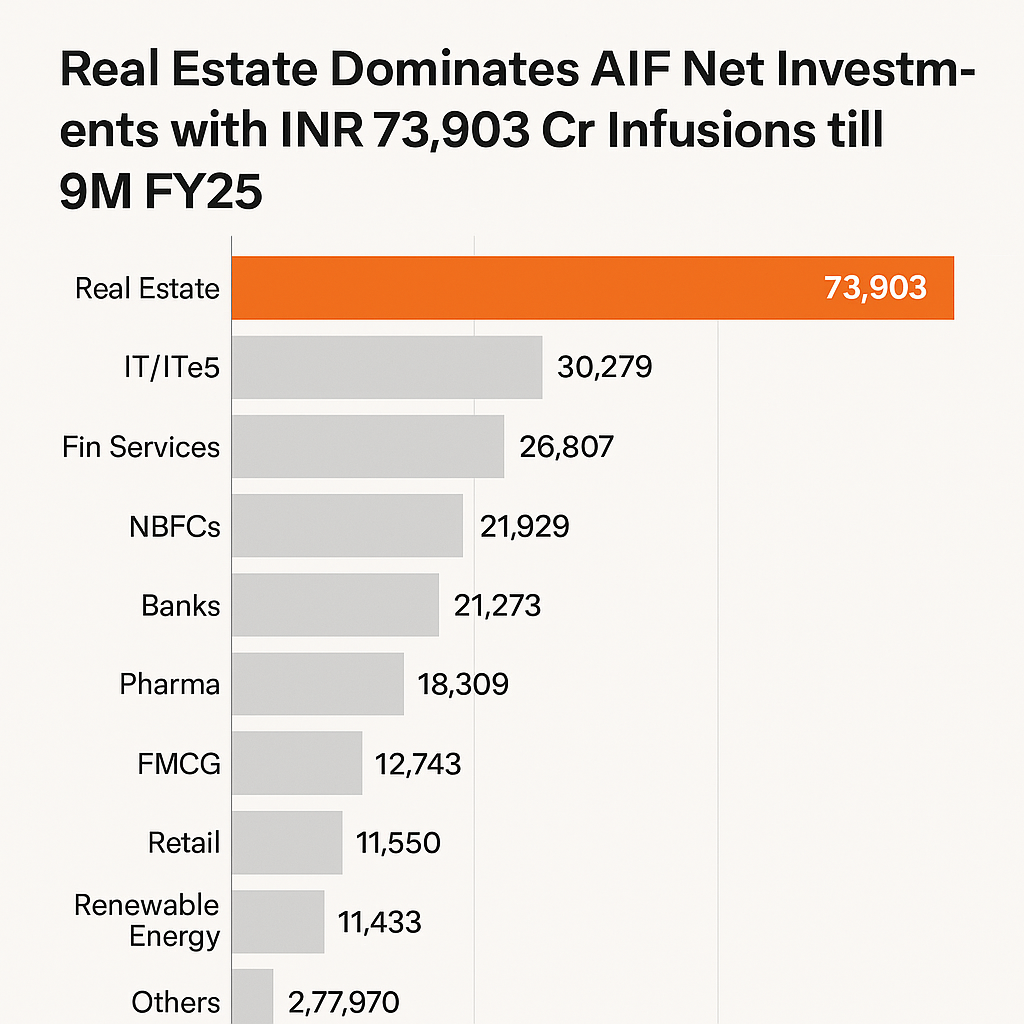
As per data compiled from SEBI and ANAROCK Research, real estate accounted for the highest share of cumulative net AIF investments till the first nine months (9M) of FY2025, with ₹73,903 crore infused into the sector. This represents 15% of the total ₹5,06,196 crore invested across various sectors.
Net AIF Investments by Sector – 9M FY2025
| Sector | Amount Invested (INR Cr) |
|---|---|
| Real Estate | 73,903 |
| IT/ITeS | 30,279 |
| Financial Services | 26,807 |
| NBFCs | 21,929 |
| Banks | 21,273 |
| Pharma | 18,309 |
| FMCG | 12,743 |
| Retail | 11,550 |
| Renewable Energy | 11,433 |
| Others | 2,77,970 |
| Total | 5,06,196 |
The ₹73,903 crore investment in real estate marks an 8% increase from ₹68,540 crore at the end of FY2024—signaling continued momentum in the sector despite macroeconomic headwinds.
🏗️ AIFs Powering Real Estate Revival
“Amidst increasing constraints on traditional funding sources, AIFs are an agile and innovative financing mechanism to address capital gaps at various stages of real estate development,” said Prashant Thakur, Regional Director & Head – Research, ANAROCK Group.
He added that the future of AIFs lies in blended finance models, AI-driven risk assessments, and streamlined regulatory frameworks, all of which will maximize their impact on infrastructure and housing.
🚀 Commitments Skyrocket Across the Decade
The AIF sector in India has grown exponentially, with commitments rising from ₹2.82 lakh crore in FY2019 to ₹13.05 lakh crore in 9M FY2025—a near five-fold increase. From just 42 registered AIFs in 2013, the number surged to 1,524 as of March 2025.
AIF Commitments: FY2019 vs 9M FY2025
| Metric | FY2019 | 9M FY2025 |
|---|---|---|
| AIFs Registered | 42 | 1,524 |
| Total Commitment (INR Cr) | 2,82,148 | 13,05,179 |
| CAGR (FY19–FY25) | ~26% | — |
Category II AIFs—comprising real estate, private equity, debt funds, and fund of funds—have been the primary growth engine, accounting for nearly 80% of total AIF commitments over the past five years.
🧱 SWAMIH Fund: Real Estate’s Financial First Responder
India’s flagship real estate AIF, the SWAMIH Fund, has played a pivotal role in reviving stalled housing projects, injecting over ₹35,000 crore into the market. It has successfully enabled the completion of thousands of homes for distressed homebuyers.
“The SWAMIH Fund has been an unmitigated boon for homebuyers across the country,” said Anuj Puri, Chairman, ANAROCK Group. “However, the Fund’s journey is fraught with regulatory, financial, and operational challenges.”
🛑 Challenges Facing SWAMIH Fund
Despite its success, SWAMIH still faces systemic roadblocks that limit its full potential.
Key Bottlenecks
| Challenge | Impact |
|---|---|
| Limited Corpus (₹15,000 Cr under SWAMIH II) | Insufficient for nearly 2,000 stalled projects |
| Regulatory Hurdles (NCLT cases, RERA) | Slow project clearances, expired approvals |
| Lender Resistance | Existing lenders reluctant to cede first charge |
| Buyer Litigations & Withheld Payments | Disrupt cash flows, complicating execution |
| Environmental Clearances | Often delayed, causing implementation bottlenecks |
“Fixing India’s housing crisis needs more than capital — it demands reform,” added Puri.
🔍 Conclusion: AIFs Driving New Era in Real Estate Funding
AIFs are no longer on the fringes of India’s investment ecosystem. With growing institutional interest, high net-worth participation, and a sharp focus on real estate, they are positioned to bridge critical funding gaps in urban development and housing.
As regulatory frameworks evolve and adoption widens, AIFs—particularly Category II and vehicles like SWAMIH—are likely to redefine the contours of real estate financing in the country.
Also Read: Modern Real Estate Investment Approaches Empowering Retail Investors in Long-Term Wealth Building