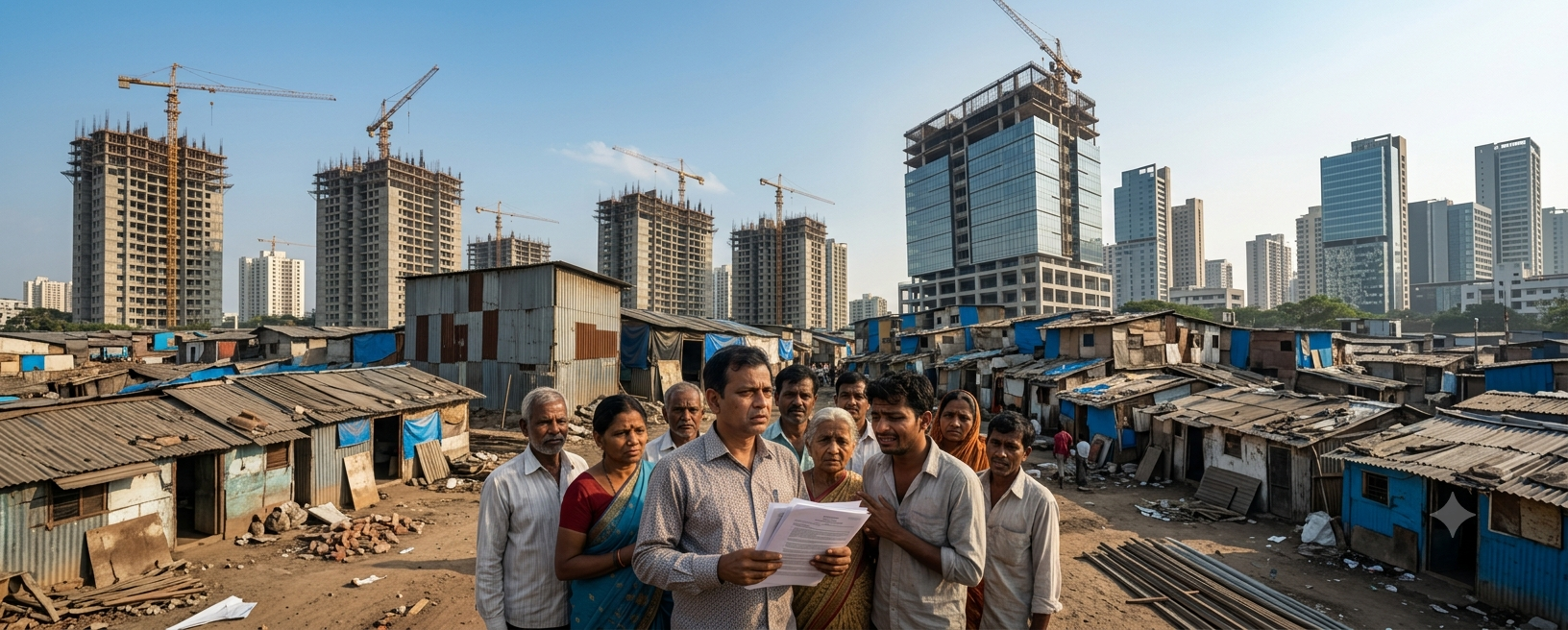
MahaRERA has once again clarified that eligible slum dwellers and original tenants entitled only to free rehabilitation tenements in SRA redevelopment projects cannot seek relief before the Authority.
In an order dated 8 July 2026, Member-II Ravindra Deshpande rejected a miscellaneous application filed by Murli Madhavan against Shreedham Constructions Pvt. Ltd. in Complaint No. CC006000000198525 (project “Shreedham Classic”, registration No. P51800012234). The Authority upheld its Interim Order of 3 July 2025 and dismissed the complaint as not maintainable.
The complainant claimed a 260 sq. ft. commercial premises. He contended that the Interim Order had wrongly treated the dispute as relating to the rehabilitation component. According to him, the premises formed part of the free-sale component of the registered project. He argued that the shop was allotted in consideration of surrender of tenancy rights, which constituted valid consideration under Section 2(d) of the RERA Act, making him an “allottee”. He further submitted that the developer had voluntarily registered the project under MahaRERA and therefore could not later claim exemption under Section 3(2)(c). Through the miscellaneous application under Rule 22 read with Section 37, he sought rectification of the Interim Order, restoration of the complaint for hearing on merits, execution of the Agreement for Permanent Alternate Premises, and handover of possession.
Builder’s stand
Shreedham Constructions strongly opposed the application. The developer submitted that the application was misconceived, not maintainable and liable to be dismissed with costs. It contended that although an alternate shop had been proposed in a free-sale building, it was never allotted in the registered project “Shreedham Classic”. According to the respondent, the premises are situated in the Vivekanand SRA CHSL building, which forms part of the redevelopment/rehabilitation component and has not been registered under RERA.
The developer argued that the dispute arises purely out of a Permanent Alternate Accommodation Agreement (PAAA) executed in a redevelopment project and not from an Agreement for Sale governed by the RERA Act. It maintained that the complainant’s predecessor was merely a tenant and not an allottee under Section 2(d). Since no sale transaction or Agreement for Sale existed, the complainant could not claim the status of an allottee or invoke RERA remedies.
The respondent further submitted that surrender of tenancy rights does not constitute consideration under the RERA Act and that the rights claimed arise solely out of redevelopment arrangements, which stand excluded under Section 3(2)(c). It also contended that Rule 22 read with Section 37 is confined to correction of clerical or apparent errors and cannot be used to review or reopen findings on jurisdiction already recorded in the Interim Order. The developer alleged that the complainant was attempting to substantially amend the original complaint by introducing new facts and legal grounds after the Interim Order had been passed. Possession of the allotted shop in the SRA building, it claimed, had been offered since 2017, but the complainant refused to accept it while insisting on a shop in “Shreedham Classic”, which was never allotted under the PAAA.
MahaRERA’s findings
The Authority rejected the complainant’s application. It held that the finding of lack of jurisdiction was not based merely on the physical location of the premises. The decisive factor was the nature of the transaction. The complainant’s rights flowed from an unregistered Permanent Alternate Accommodation Agreement executed in lieu of surrender of tenancy rights, and not from an Agreement for Sale under the RERA Act.
MahaRERA observed that a Permanent Alternate Accommodation Agreement is legally distinct from an Agreement for Sale. A rehab claimant receives the alternate premises against surrender of existing tenancy or hutment rights and not pursuant to a sale transaction for monetary consideration. The definition of “allottee” under Section 2(d) must be read with the scheme of the Act, particularly Sections 2(c), 2(zk), 3 and 13, which contemplate a promoter-allottee relationship founded on an Agreement for Sale.
The Authority relied on the Maharashtra Real Estate Appellate Tribunal’s decision in Savita Ravindra Deokar v. Bhalchandra Vinayak Wadnerkar, which held that the rehabilitation component of a hybrid redevelopment project falls outside the purview of RERA. Even if the alternate premises are located in the free-sale building, the mere location does not convert a redevelopment/PAAA arrangement into a RERA-regulated sale. Registration of the free-sale component also does not automatically bring pure rehab claims under the Act.
The miscellaneous application was held to be an impermissible attempt to review and reopen the Interim Order under the guise of rectification. Rule 22 and Section 37 do not confer power of review or rehearing.
What MahaRERA covers and what it does not
- Covered: Buyers who purchase units in the free-sale component of a registered project by paying monetary consideration and executing an Agreement for Sale. Such allottees can approach MahaRERA for delayed possession, refund with interest, deficiency in amenities and other statutory reliefs.
- Not covered: Pure rehabilitation claims of eligible slum dwellers, original tenants or society members entitled only to free permanent alternate accommodation under a PAAA or Development Agreement in SRA or other redevelopment schemes. These disputes fall outside RERA and must be pursued before the Slum Rehabilitation Authority, civil court, MHADA or other competent forums.
The order reinforces the consistent position that RERA is designed to regulate sale transactions, not rehabilitation entitlements arising out of redevelopment arrangements.
Also Read: MahaRERA Allows Parking in Adjacent Building of Same Layout