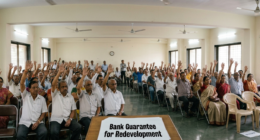

In a powerful and hard-hitting judgment delivered on February 16, 2026, the Bombay High Court has handed a resounding victory to The Mulund Endeavour Co-operative Housing Society Ltd., directing defaulting developer M/s Alag Property and Constructions Private Ltd. to immediately hand over peaceful possession of the redevelopment site. Justice Somasekhar Sundaresan, in a detailed 20-page order, not only appointed the Court Receiver to take physical charge of the property but also rejected the developer’s plea for a stay, underscoring a rare judicial intervention that restores control to a displaced housing society after prolonged suffering.
The dispute revolves around a ~4182.60 sq m plot (CTS No. 554/1) in Mulund East, Mumbai, comprising four old buildings (A, B, C, D). Chronologically, key events unfolded as follows:
- July 2, 2016: The society executed a Development Agreement with the developer for full redevelopment, promising new flats, corpus, transit rent, brokerage, transportation, and hardship compensation to members.
- September 13, 2017: Delayed application for Intimation of Disapproval (IOD), obtained only on September 3, 2019 — over three years after the original agreement.
- September 30, 2019: Supplementary Development Agreement signed to address time lapse and incorporate DCPR 2034 regulations.
- January 5, 2020: Possession of the site handed over to the developer; society members vacated their homes expecting timely completion.
- September 3, 2020: IOD re-validated; first Commencement Certificate (up to plinth level) obtained on January 27, 2021 — five years post-original agreement.
- Ongoing issues (2020–2025): Repeated plan changes, contractor switches, minimal progress (society claimed ~30% completion; developer disputed at 40–45%), non-loading of required TDR/FSI, and complete work stoppage by January 2025.
- Financial defaults: Arrears of ~₹9.77 crore in transit rent (escalating annually), brokerage, transportation, hardship compensation, and municipal taxes (~₹1.13 crore unpaid since 2023), exposing the society to attachment risks.
- February 23, 2025: Unanimous Special General Body Meeting resolution to terminate agreements due to multiple breaches.
- February 28, 2025: Termination Notice served.
- May 10, 2025: Arbitration invoked; Section 9 petition filed for interim relief.
- February 16, 2026: Judgment pronounced.
The court found the developer seriously in default on time and cost commitments, with members displaced for over five years facing unpaid dues and uncertainty. Justice Sundaresan described redevelopment agreements as a matter of “entrustment” of the society’s sole asset — its homes — and cited precedents like Rajawadi Arunodaya Co-operative Housing Society v. Value Projects Pvt Ltd. (2021) to emphasize that loss of faith due to breaches justifies termination. He rejected excuses like COVID-19 aftermath, pollution restrictions, and NGT orders as insufficient.
Critically, the judgment clarified that third-party flat purchasers (who entered agreements with the developer) buy at their own risk. Their rights derive from and are subordinate to the developer’s; no privity exists with the society, and they cannot bind the society post-termination (relying on Vaidehi Akash Housing Pvt. Ltd. v. New D.N. Nagar Co-operative Housing Society, 2014).
The court highlighted the imbalance: real, immediate hardship to residents (survival via rent, separation from homes) versus the developer’s notional commercial risk. It rejected balancing arguments, noting developers invest for profit and assume project risks.
Key reliefs granted:
- Developer to hand over peaceful possession of the land and structures.
- Court Receiver (with police assistance if needed) to take possession and transfer the project to the society.
- Permanent injunction against the developer creating third-party rights or interfering in the society’s redevelopment (self or via new developer).
- Interim measures to continue until four weeks after Arbitral Tribunal constitution (society directed to file Section 11 application within eight weeks if needed).
This order empowers housing societies across Mumbai facing stalled redevelopments, signaling that courts will not tolerate prolonged defaults or attempts to renegotiate via dilutions (e.g., proposed slum rehab linkage). The final merits await arbitration, but the interim protection decisively favors the society.