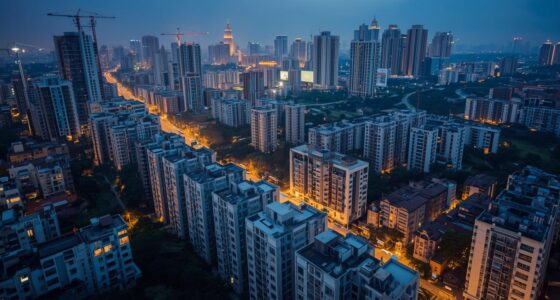

In a significant ruling protecting cooperative housing societies, the Bombay High Court has upheld the right of four societies in the Dheeraj Dreams complex at Bhandup (West) to refuse membership to two buyers who purchased “flats” that never existed — they were actually mandatory refuge areas.
Justice Firdosh P. Pooniwalla, in his judgment dated 25 March 2026 in Writ Petition No. 973 of 2023, quashed the orders of the Divisional Joint Registrar and restored the Assistant Registrar’s decision rejecting the buyers’ membership claims.
The Case
The petitioner societies — Dheeraj Dreams Building No.1, 3, 4A, and 4B CHS Ltd. — manage several wings of the residential complex. The Full Occupancy Certificate was issued by the Municipal Corporation of Greater Mumbai (MCGM) in 2009. Floor plans attached to all legitimate flat purchases clearly marked certain open spaces on the 8th and 15th floors as refuge areas — compulsory unconstructed safety zones required under building regulations for emergency evacuation during fire or other hazards.
Despite this, Housing Development and Infrastructure Ltd (HDIL), the developer, executed five registered Agreements for Sale on 30 April 2019 with two individuals, Hukamsingh B. Sewadsha and Chetansingh B. Sewadsha, describing these refuge areas as residential flats (including units like A-1506, D-1501, etc.).
By then, key legal milestones had already passed:
- The societies were registered in 2008-09 with no unsold flats remaining. HDIL did not join as a member, which it was legally required to do under Section 10 of the Maharashtra Ownership Flats Act (MOFA) if any flats were unsold.
- In 2017, the societies obtained a Certificate of Entitlement for Deemed Conveyance, which divested the developer of further rights to sell or deal with the property.
The two buyers approached the societies seeking membership based on these agreements. When refused, they moved the Assistant Registrar under Section 22(2) of the Maharashtra Co-operative Societies (MCS) Act. The Assistant Registrar rejected their application on 19 October 2020, observing that the developer had no right to sell non-existent flats.
The buyers then filed revision applications. The Divisional Joint Registrar reversed the order on 22 July 2022, directing the societies to admit them as members, and an execution order followed in October 2022.
Court’s Strong Observations
Justice Pooniwalla held that:
- The so-called “flats” were refuge areas, not constructed residential units. They were shown as open spaces in the original plans and continue to be assessed as refuge areas by municipal authorities (with no property tax levied on them as flats).
- HDIL had no authority to sell these spaces after the Deemed Conveyance entitlement certificate was issued.
- Forcing the societies to admit the buyers would violate Section 154B-5 of the MCS Act, which prohibits admitting more members than the actual number of flats available in the society.
The court distinguished this case from earlier precedents (such as the Videocon Appliances judgment), noting that the issue here was not merely “unauthorised construction” but the complete non-existence of any flat. A society cannot be compelled to breach a statutory provision.
The High Court quashed both the revision order of 22 July 2022 and the subsequent execution order. It restored the Assistant Registrar’s order of 19 October 2020, declaring that the societies were right in refusing membership.
Significance
This judgment reinforces that:
- Refuge areas, meant for life safety, cannot be converted or sold as private flats.
- Once the Deemed Conveyance process begins, a developer loses the right to create new sales in the project.
- Cooperative societies have strong legal grounds to resist attempts to inflate membership beyond the actual number of flats.
The refuge areas remain under the control and possession of the societies.
The buyers’ agreements for sale were not directly declared void in this writ petition (a separate civil suit for that purpose is reportedly pending), but the ruling makes it clear that such transactions carry no enforceable right to membership in the housing society.
This decision is likely to be welcomed by housing societies across Maharashtra facing similar attempts to sell common or prohibited spaces.
Also Read: HDIL Homebuyers Get No Relief From MahaRERA