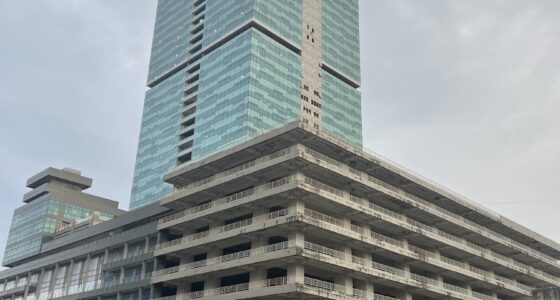

In a landmark judgment that brings closure to a two-decade-long property dispute, the Bombay High Court has ordered the immediate eviction of obstructionists from three shops constructed on a prime open plot in Bandra, Mumbai. Justice Sandeep V. Marne, pronouncing the judgment on April 6, 2026, allowed Civil Revision Applications Nos. 417 and 418 of 2022 filed by the landlords and restored the Trial Court’s order of November 3, 2018, directing the vacation of Gala Nos. 1, 2 and 3 along with demolition of the structures.
The suit property is Final Plot No. 650 of Bandra Town Planning Scheme-III, an open plot admeasuring approximately 450 square yards situated on S.V. Road (Ghodbunder Road), Bandra — a highly valuable commercial location. The land was first leased in 1934 by Domnic A. D’Monte to Moogatlal J. Bhat for five years and five months. Subsequent leases followed in 1949 and finally on March 6, 1959. All three lease deeds explicitly covered only open/vacant land, with clear covenants requiring the lessee to remove all structures at the expiry of the lease term and hand over vacant possession of the land in its original condition.
Around 1948-49, Moogatlal constructed three temporary structures (Gala Nos. 1, 2 and 3) on the plot. He let out Gala No. 1 to Halimabai Madraswala (later transferred to White Rose Properties Pvt. Ltd. / Vadilal Kunverji Gada group) and Galas 2 and 3 to Jagannath Tare and his family. The 1959 lease was executed after all 15 legal heirs of Moogatlal surrendered their rights in the land. A fresh lease was created only in favour of three joint tenants — Parvatishankar Moogatlal Bhat, Madhusudan Moogatlal Bhat, and Vijaykumar Moogatlal Bhat — with an express survivorship clause. The lease expired on December 31, 1979.
After the Maharashtra Rent Control Act, 1999 withdrew protection for open-land tenancies, the landlords filed T.E. & R. Suit No. 66 of 2002 under Section 41 of the Presidency Small Causes Courts Act, 1882, against the heirs of the lessees. The heirs of the last surviving joint tenant (Vijaykumar Bhat) — Defendant Nos. 8 to 11 — executed consent terms on April 29, 2006, surrendering the tenancy. Other heirs of Moogatlal had already filed additional written statements disclaiming any tenancy rights. The suit was decreed on consent on May 6, 2006.
When the landlords sought execution of the decree, they encountered obstruction from the occupants of the three Galas. They filed Obstructionist Notice No. 15 of 2006. The Small Causes Court (Trial Court) allowed the notice on November 3, 2018, directing obstructionists (including White Rose Properties Pvt. Ltd. and its directors for Gala 1, and the Tare family for Galas 2 and 3) to vacate the premises, permitting the landlords to demolish the structures at the obstructionists’ cost, and ordering an enquiry into mesne profits.
The Appellate Bench of the Small Causes Court reversed this order on May 4, 2022, erroneously holding that the consent decree was an “incomplete decree” as it was not against all 15 alleged tenants and that the obstructionists were lawful sub-tenants of the landlords.
Justice Marne, in a detailed 65-page judgment, set aside the Appellate Bench’s order, describing its reasoning as “fundamentally erroneous,” “perverse,” and based on a complete misreading of the 1959 lease deed. The High Court clarified that the 15 heirs had surrendered their rights and that tenancy was created only in favour of the three named joint tenants with survivorship. The consent decree was therefore valid and fully executable.
On the rights of the obstructionists, the Court held that since the lease was only of open land with an explicit obligation to remove structures, the occupants were mere licensees of the original lessee. They had no privity of contract with the landlords and no independent right to occupy the structures once the head tenancy ended. The Court relied on long-settled principles from judgments such as Jamnadas Dharamdas v. Dr. J. Joseph Farreira, Sanjay Ramchandra Parab v. Ashok D. Bhuta, Ramkrishna G. Dode v. Anand Govind Kelkar, Virji Nathuram v. Krishnakumar, and Goregaon Malayalee Samaj v. Popatlal Prabhudas. It ruled that Sections 15 and 15A of the Bombay Rent Act do not protect occupants of structures built on leased open land where the lessee was bound to demolish them.
The High Court emphasized that in obstructionist proceedings under Order XXI Rules 97 and 101 CPC, the obstructionist must prove an independent right; they cannot collaterally challenge a valid decree. No such right existed in this case. The plea for stay of the judgment was rejected.
Outcome: The obstructionists must forthwith vacate Gala Nos. 1, 2 and 3. The landlords are entitled to demolish the structures and recover the cost from the obstructionists. An enquiry into mesne profits will now proceed. The ruling is likely to impact similar long-pending open-land lease disputes in Mumbai where third-party occupants claim protection.
Also Read: Landowners Win vs NHAI: Bombay HC Upholds Higher Compensation