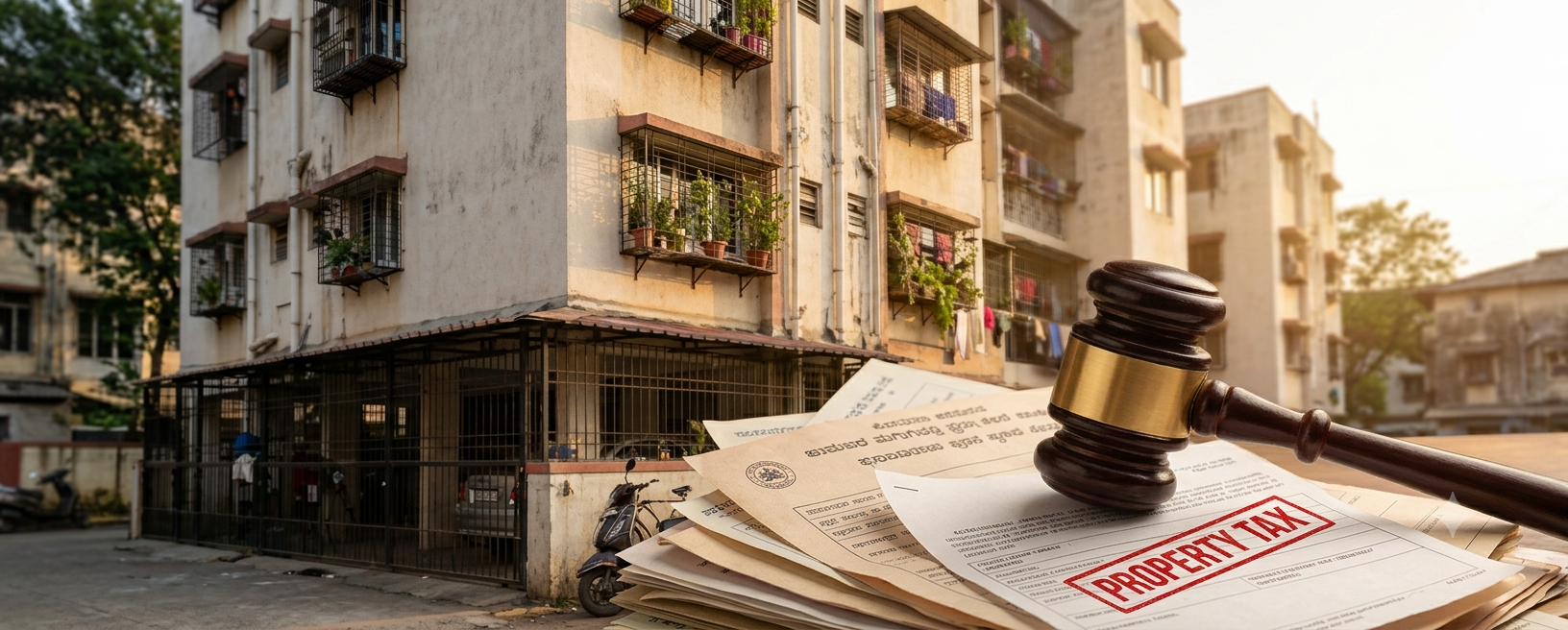

The Maharashtra State Co-operative Appellate Court, Mumbai, has held that merely paying municipal property tax on an alleged encroachment does not amount to its regularisation, rejecting a review application filed by two flat owners at Dharti Co-operative Housing Society in Versova, Andheri West.
The order, passed by Member A.S. Wanve on July 15, 2026, dismissed Review Application No.4 of 2025 filed by Adam Ishaq Memon and Noorjahan Ishaq Memon, owners of Flat No. FG-3 in the society, against an earlier appellate order dated November 15, 2025, which had itself dismissed their appeal with cost.
The underlying dispute
The matter traces back to a stilt-area enclosure attached to the flat, identified as Unit BK-3. According to the order, this enclosure was demolished by the BMC in 2014 but was subsequently re-built by the flat’s previous owner before the property was sold to the current applicants. The demolition process for this structure remains pending before the Municipal Corporation of Greater Mumbai.
The society had been billing the applicants for maintenance on the basis of 330 sq. ft., while the applicants sought a direction to bill them on 630 sq. ft. — effectively seeking recognition of the disputed enclosed area as legitimately part of the flat. They had also sought to restrain the society from implementing a resolution dated August 1, 2021, and from levying encroachment charges.
This interim relief request was first rejected by the Trial Court on August 28, 2024. The applicants’ appeal against that rejection was dismissed with cost by the Appellate Court on November 15, 2025, prompting the present review application.
The new evidence and the court’s reasoning
In seeking review, the applicants placed on record an MCGM Assessment Chart dated September 15, 2021, which listed Unit BK-3’s carpet area as 20.90 sq. ft. along with an “extension” of 27.97 sq. ft., each carrying separate property tax liability. The applicants argued this assessment showed the disputed area had been officially recognised and that, as bona fide purchasers, they were entitled to the benefit of this evidence.
The society opposed the review, contending that the applicants were aware of the pending demolition proceedings but had not disclosed them fully, and that municipal tax assessment serves only a fiscal purpose — it cannot legalise an illegal structure or override judicial orders already passed.
The Appellate Court agreed with the society’s position. Examining the scope of review under Order 47 Rule 1 of the Civil Procedure Code, the court relied on the Supreme Court’s ruling in S. Murali Sundaram vs. Jothibai Kannan & Ors. (2023 SCC OnLine SC 185), which holds that review proceedings are not equivalent to an appeal and must be confined to errors that are apparent on the face of the record — errors identifiable without extended reasoning, and not merely because an alternative view is conceivable.
Applying this standard, the court held that paying property tax to MCGM on the encroached area does not amount to regularisation of the encroachment, nor can it be treated as certification of ownership. It found that the assessment chart, therefore, did not disclose any error apparent on the face of the earlier order, and that a review could not be used to re-appreciate evidence or arrive at a different conclusion, even if such a conclusion were otherwise possible.
Outcome
Holding that the applicants failed to establish any apparent error in the November 2025 order, the court answered the sole point for determination in the negative and rejected Review Application No.4 of 2025, with cost.
Also Read: MHADA removes encroachment on its 9 acre land in Mumbai