Vile Parle society’s attempt to load litigation costs solely on members who filed a ₹3 crore misappropriation case has been restrained by the Maharashtra State Co-operative Appellate Court.
In a significant interim order, the Maharashtra State Co-operative Appellate Court, Mumbai, has restrained Vallab Darshan Co-operative Housing Society Ltd. in Vile Parle (East) from levying or collecting legal expenses only from members who had filed a dispute against the managing committee.
The order, passed on 12 October 2026 in Appeal No. 64 of 2026, sets aside an earlier decision of the Co-operative Court that had refused interim protection to the members.
Background: Dispute Over Alleged ₹3.08 Crore Loss
Several members of Vallab Darshan CHS had filed a dispute (CC/IV/297/2023) against the society and its managing committee members. They alleged high-handed functioning, falsification of accounts, financial irregularities, and misappropriation of society funds amounting to approximately ₹3.08 crore. They sought a declaration that the managing committee members were jointly and severally liable to make good the loss with interest.
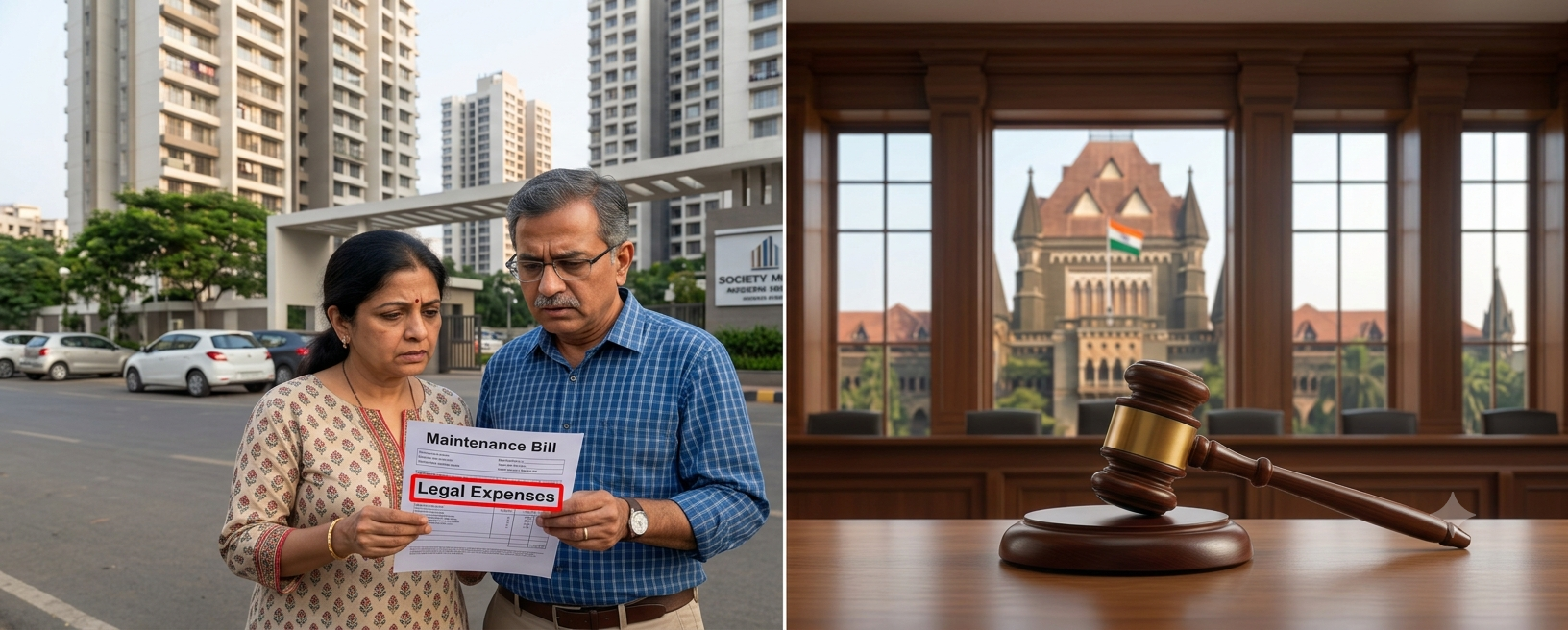
During the pendency of this dispute, the society began adding substantial legal expenses — around ₹71,429 per month in the months referred to — along with interest, exclusively to the maintenance bills of these disputing members. The members contended that this was done with the intention of harassing them and eventually declaring them defaulters.
Society’s Resolution Came After the Charges Were Already Levied
The society later passed a resolution in its Annual General Meeting held on 3 September 2024. Under agenda item 4, it decided that legal expenses would be charged to members who had filed cases against the managing committee, covering the financial year 2023 and future years.
However, the Appellate Court noted a critical timeline issue: the legal expenses had already been debited in the members’ bills in June 2024 — months before the AGM resolution was passed. As a result, the charges could not be treated as having been levied pursuant to that resolution.
What the Appellate Court Held
The Co-operative Court had rejected the members’ interim application, largely on the ground that they had not specifically challenged the AGM resolution and that the interim relief was not sufficiently connected to the main dispute.
The Appellate Court disagreed. It held that a prima facie case existed in favour of the members, the balance of convenience lay with them, and they would suffer irreparable loss if the injunction was not granted. It therefore allowed the appeal and restrained the society from levying, charging, demanding, or collecting legal expenses along with interest from the disputants till the disposal of the main dispute.
Legal Position: How Legal Expenses Must Be Distributed
The Court relied on the model bye-laws applicable to co-operative housing societies. Under these bye-laws, legal charges form part of the society’s service charges. Service charges, in turn, are required to be equally divided among all flats or units.
The Appellate Court observed that charging legal expenses only to the members who had approached the court was, on a prima facie view, contrary to this requirement. It further noted that the society’s action appeared to be an extra-judicial method aimed at pressuring the members and obstructing them from pursuing their legal remedies.
The Court also referred to Section 95(4) of the Maharashtra Co-operative Societies Act, which empowers the Co-operative Court to pass interlocutory orders to prevent the ends of justice from being defeated. It held that the trial court had failed to properly exercise this jurisdiction.
Distinction from Another Recent High Court Ruling
The society had relied on a recent Bombay High Court judgment (Nitin Kantilal Gandhi v. Sanket Co-operative Housing Society). The Appellate Court distinguished that case, observing that the facts were different. In the present matter, the legal charges had been levied before any supporting AGM resolution existed.
What This Means for Society Members
The order is interim in nature and will remain in force only until the main dispute is decided. It does not finally determine whether the managing committee is liable for the alleged loss, nor does it permanently bar recovery of legitimate legal expenses in accordance with bye-laws and law.
However, it sends a clear message: a co-operative housing society cannot selectively load litigation costs arising from a case filed by some members onto those members alone, particularly when the charges do not conform to the equal-sharing requirement under the bye-laws and when they appear intended to penalise members for approaching the court.
The judgment reinforces that members have the right to challenge alleged mismanagement without the immediate risk of being singled out for disproportionate financial burden in their maintenance bills.