
By Architect Nitin Killawala
It’s a matter of great concern for all Mumbaites that successive governments have shown little interest in resolving the burning issue of housing, including the recent phenomena of private property redevelopment in every corner of the city.
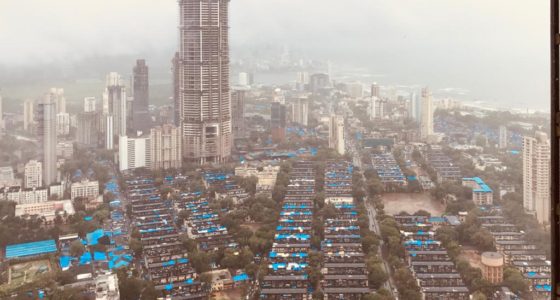
Ever since the SRA/MHADA authorities were formalized way back in 1996, when the slum population was in its nascent stages, these government authorities have kept on tweaking their policies in the name of eradicating slums. This, sadly, is just the opposite of what’s happening, keeping the issue burning. It’s no secret that it’s in the government’s interest to proliferate slums and keep on amending Development Control (DC) regulations to create large swathes of land for private developers. Most luxury towers in recent times have therefore mushroomed on such slum lands, and the government gave away insane concessions by charging exorbitant premiums for new construction—not for better planning, but for mutual profiteering!
Until now, real estate has thrived by abusing slum lands. However, as they say, greed has no limits. Now, under DCR 33(11) as well as 33(12), the government even lures private, often smaller properties on the pretext of constructing homes for Project Affected Persons (PAPs) in the same or an adjoining ward. In other words, you pay huge premiums to the government to construct housing for unknown PAPs. There is no official information on how many PAP houses have been constructed from premiums accrued under these regulations. The intent of regulation 33(11) is so blatant that the government has no qualms in selling additional FSI (Floor Space Index) in proportion to the Ready Reckoner (RR) rates of the proposed redevelopment. Today, in the western suburbs, the total redevelopment amount is three to four times that of the construction cost. So, even if the private plot owner or a cooperative society has their own land, which is the most expensive component in real estate, occupants are at the mercy of the government and private developers, as the entire process is complex and opaque. This is one of the main reasons that property sale prices in Mumbai are far more expensive than in any other metro city in the country.
The regulation is deliberately designed only to construct more on a given plot with the least respect for improving liveability. The FSI is randomly increased up to 4.05 to 5.40 for properties abutting roads that are 12 meters or 18 meters wide. In the process, open spaces are reduced to a width of 1.50 meters, irrespective of the building’s height, by charging an exorbitant premium. In other words, the government is actually selling our fundamental right to minimum natural light and air!
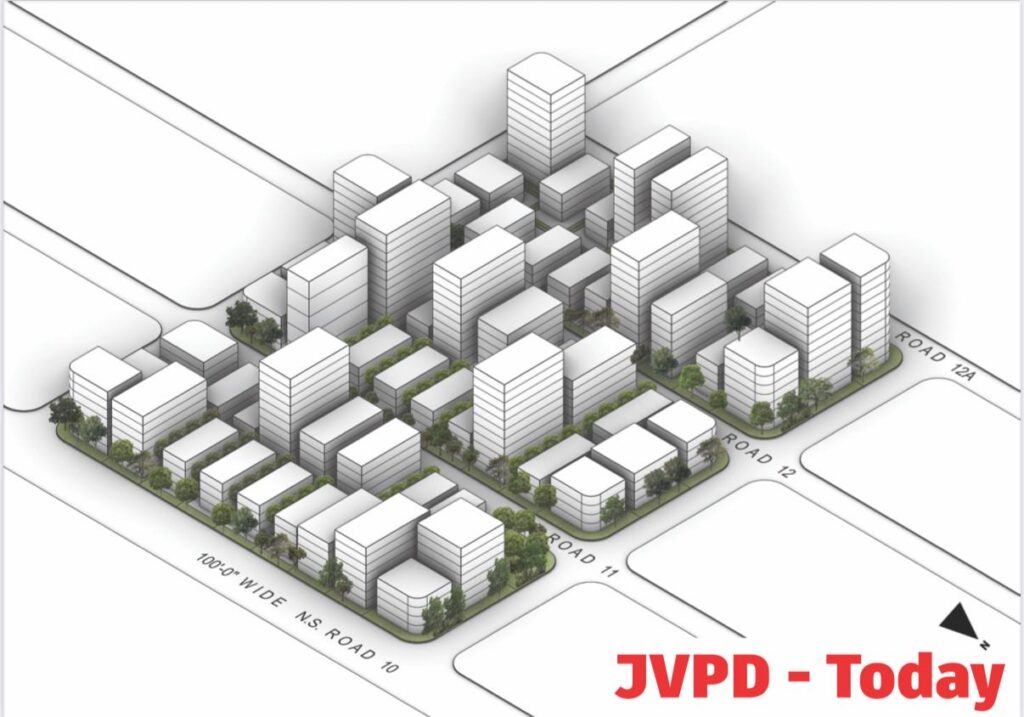
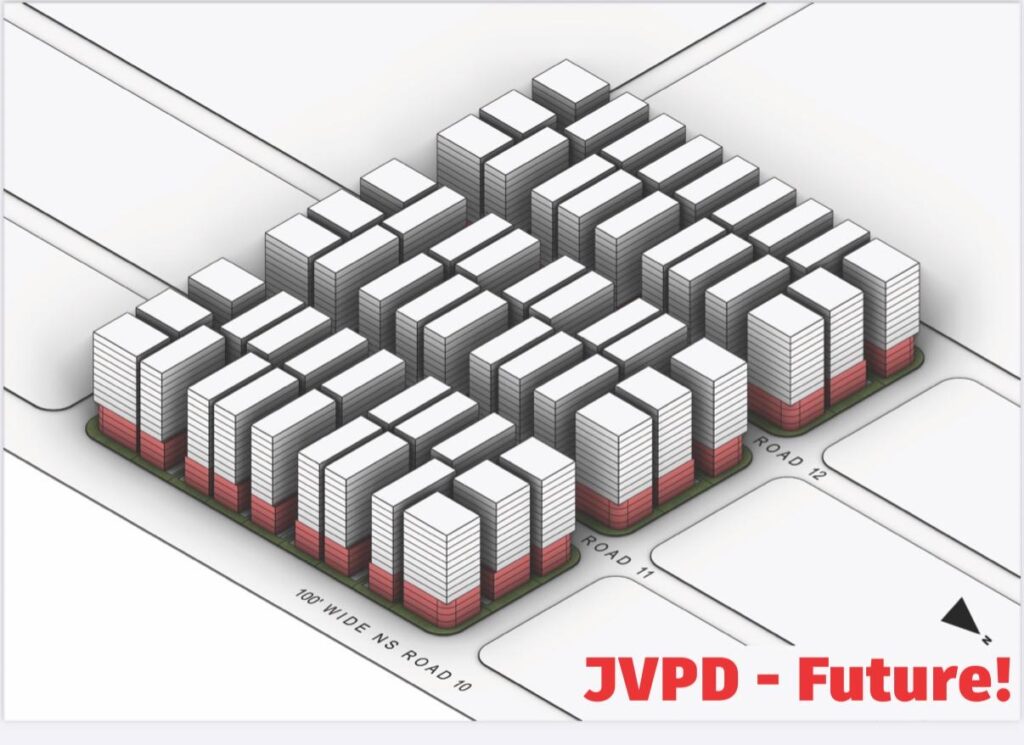
A recent study conducted in the upmarket JVPD area clearly shows how an absurd volume of concretization is detrimental not only to the urban skyline but also eventually leads to a terrible quality of life. This study of sixty small plots reveals that open spaces, designed as per the Town Planning (TP) scheme in the late sixties, constituted 6.00 acres out of a total of 9.76 acres of developable land, with an average building height of two to four stories. Now, with DCR 33(11), this open space is reduced to less than half—2.9 acres—whereas the building heights are touching 12 to 15 floors! Hence, the government has virtually snatched the right to natural light and air of not only the plot seeking development but also the neighboring plots. Such a drastic reduction of open space has already impacted the green cover. Similarly, roads originally planned for approximately 120 residents’ cars would now have to accommodate a whopping 1200 cars for the same width and length of roads, in addition to the ever-increasing through traffic. The two visual diagrams say it all: JVPD – Today & JVPD – Future!
Generally, building regulations are amended from time to time primarily to improve the quality of life and resolve new challenges for the future. But in our city, all along it’s only been about more construction, more density, more floating population, more car parks, more misuses, more greed, more social disharmony, and more corruption. The additional construction not only increases habitable areas as per the enhanced FSI but also allows another 70 to 80 percent of “free FSI” construction such as free stilts and entrance halls, free stairs and lift lobbies, free podiums, free basements, free gyms, free society offices, and so on.
The permissions under DCR 33-11 are issued by MHADA, so corruption is taken for granted. This is evident when hundreds of crores in corruption have made routine headlines in the media. While the credibility of many private developers is questionable, even the listed corporate companies have indulged in money-spinning redevelopment projects as another vertical to reflect in their balance sheets.
In this entire complex process, how the PAPs benefit becomes non-significant. I really wonder when our city’s influencers in government and privileged citizens will realize that it’s bad money when it is earned dubiously in the name of the poor!
Note: Killawala is an acclaimed and renowned architect based out of Mumbai. Views expressed in the article solely belong to the author.