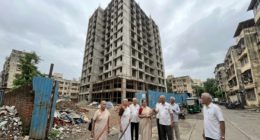

The Brihanmumbai Municipal Corporation (BMC) has issued fresh procedural guidelines to operationalise an Occupancy Certificate (OC) Amnesty Scheme for buildings occupied before 17 November 2016 but still without OC. The circular, dated 08 September 2026, carries reference ChE/DP/15310/GEN and is issued under approvals from the Standing Committee (SCR no. 649, 08.07.2026) and the Corporation (CR no. 455, 18.08.2026), following directives from Maharashtra’s Urban Development Department (UDD) dated 11 December 2025.
The scheme aims to clear a long-standing backlog of OCs by allowing eligible societies and individual flat owners to regularise violations, pay prescribed charges (with concessions), and obtain OC without being held up by several common compliance bottlenecks.
Who issued the circular and when does it apply?
- Issuing authority: Brihanmumbai Municipal Corporation (BMC), Building Proposal Department.
- Circular number & date: No. ChE/DP/15310/GEN, dated 08 September 2026.
- Legal/policy basis: UDD directives (11.12.2025); Standing Committee sanction (08.07.2026); Corporation sanction (18.08.2026).
- Effective from: The policy states that time limits for submission are calculated from the date of issuance of this policy circular (i.e., 08 Sep 2026).
Who is eligible?
The amnesty applies to residential, hospital and school buildings that satisfy all of the following:
- Occupied before 17/11/2016.
- Have valid IOD (Intimation of Disapproval), approved plan(s) and Commencement Certificate (CC) as per prevailing BMC rules.
- Have not received OC to date.
- Unit carpet area ≤ 80 sq.m (RERA carpet as per DCPR 2034 definition) at the time of regularization; post-regularization carpet may exceed 80 sq.m.
- For residential buildings, residential use must be >50%; commercial shops/offices in such buildings can be included but get no financial concession.
Proof of pre-2016 occupation must be submitted: property assessment record from Assessment & Collection Dept, authorized electricity bill, municipal notice regarding occupation without OC, or architect’s BCC.
What the scheme allows (key entitlements)
- OC to societies and individual flat/tenement owners, including partial OC for a specific flat without insisting that the applicant clear unrelated common-area violations.
- Use of proportionate additional FSI / fungible compensatory area / TDR to regularise, with a cap that total FSI on the plot must not exceed permissible limits.
- No additional parking will be insisted since occupant load does not increase under this method.
- Rehab components in redevelopment schemes can get OC independently, delinked from violations in sale components (subject to MC approval).
- For layouts with multiple buildings, if only some buildings apply, additional FSI for regularization can be permitted on a pro-rata basis without NOC from other societies.
Step-by-step: How to apply under the OC Amnesty Scheme
- Appoint professionals: Engage an Architect / Licensed Surveyor (and other required professionals). If the earlier Professional on Record is uncooperative, a new Architect/LS can certify executed work and submit amended/OC plans and BCC.
- Prepare documents: Fill the prescribed application form and attach all necessary documents, including proof of pre-2016 occupation, IOD/CC/approved plans, and mandatory NOCs.
- File online via Auto-DCR: Submit the proposal through BMC’s Auto-DCR portal; a dedicated tab “OC Amnesty Scheme” will list all proposals.
- Public notice & objections: The proposal is published on Auto-DCR for 15 days for objections/complaints/representations or prohibitory orders. After 15 days, the Building Proposal (BP) department scrutinizes the file.
- Deficiency letter: If documents are incomplete, BMC issues a compliance letter; the applicant must resubmit within 15 days. Failure leads to the application being deemed recorded and losing concession benefits; a fresh application resets the concession timeline.
- Payments: Pay applicable revalidation fees, penalties, balcony/otla/loft fees, and premiums as per policy rates (concessions apply where eligible).
- OC grant: Upon satisfaction of conditions and statutory NOCs, the Zonal Dy. Ch. Eng. (Building Proposal) grants OC.
Charges, penalties and concessions (money matters)
The circular spells out specific concessions to encourage early applications:
- 50% discount on regular charges for revalidation fees, balcony/otla/loft fees, penalties, etc., for regularizing violations in tenements.
- Converting elevation/FSI-free features to habitable use:
- 0% penalty if proposal is received within first 6 months from SOP issuance date.
- 50% discount on penalty for proposals between 6–12 months.
- No discount after 12 months.
- 50% concession in premium for Additional FSI & Fungible Compensatory FSI (at RR rate prevailing at submission) applies only where regularization involves no additional horizontal/vertical construction beyond approved building line and for units with RERA carpet ≤ 80 sq.m in the approved plan/sale deed. Units above 80 sq.m get no concession on premium or penalty under this scheme.
Important relaxations and “do not get stuck” clauses
The guidelines list 22 operational points to prevent OCs from being held up unnecessarily. Key highlights:
- BCC not submitted: New Architect/LS can certify as-built status and submit amended/OC plans with BCC.
- PR Cards (area in words) missing: OC can be granted without insisting area in words; Zonal BP offices will forward such cases to UDD/Collector.
- Incomplete layout infrastructure (roads, SWD, street lights, water mains, sewer, RG): OC granted “as is where is” with society’s undertaking/indemnity to complete later; ward offices to proactively take over reservations.
- Setback/DP Road handing over: OC can proceed without insisting transfer; however, further additional FSI use on that plot is blocked until compliance. For individual apartment OCs, no insistence on handing over.
- ULC/MHADA reserved flats not handed over: OC can be granted to other flats; lists to be sent to authorities for action against developers.
- Statutory safety NOCs still required: CFO completion certificate, Lift Inspector certificate, Drainage Completion Certificate (DCC) from Licensed Plumber (or new LP if earlier LP uncooperative), Rain Water Harvesting completion certificate.
- AAI (Civil Aviation) height NOC: OC may not be granted unless fresh AAI NOC is submitted; if height isn’t permissible per CCZM, cases go to a joint meeting (AAI–State–BMC).
- Unauthorized additions/alterations: Regularize if permissible; if not, AC (Ward) to take action and OC refused for that part.
- Structures proposed for demolition not demolished: If additional FSI/premium/TDR was utilized, OC only after demolition; if not utilized, OC can be granted with a condition that future additional FSI use will be allowed only after demolition.
- Tax clearance (A.A. & C.) held up: If no response within 7 days after informing Assessor & Collector, OC can be granted; recovery/action remains with Assessment Dept.
- Cases pending with ACB or courts: Generally, no OC without order of competent authority/court (with limited exceptions for certain occupation proceedings under MMC/MRTP).
Who can apply: society vs individual flat owner
- Both Housing Societies and individual flat/tenement owners can apply.
- For individual applicants, the scheme explicitly states that removal of encroachments on RG or non-buildable reservations will not be insisted, and partial OC can be issued without forcing the applicant to clear common-area violations unrelated to their premises.
- NOC from owner/developer is required; if unavailable, BMC can issue notice under MMC Act, and Auto-DCR website notice is deemed service. However, implementation of this NOC waiver for societies/individuals awaits temporary amendments to MMC Act/MRTP Act as proposed to UDD; BMC will intimate on its portal once sanctioned.
Important caveats
- The scheme cannot be used to authorize new unauthorized constructions; non-regularizable violations will face action and OC can be restricted to compliant portions.
- All decisions under the scheme do not absolve owners/developers of liabilities; BMC/State/regulators may still take action under applicable laws.
- Zonal offices must maintain a separate register of penalties/fees/charges waived per case.
Why this matters for Mumbai’s housing market
Thousands of older buildings in Mumbai have been occupied for years without OC due to procedural gaps, legacy violations, or developer-related issues. This amnesty provides a structured, time-bound route to secure OC—critical for bank loans, resale, insurance, and legal clarity—while offering meaningful fee/penalty relief for early movers.
Also Read: Exclusive: BMC OC Amnesty Scheme; Draft to be Presented in Standing Committee Tomorrow