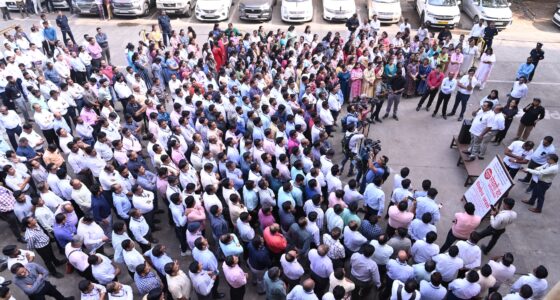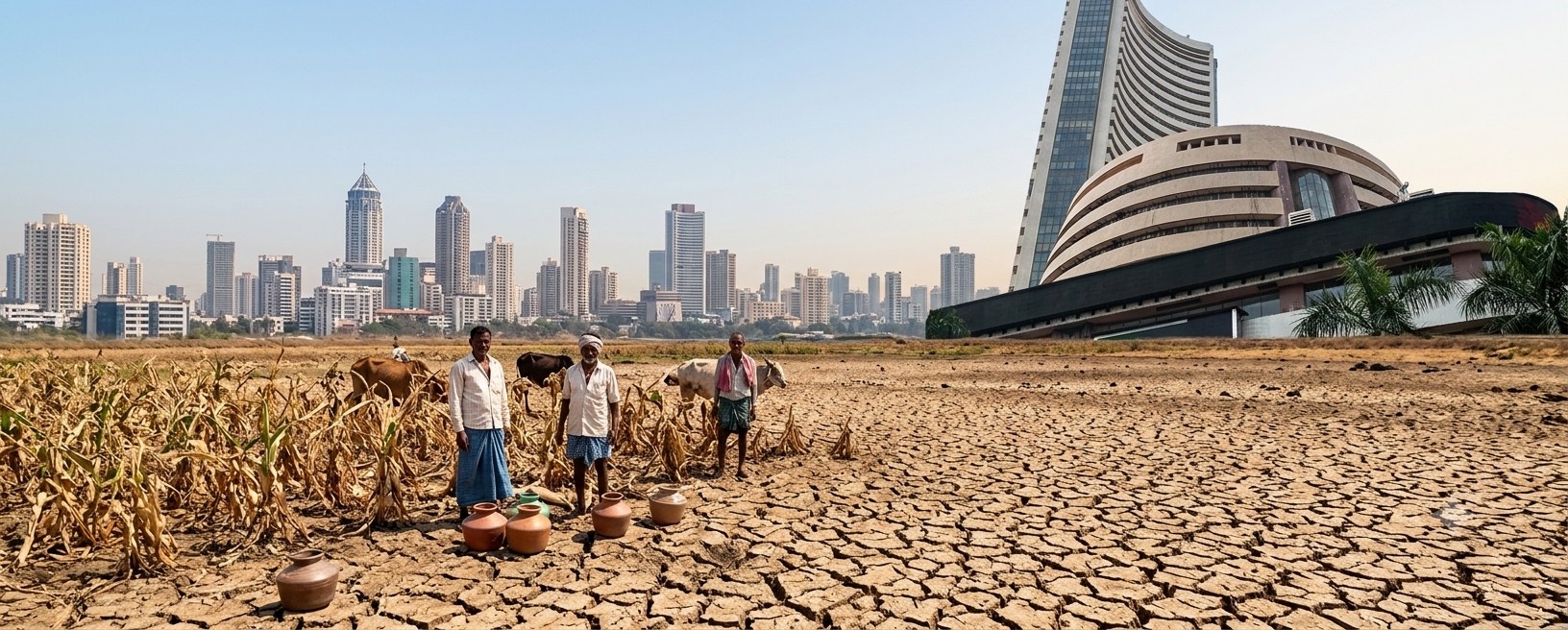

Tuesday September 29 opens the last trading day of the month — and of Q2 FY27 — with the Indian market at its lowest level since April 2026. The Sensex lost 1,124 points or 1.52% on Monday to close at 72,772. The Nifty crashed 360 points or 1.56% to 22,780 — a level not seen since spring. Every single Sensex sector declined. HDFC Bank fell 1.8%. Reliance Industries dropped 1.4%. NSE shares fell 1.5% on only their second day of trading. And then arrived the domestic development that no one had on their September calendar — the Maharashtra government declared drought across large parts of the state. For India’s real estate sector, which earns more revenue from Maharashtra than from any other single state, a drought declaration in the market’s most important geography adds a layer of demand-side anxiety to a week that was already defined by macro pressure from all directions.
The Peg: Maharashtra Declares Drought. The Quarter Ends Tomorrow. Navratri Begins in Three Days.
The Maharashtra drought declaration is Tuesday’s most specifically domestic and most directly realty-relevant development. Maharashtra is not just any state for the listed real estate sector. It is the sector’s most important single geography — Lodha Developers’ entire Mumbai and Thane business is Maharashtra, Oberoi Realty is entirely Mumbai, Prestige Estates has been building its Maharashtra presence aggressively, and Godrej Properties counts Mumbai and Pune among its highest-revenue markets. When the Maharashtra government declares drought — signalling that the monsoon shortfall has been severe enough to trigger the formal administrative mechanism for agricultural relief — it introduces three specific concerns for the residential real estate market in the state.
The first is direct. Drought reduces rural purchasing power in the districts surrounding Maharashtra’s major cities — Nashik, Aurangabad, Pune’s periphery, Thane’s hinterland. Homebuyers from these areas who aspire to apartments in Mumbai Metropolitan Region and Pune’s expanding suburbs may defer their purchases when agricultural income is disrupted. The second is indirect. Drought pushes food prices higher in Maharashtra — adding to a CPI that was already at 4.82% nationally, and that could push the state’s own inflation above the national average in October and November. The third is psychological. A drought declaration in the festive season’s opening week — with Navratri beginning October 2 — introduces the most inauspicious possible backdrop for a homebuying window that depends on positive sentiment as much as on financial readiness.
Against all of this, the broader macro environment on Tuesday morning is its own story of pressure. The US 10-year bond yield surged 11 basis points to 5.27% on Monday — its highest level in 19 years. That single bond market move is the most alarming external development of the week for rate-sensitive sectors. A US 10-year yield at 5.27% means that global capital has a risk-free return option at a level not seen since 2007. Every basis point above 5% on the US 10-year pulls capital out of emerging market equities and into US treasuries — a mechanical outflow that Indian equities, and specifically rate-sensitive sectors like real estate, cannot insulate themselves from.
How Realty Stocks Are Opening
GIFT Nifty at 22,834 — down 9 points — signals a muted open that is almost flat relative to Monday’s devastating close at 22,780. That muted signal, on a day following a 360-point Nifty crash, is the closest thing to a positive morning the market can offer in the current environment. The market is not collapsing further — it is pausing at the edge of the April low and assessing whether this is a floor or a stepping stone lower.
The Nifty Realty index opens Tuesday at approximately 790-805 — its lowest level since the pre-June recovery period. The sector has now given back the entire recovery from April’s low of 638.65 to July 13’s CY26 high of 1,009.30. The round trip has taken seven months and has been driven not by any fundamental deterioration in the sector’s demand story but by the macro environment’s sustained assault — crude above $100, a Fed rate hike, bond yields at 19-year highs, a Maharashtra drought, and a market that has lost seven consecutive weeks.
DLF, the index’s largest constituent at a 26.86% weight, opens Tuesday at its CY26 low territory — approximately ₹600-620. The stock’s discount to analyst targets of ₹775 has never been wider in the current cycle. At ₹600-620, DLF is trading at a level that implies either the analyst targets are wrong or the market is providing an extraordinary accumulation opportunity to investors who believe the macro environment will reverse. The former is possible but the latter is the institutional consensus — every major broking house that covers DLF maintains a buy rating with targets significantly above current levels.
Godrej Properties opens Tuesday at approximately ₹1,700-1,750 — more than 28% below its CY26 high. The company’s ₹27,000 crore FY27 presales target and ₹2 lakh crore GDV pipeline have not changed. Its Maharashtra portfolio is the one most directly exposed to Monday’s drought declaration — but its geographic diversification across NCR, Bengaluru, and Pune provides a degree of insulation from a Maharashtra-specific demand disruption. Lodha Developers, whose business is almost entirely Mumbai and Thane, opens Tuesday as the constituent most directly affected by the Maharashtra drought declaration. The company’s record Q1 FY27 presales of ₹5,620 crore remain the sector’s most powerful fundamental anchor — but the drought’s shadow over Maharashtra’s festive season demand is a company-specific concern that buyers will factor into their positioning.
Prestige Estates Projects, whose Bengaluru, Hyderabad, and Mumbai pipeline gives it both Maharashtra exposure and South India insulation, opens Tuesday with cautious buyers. Sobha’s Bengaluru focus insulates it most directly from the Maharashtra drought. Phoenix Mills’ retail and commercial portfolio in Mumbai and across India opens cautiously. Brigade Enterprises, Anant Raj, Aditya Birla Real Estate, and Oberoi Realty all open Tuesday with a negative bias — the sector at its worst opening level of CY26 since April.
What Is Working
GIFT Nifty’s muted 9-point decline — almost flat after Monday’s 360-point Nifty crash — is Tuesday’s most constructive signal. A market that opens flat after one of its worst single sessions of the year is a market that has found, at least temporarily, a level where sellers have exhausted their immediate inventory and buyers are willing to hold. That stabilisation — even without a recovery — is the necessary precondition for any Tuesday bounce.
India’s industrial production data for August is due today — a scheduled domestic data release that could provide the market with a positive surprise. August IP is expected to ease to 6% from 6.7% in July, but any print above that expectation — particularly in manufacturing and construction-adjacent sectors — would provide a domestic growth confirmation that partially offsets the Maharashtra drought’s demand anxiety.
DII buying through every major crisis session of CY26 — including the ₹4,301 crore deployed on Thursday September 24’s worst-since-March-9 crash — remains the structural floor mechanism that has prevented every selldown from becoming a capitulation. With the Nifty at its April 2026 lows, the distance between current prices and institutional fair value assessments is at its maximum since the June recovery began. That distance is the most powerful single argument for DII accumulation — and with the quarter ending today, institutional investors who believe in the festive season demand catalyst have a specific and time-limited opportunity to build positions before Q3 FY27’s booking data begins arriving.
The festive season is three days away. Navratri begins October 2 regardless of what bond yields or crude oil do between now and then. The homebuyer who has been saving for a home through September’s market turbulence has not cancelled their purchase plans because the Sensex lost 1,124 points on Monday. The developer who has prepared a Navratri launch has not cancelled the launch because the US 10-year yield crossed 5.27%. The cultural and financial demand cycle of India’s festive season operates on a different clock than the equity market — and it opens in three days.
Runwal Enterprises on its final IPO subscription day is a sector-specific domestic positive embedded in Tuesday’s primary market calendar. Runwal is a Mumbai-based real estate developer — and its IPO entering its final subscription day confirms that despite the equity market’s losses, the primary market appetite for real estate developer listings remains active. Investor interest in Runwal’s IPO subscription on a day when the Nifty is at April lows is the most direct evidence available that long-term demand for India’s real estate sector, as an investment category, has not been extinguished by September’s macro turbulence.
What Isn’t Working
The Maharashtra drought declaration is Tuesday’s most directly damaging domestic development for the sector. Maharashtra accounts for a disproportionate share of India’s listed developer revenue — and a drought in the state in the week before the festive homebuying season introduces demand disruption anxiety at precisely the worst possible moment. The specific impact — reduced rural purchasing power in Maharashtra’s districts, higher food inflation in the state, and negative festive season sentiment — will play out through October’s actual booking data. But the anticipation of that impact is enough to add a Maharashtra-specific selling premium to DLF, Lodha, Oberoi Realty, and Godrej Properties’ Maharashtra-exposed portfolios at Tuesday’s open.
US 10-year bond yields at 5.27% — a 19-year high — is the external variable that carries the most systemic consequence for rate-sensitive sectors globally. At 5.27%, US treasuries are attracting capital from every risk asset category — including emerging market equities. The mechanical FII outflow this level of US yields triggers is the structural selling force that has driven India’s seven consecutive weekly losses and pushed the Nifty to April lows. Until US bond yields peak and begin declining — which requires either a Fed pause or evidence of genuine economic slowdown — the FII selling pressure on Indian rate-sensitive sectors will not structurally reverse.
The bank strike on its second day — running through September 30 — continues to create home loan processing friction in the final days before Navratri. A homebuyer who wanted to get their loan sanctioned, their documentation processed, and their disbursement arranged before October 2 is facing administrative delays that push the transaction timeline into the post-Navratri period. Those delays reduce the immediate booking momentum the festive window would normally generate in its opening days.
The quarter ending today — Q2 FY27 — will bring Q2 presales disclosures from listed developers through October. While those disclosures are expected to show continued demand strength, the macro environment during Q2 FY27 — crude above $100 for significant periods, Fed rate hike, bond yields at highs — will have created some Q2 cost pressure that developers will need to navigate in their guidance language. Any disappointment in Q2 presales relative to elevated Q1 FY27 benchmarks — Lodha’s ₹5,620 crore, Godrej’s ₹4,500+ crore, DLF’s ₹5,600 crore — would add a company-specific negative to the macro headwinds.
What to Watch Through the Day
India’s August industrial production data — due today — is the morning’s most important scheduled domestic release. A print at or above 6% would confirm that India’s manufacturing and construction sectors are sustaining growth despite the external macro headwinds. A miss below 5.5% would add a domestic growth concern to the Maharashtra drought and bond yield pressures already weighing on the market.
The Nifty50’s hold of 22,700 — the April 2026 low — is Tuesday’s most critical technical checkpoint. If the index touches and holds that level, DII buyers are expected to step in with the same conviction they have demonstrated through every prior crisis bottom of CY26. A close below 22,700 would take the Nifty below levels it has not seen since early Q4 FY26 and would signal that the current correction cycle is deeper than the India-fundamental story justifies — an overreaction that historically reverses sharply when a positive catalyst arrives.
The Maharashtra drought’s immediate policy response — which typically includes agricultural relief packages, loan waiver discussions, and state government fiscal measures — will be tracked through Tuesday’s session. Any Maharashtra government announcement of specific agricultural support measures — however preliminary — would ease the festive season demand anxiety the drought declaration has created and partially restore the homebuying sentiment that Navratri’s opening depends on.
The Runwal Enterprises IPO closing today is the real estate primary market confidence indicator to watch. Strong subscription on the final day of a Mumbai developer’s IPO — on a day when the broader market is at April lows — would confirm that long-term real estate investment appetite in India remains intact regardless of equity market sentiment.
Tuesday September 29 is the last trading session of the month and the quarter. It is the morning that asks the sector the hardest question of CY26: can you hold your ground at April lows, with a Maharashtra drought declared, US bond yields at 19-year highs, crude at $107, and Navratri three days away? The sector’s answer — built on record Q1 FY27 presales, MoHUA RERA protection, DII institutional conviction, and 7.8% GDP growth — is that it can. Whether the market agrees with that answer by 3:30 PM will determine whether September ends as the month that found the floor or the month that simply passed through it on the way lower.
Also Read: Realty Stocks Open Weak as Dalal Street Turns Cautious; Heavyweights Drag Realty Index Lower