A developer who abandoned a Chembur redevelopment project has been directed by the Bombay High Court to pay ₹7.35 crore in outstanding transit rent to the 22-member Maruthi Co-operative Housing Society. In an ex-parte order dated 16 October 2026 under Section 9 of the Arbitration and Conciliation Act, Justice Arun R. Pedneker also cleared the way for the society to appoint a new developer and restart the long-stalled project.
The society’s 1967 building “Shobha” is located on roughly 1,131 square metres at Pestom Sagar Road No. 1, Chembur. It signed a Development Agreement with Tridhaatu Maruthi Developers LLP and Tridhaatu Realty and Infra Pvt. Ltd. on 10 July 2013. All members vacated in May–June 2014 and handed over the site. The agreement required completion within 24 months plus a six-month grace period, i.e., by around January 2017–18.
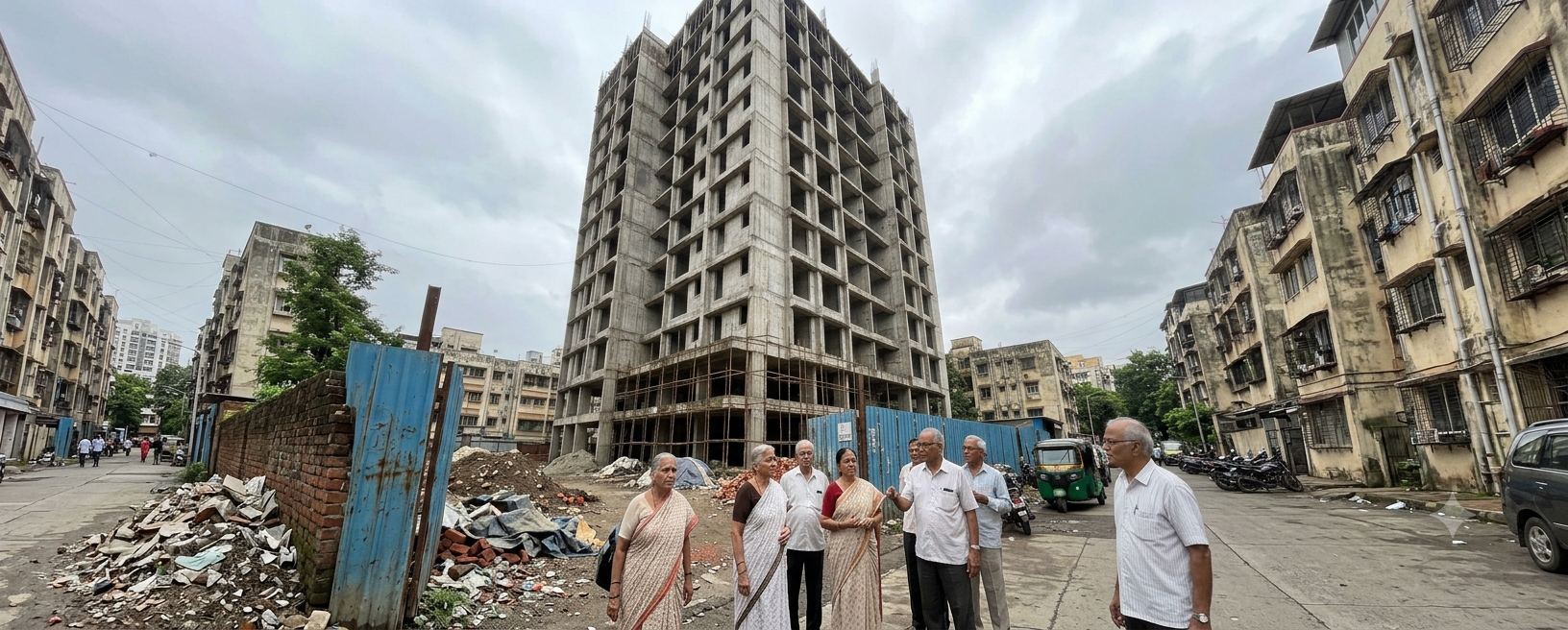
The developer raised an external bare structure up to the 10th floor (beyond the sanctioned 8th floor) and then stopped work. Transit rent payments became intermittent and eventually ceased. By the society’s termination of the agreement on 7 April 2026, arrears of transit rent had reached ₹7,35,07,670. Statutory dues of approximately ₹1.11 crore were also unpaid. Most members are senior or super-senior citizens who have been arranging and paying for their own alternate accommodation for years.
After repeated communications and a show-cause notice, the society terminated the Development Agreement and Power of Attorney and published a public notice. The developers, though served, did not appear in the petition. The court appointed an amicus curiae to assist.
The court found a strong prima facie case in the society’s favour. A developer who leaves a project incomplete for eight years after the contractual deadline, fails to pay transit rent, and abandons the site cannot continue to restrain the society from redeveloping its own land. The court noted that third-party flat-purchase agreements entered into by the developer do not bind the society, as there is no privity of contract between the society and those buyers. Their rights rise and fall with the developer. RERA registration of the project does not change this legal position. The developer’s remedy, if any, lies in pursuing monetary claims through arbitration rather than freezing the project.
In addition to the direction to pay the ₹7.35 crore transit-rent arrears, the interim order grants the society several other protections pending arbitration. These include a direction to clear the outstanding statutory dues, injunctions restraining the old developers and anyone claiming through them from interfering with the site or with a new developer appointed by the society, directions to return original documents, plans, permissions and keys, permission for the society to redevelop itself or through a new agency, appointment of a Court Receiver to assist with access and related steps, and restraints on creating further third-party rights.
The society must issue a Section 21 notice invoking arbitration within 30 days. If the developer does not agree to an arbitrator, the society must approach the court under Section 11 within a further 60 days. Missing these timelines will automatically vacate the interim order. All rights and contentions of both sides remain open for the arbitration.
Lesson for other societies
When a redevelopment project stalls and transit rent stops, societies should maintain clear records of defaults, follow the termination procedure in the agreement, and act without indefinite delay. Members—especially senior citizens—should not be left paying rent from their own pockets while the developer retains control of the land. A properly prepared Section 9 petition can secure both recovery of outstanding transit rent and freedom to appoint a new developer. Third-party agreements created by a defaulting developer do not give it a permanent veto over the society’s property.
The order underscores that prolonged abandonment combined with unpaid transit rent can result in the society regaining practical control of its land and moving forward with fresh redevelopment.
Also Read: Bombay HC Orders Demolition of 14-Storey Illegal Building