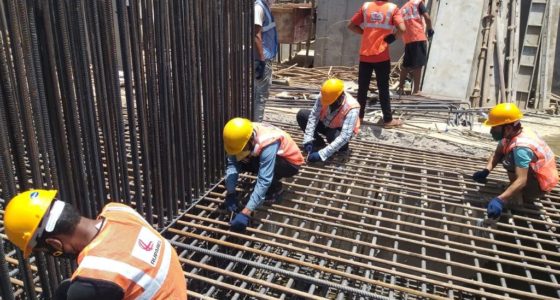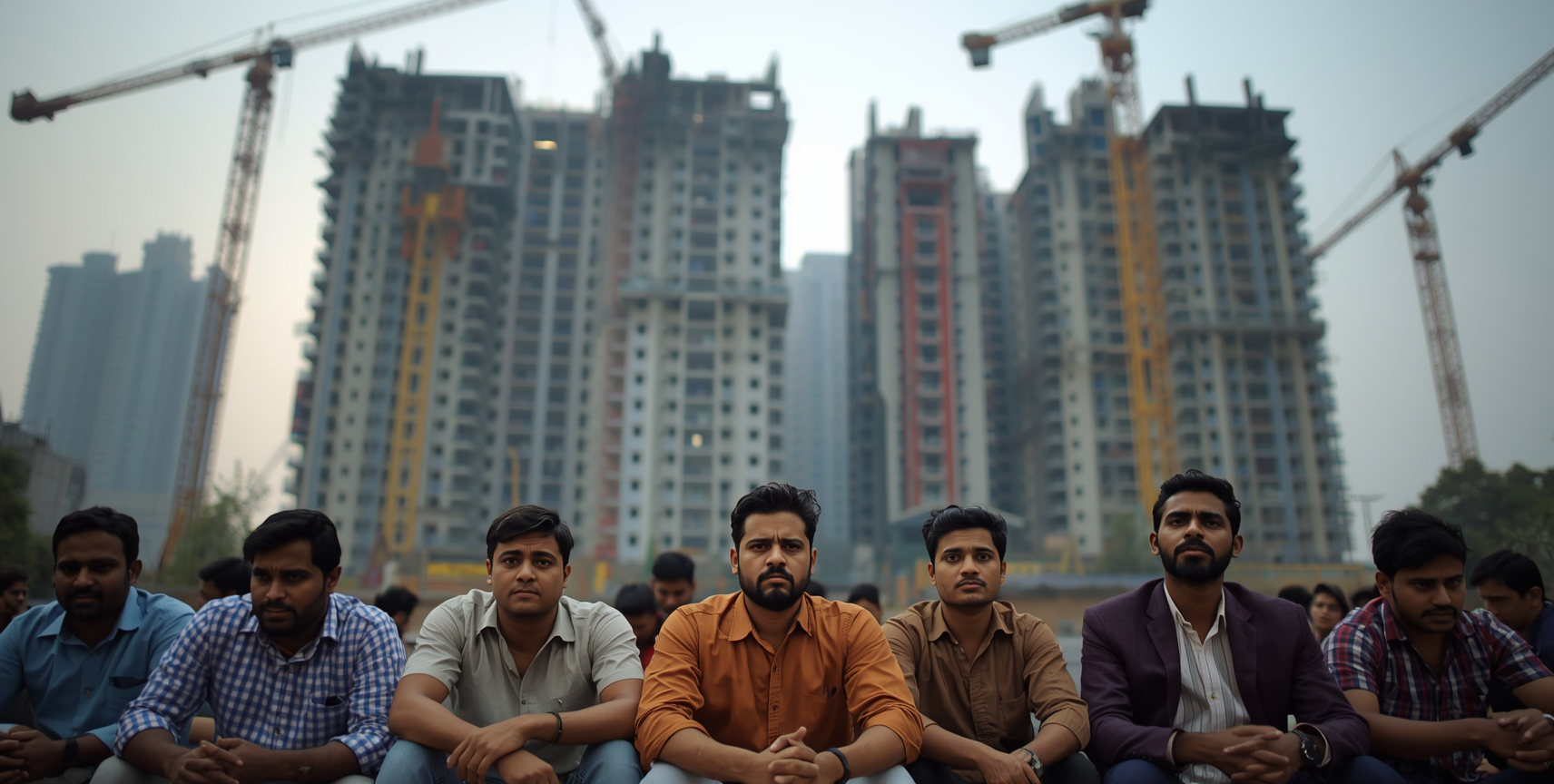

Eight families in Mumbai paid crores of rupees for flats in a redevelopment project in Borivali. The builder took their money, built up to the fourth floor slab, and stopped. The housing society that owned the land terminated the builder, appointed a new developer, and moved on. The new developer demolished even the four floors that had come up, got fresh permissions, and registered a brand new project.
The eight families? They were told to go chase the failed builder.
That, in essence, is what the Maharashtra Real Estate Appellate Tribunal (MREAT) ruled in a judgment pronounced on April 22, 2026 — in eight consolidated appeals filed by flat buyers against the SBI Employees Prashant Co-operative Housing Society, its erstwhile developer M/s Aditya Developers, and its new developer M/s URNA Evolved Living Private Limited. The bench of Shri S.S. Shinde J. (Chairperson) and Shri Shrikant M. Deshpande (Member-A)) dismissed all eight appeals, holding that neither the housing society nor the new developer is answerable to the flat buyers for the failures of the erstwhile developer.
The judgment does not make new law. What it does is apply — firmly, clearly, and without exception — a line of Bombay High Court rulings that have settled this question so definitively that the High Court itself has declared it “no longer res integra” — meaning it is beyond argument.
The Project, the Promise, and the Collapse
The SBI Employees Prashant Co-operative Housing Society is the owner of a plot of land bearing CTS No. 444/B at village Kanheri in Mumbai’s suburban district, in Borivali. The society has 26 members who lived in an old building on this plot. Like thousands of housing societies across Mumbai, they decided to redevelop — demolish the old building, build a new one for the members, and allow the developer to construct and sell additional flats to outside buyers to fund the project.
In September 2013, the society signed a Development Agreement with M/s Aditya Developers, a Borivali-based developer. The arrangement was standard for Mumbai redevelopments — the society would get a new, larger building for its members (the rehabilitation component), and Aditya would build and sell flats from the free-sale component on its own account, keeping the proceeds as its profit. Aditya was also granted a power of attorney by the society to execute these sale transactions.
Armed with the development agreement, Aditya obtained the necessary permissions — IOD in January 2015 and commencement certificate in May 2016, extended to the 10th floor in October 2017. The project was registered with MahaRERA in August 2017 under registration number P51800009323, with a promised completion date of May 2020 — later extended to May 2022.
Aditya then sold flats from the sale component to 12 outside buyers, including the eight appellants in this case. These buyers executed registered agreements for sale and paid substantial amounts to Aditya.
Construction progressed up to the fourth floor slab — and then stopped.
The Builder Defies Court Orders
In 2018, the society had had enough. Alleging prolonged delay and non-performance, it filed Arbitration Petition No. 711 of 2018 before the Bombay High Court against Aditya. During those proceedings, the High Court directed Aditya to do two things — not create any further third-party rights in the project, and deposit the money received from the flat buyers into a separate account.
Aditya violated both directions.
The society issued a termination notice to Aditya in April 2019 and filed a fresh Arbitration Petition No. 1470 of 2019. In December 2019, the Bombay High Court confirmed the termination of Aditya’s development agreement and permitted the society to complete the project — either by appointing a contractor or by bringing in a new developer.
It took the society over two years to act on that permission. In February 2022, it issued a public notice inviting a new developer. The notice disclosed the list of 12 existing flat buyers. In June 2022, the society’s General Body Meeting approved the appointment of URNA Evolved Living Private Limited (then called Living Habitats Pvt. Ltd.) as the new developer. A fresh development agreement was executed with URNA in August 2022.
What happened next was a blow to the flat buyers — URNA demolished the construction that Aditya had carried out up to the fourth slab, describing it as a dilapidated and faulty structure. URNA then obtained revised permissions from the MCGM, registered the project afresh with MahaRERA in June 2023 under a completely new registration number P51800051383, and started the project from scratch.
The original flat buyers — who had paid crores to Aditya for flats in the original project — found themselves completely outside the new project.
The Flat Buyers Fight Back
The eight families filed complaints before MahaRERA. They were not asking for anything unreasonable — they wanted possession of the flats they had paid for, interest for the years of delay, and legal protection of the rights they had acquired through their registered agreements for sale.
They made three specific legal arguments:
The first was that the housing society qualifies as a “promoter” under RERA. They argued that the society’s members received 52% additional area in their rehabilitation flats as a benefit flowing from the project — which, they said, amounted to an area-sharing arrangement that makes the society a co-promoter under RERA and therefore liable to discharge the developer’s obligations towards flat buyers.
The second was that the new developer URNA must honour their agreements. They pointed to Clause 12.4 of URNA’s development agreement with the society, which they argued contained an acceptance by URNA to discharge liabilities on behalf of the society. They also argued that URNA entered the project with full knowledge of the existing flat buyers and therefore cannot claim ignorance of their rights.
The third was that the new project registration obtained by URNA violated Section 15 of RERA. Section 15 requires that when a promoter seeks to transfer a project to another promoter, the prior written consent of at least two-thirds of the allottees must be obtained. The flat buyers argued that instead of getting a brand new registration, URNA should have applied for a change of promoter in the old registration — which would have automatically kept their rights intact.
What the Society, the New Developer, and the Old Developer Said
The society’s position was straightforward — it had no contract with the flat buyers, had never sold them anything, had never collected any money from them, and was not responsible for what Aditya did. Its members had been without permanent housing since 2014 — over eleven years — and the equity, it argued, lay with them, not with the flat buyers who dealt with a developer the society had lawfully terminated.
URNA’s argument was equally firm. It had come into the project pursuant to a Bombay High Court order — not as a voluntary successor to Aditya. It had no contract with the flat buyers, had made no representations to them, had received no money from them, and had issued no advertisements or assurances to them. Section 15 of RERA, URNA argued, applies to voluntary transfers between promoters — not to court-mandated appointments of a new developer after lawful termination of the old one. And since the old registration had already lapsed in May 2022, there was nothing to “transfer” — URNA needed and obtained a fresh registration legitimately.
Aditya, interestingly, partly sided with the flat buyers — arguing that URNA should have applied under the old registration and that after its termination, all liability towards flat buyers passed to the society and URNA. This argument served Aditya’s interest in deflecting its own liability.
MahaRERA Dismisses the Complaints
MahaRERA dismissed all the flat buyers’ complaints. It held that the society was not a promoter under RERA, that URNA’s fresh registration was valid, that Section 15 did not apply because the change of developer happened under court orders and not voluntarily, and that there was no privity of contract between the flat buyers and either the society or URNA. The flat buyers were given liberty to pursue their claims against Aditya in the pending arbitration proceedings.
The flat buyers appealed to the MREAT.
The Tribunal’s Ruling: A Wall of Precedent
The MREAT dismissed all eight appeals and affirmed MahaRERA’s order in full. In doing so, it walked through a line of Bombay High Court judgments that have, over the years, built an almost impenetrable legal wall around housing societies in failed redevelopment scenarios.
On whether the society is a promoter, the Tribunal relied on the landmark ruling in Vaidehi Akash Housing Pvt. Ltd. vs. New D.N. Nagar Co-operative Housing Society Union Ltd. (2014), which held that a housing society that gives development rights to a developer is not a “promoter” under the law. The developer builds and sells the free-sale component entirely on its own account, as an independent contractor. The society is merely the land owner. Getting additional area in the rehabilitation component — which is what the members received — is not the same as having a revenue-sharing or area-sharing arrangement from the sale component. Unless the society is registered as a co-promoter on MahaRERA and has a direct financial stake in the sale proceeds, it does not qualify as a promoter.
The Tribunal also noted that the society had not been shown as a promoter or co-promoter when Aditya registered the project with MahaRERA. The development agreement was executed on a principal-to-principal basis — there was no agency relationship between the society and Aditya.
On whether URNA must honour old agreements, the Tribunal’s answer was equally clear. The Bombay High Court in Goregaon Pearls CHSL vs. Dr. Seema Mahadev Paryekar had reiterated that third-party purchasers from a developer whose agreement has been lawfully terminated cannot claim performance of their agreements against the society or anyone claiming through the society — including a new developer. This position was reaffirmed by the Division Bench of the Bombay High Court in Deepak Prabhakar Thakoor vs. MHADA (2023) and again in Kapilkunj Co-operative Housing Society Ltd. vs. State of Maharashtra (2023), which went as far as to say: “Third party purchasers will have no rights over the assets of the Society… amounts paid to Ved cannot possibly be given credit to by the Society.”
The most recent reaffirmation came in Tuvin Constructions LLP vs. State of Maharashtra decided by the Bombay High Court in September 2025, which held that no third-party purchaser from a terminated developer can seek performance against the society or its new developer, and that the new developer can obtain fresh registration without carrying any liability of the allottees of the erstwhile promoter.
On Section 15 of RERA, the Tribunal held that the provision simply does not apply here. Section 15 governs voluntary transfers of a project between promoters and requires 2/3rd allottee consent for such transfers. What happened in this case was not a voluntary transfer — Aditya was thrown out by court order, its agreement was terminated, its old registration had lapsed, and URNA came in through a fresh development agreement with the society, obtained fresh permissions, and registered a new project. This is a new project, not a transfer of the old one.
The Only Remedy: Chase the Failed Builder
All eight appeals were dismissed. The flat buyers were left where MahaRERA had left them — with nothing but the right to pursue Aditya Developers in the pending arbitration proceedings before the Bombay High Court in Arbitration Petition No. 1470 of 2019.
In practice, this is a remedy that offers little comfort. Aditya Developers — a company that violated High Court orders, stopped construction midway, and presumably exhausted the money it collected from buyers — is unlikely to have assets sufficient to compensate all its creditors. The flat buyers may win in arbitration and still recover nothing.
Why This Order Matters Beyond These Eight Families
Mumbai has hundreds — possibly thousands — of redevelopment projects at various stages. Many involve developers who are delayed, struggling, or have failed entirely. In most of these projects, the flat buyers who have paid money to the developer are in the same legal position as these eight families — their contract is with the developer, not the society, and if the developer is terminated, they are legally stranded.
This judgment is a stark reminder of that vulnerability. It also raises a question that courts and legislators have not yet squarely addressed — should RERA be amended to give flat buyers in failed redevelopment projects a direct claim against the society or the incoming new developer?
The arguments for such protection are not trivial:
- The society knew the flat buyers existed — they were disclosed in court proceedings
- The buyers’ money funded the construction of the rehabilitation building from which the society’s members benefited
- The society chose to appoint a new developer without making any provision for the existing buyers
- The new developer entered the project with full knowledge of the buyers’ existence
And yet, as the law stands today, none of this is enough to create liability. The absence of a signed contract between the society and the buyers is an absolute bar — regardless of the equities.
Until either the legislature amends RERA or the Supreme Court takes a different view, flat buyers in failed redevelopment projects will remain among the most exposed and least protected consumers in India’s real estate market. This judgment, and the long line of High Court decisions it follows, makes that vulnerability impossible to ignore.