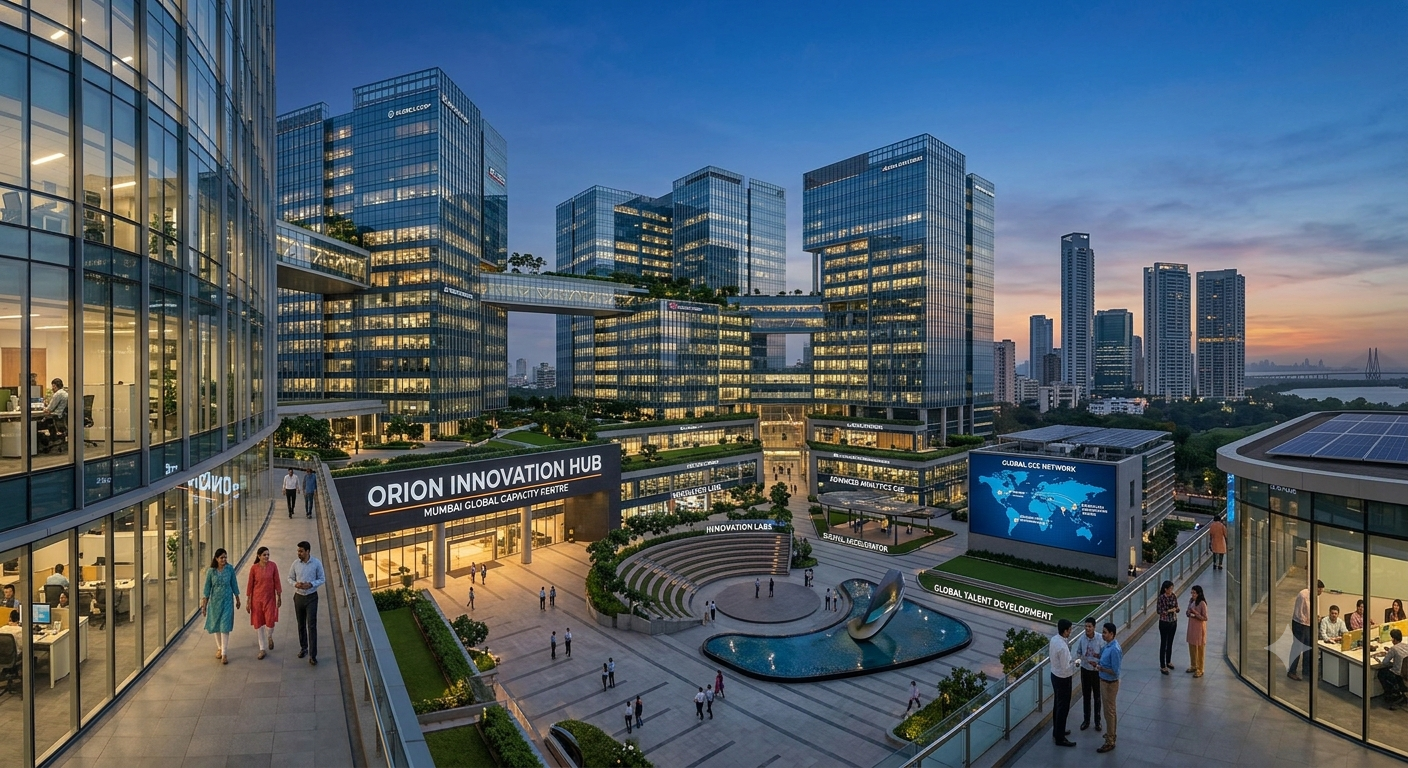

Global Capability Centres (GCCs) have emerged as the single largest driver of India’s Grade A office market in the first half of 2026, accounting for 45% of total gross leasing across the top seven cities, according to the latest research by ANAROCK.
Of the approximately 42.6 million sq ft of gross office space leased in H1 2026, GCCs absorbed about 19.2 million sq ft. This marks a clear rise from H1 2025, when GCCs accounted for 41% (nearly 15.78 million sq ft) of the then total of 38.24 million sq ft.
The southern markets continued to lead the GCC surge. In Bengaluru, GCCs took 70% of the city’s 10.8 million sq ft gross absorption (around 7.55 million sq ft). Their share stood at 55% in Chennai (approximately 1.75 million sq ft of 3.2 million sq ft) and 48% in Hyderabad (around 3.05 million sq ft of 6.4 million sq ft).
Anuj Puri, Chairman of ANAROCK Group, said: “This trend points to a structural shift in India’s office market. This is not a short-term demand spike — MNCs are increasingly expanding India-based GCCs to house core functions such as engineering, R&D, AI, finance, cybersecurity, and digital operations. They are drawn by India’s deep talent base, operating efficiency, and mature office ecosystem – factors that will continue to drive both GCC and regular CRE absorption in the years to come.”
Grade A net absorption across the top seven cities rose a modest 2% year-on-year to 27.44 million sq ft from 26.8 million sq ft in H1 2025. Bengaluru and Hyderabad together contributed 49% of total net leasing. Bengaluru recorded a strong 26% annual jump to 8.27 million sq ft, while Hyderabad rose 24% to 5.2 million sq ft.
MMR and NCR posted almost identical net absorption volumes of 4.3 million sq ft and 4.27 million sq ft respectively. However, both markets declined on an annual basis — MMR by 4% and NCR by 15%. Pune saw the sharpest drop at 33%.
Fresh supply remained restrained. New office completions fell 10% year-on-year to 22.15 million sq ft from 24.51 million sq ft in H1 2025. With demand outpacing new supply, overall vacancy across the top seven cities eased from 16.3% to 15%. Bengaluru’s vacancy dropped to 10.8% from 12.4%, while Hyderabad improved to 23.5% from 26.6%, though it still remains the highest among the major markets.
Average monthly office rentals across the top seven cities climbed 9% to Rs 96 per sq ft from Rs 88 per sq ft a year earlier. Bengaluru, NCR and Hyderabad each recorded 10% rental growth.
Beyond the traditional IT/ITeS sector, demand remained diversified. Flexible workspace operators came within one percentage point of the IT/ITeS share (25% versus 26%), while BFSI, manufacturing and industrial occupiers also expanded their footprints.
Puri noted that the moderation in new supply reflects a more calibrated market rather than weakness, with developers aligning fresh stock more closely with actual occupier demand.
Also Read: Embassy Group Unveils India’s First Integrated GCC Platform – ‘EMBARK’