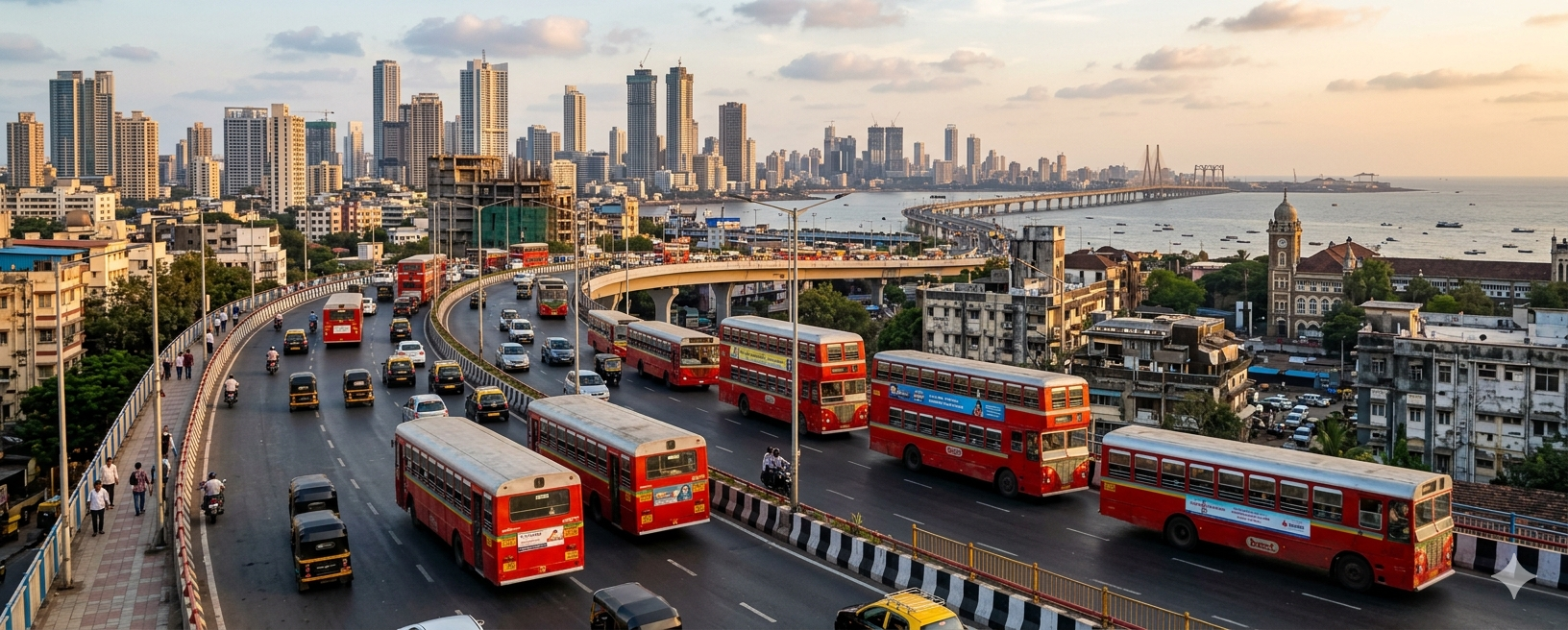

The Maharashtra government has issued a Government Resolution (GR) to establish a technical group and a study group to design and recommend an integrated bus transportation system for the Mumbai Metropolitan Region (MMR). The move is part of a broader strategy to transform the region into a high-growth economic hub under the Growth Hub (G-HUB) initiative.
The decision, issued by the Urban Development Department on June 15, 2026, aims to streamline bus services across multiple transport operators in the region, improve commuter experience, and enable seamless connectivity across municipal boundaries.
Background: Growth Hub Push for Mumbai Region
The initiative stems from policy directions aligned with NITI Aayog, which has identified the Mumbai Metropolitan Region as a pilot city-region for economic transformation under its G-HUB framework. The idea is to create a coordinated development roadmap that enhances infrastructure, mobility, and economic efficiency.
To support this, the state had already constituted a high-level coordination committee and a regulatory board under the Chief Minister. The integrated bus system now becomes a key component of this broader economic vision.
What the New GR Proposes
The government has now formed two separate bodies:
1. Technical Group (Task-Oriented)
This group will be led by officials from Brihanmumbai Electric Supply and Transport (BEST) and include representatives from multiple municipal transport bodies such as Navi Mumbai, Thane, Kalyan-Dombivli, Vasai-Virar, Mira-Bhayandar, and Panvel.
Key responsibilities include:
- Rationalising bus routes across all transport operators
- Aligning service schedules for better connectivity
- Creating a roadmap for technology integration (ticketing, tracking, etc.)
- Suggesting shared infrastructure usage across agencies
- Proposing fare structures for inter-city and inter-jurisdiction routes
- Designing revenue-sharing mechanisms
The technical group has been given a deadline of July 15, 2026 to submit its report.
2. Study Group (Policy & Implementation Focus)
This group will be chaired by the General Manager of BEST and include municipal commissioners from across the MMR, including Thane, Navi Mumbai, Kalyan-Dombivli, Vasai-Virar, Ulhasnagar, Bhiwandi, Mira-Bhayandar, and Panvel.
Its mandate includes:
- Finalising a uniform fare structure across the region
- Evaluating and improving commuter affordability
- Exploring telescopic fare systems (lower per km cost for longer distances)
- Designing a common ticketing system across operators
- Establishing revenue-sharing and reconciliation frameworks
- Reviewing and incorporating recommendations from the technical group
The study group is expected to submit its final proposal by July 31, 2026.
What This Means for Commuters
If implemented effectively, this integrated system could significantly transform public transport in the Mumbai region:
- Seamless Travel: Commuters may no longer need multiple tickets across cities
- Better Connectivity: Bus routes and timings could be aligned across operators
- Lower Costs: Telescopic fares could reduce long-distance travel expenses
- Unified Ticketing: Possibility of a single pass or digital ticket across buses
- Improved Efficiency: Reduced duplication of routes and better utilisation of fleets
A Step Towards Multi-Modal Integration
The plan also opens the door for future integration with metro and suburban rail systems operated by agencies like Mumbai Metropolitan Region Development Authority, potentially creating a unified urban mobility ecosystem.
Challenges Ahead
While the intent is clear, execution will be complex. Coordination between multiple municipal bodies, alignment of fare policies, and integration of technology platforms remain key hurdles. Additionally, revenue-sharing among transport operators could become a contentious issue.
However, if successfully implemented, this could be one of the most significant public transport reforms in the Mumbai Metropolitan Region in recent years.
Also Read: Homebuyers Alert: MahaRERA Invites Objections on De-Registration of 12 Real Estate Projects