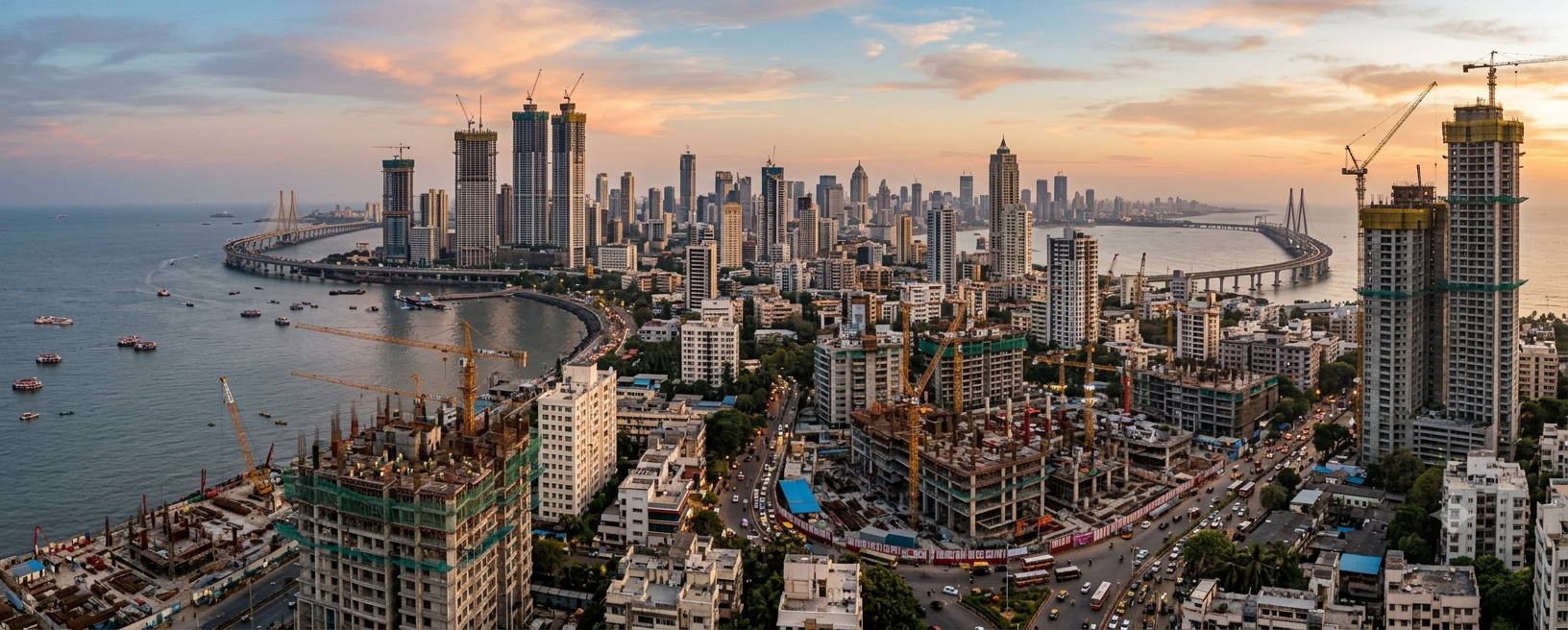

Mumbai’s redevelopment market is entering a new phase, with more than 1,000 redevelopment projects launched since 2020 and redevelopment projects accounting for 15% of the city’s residential sales in 2025-H1 2026, according to a joint report by JLL and NAREDCO Maharashtra.
The report, titled “Redevelopment in Mumbai: The Inflection Point, from Land Scarcity to Systematic Urban Renewal”, highlights a structural shift in Mumbai’s housing market as redevelopment increasingly becomes a mainstream source of residential supply rather than a niche segment.
Redevelopment projects launched since 2020 now account for around 13% of Mumbai’s overall residential supply. More significantly, their share of housing sales has risen sharply to 15% in 2025-H1 2026, compared with approximately 6% during 2016-2021.
The report suggests that sales are now consistently outpacing new launches in the redevelopment segment, indicating that homebuyers are increasingly accepting and actively choosing newly redeveloped homes in established Mumbai locations.
The shift is being driven primarily by Mumbai’s acute shortage of developable land and the growing need to replace ageing buildings.
13,500 cessed buildings create massive redevelopment opportunity
Mumbai has approximately 13,500 cessed buildings that require urgent replacement, with the Western Suburbs accounting for 22.4% of the ageing stock and South Mumbai contributing another 14.2%.
This creates a substantial redevelopment opportunity across established residential locations where land availability for conventional greenfield development is extremely limited.
Premium locations are already reflecting strong capital appreciation. Worli properties command approximately ₹1 lakh-₹1.15 lakh per sq. ft., with values rising 25-28% over three years. Bandra-Khar has reached around ₹90,000-₹95,000 per sq. ft., recording 25-30% appreciation over the same period.
Even the mid-market Kandivali-Borivali belt has recorded 20-25% capital appreciation, with prices ranging between approximately ₹32,000 and ₹37,000 per sq. ft.
Five locations — Borivali, Malad, Andheri, Vikhroli and Goregaon — account for around 36% of redevelopment projects launched since 2020.
The Western Suburbs alone account for approximately 35-45% of redevelopment launches and sales during 2025-H1 2026.
Slum redevelopment reaches unprecedented scale
One of the biggest changes highlighted by the report is the scale of slum redevelopment activity.
There are currently 1,202 active projects covering 321,858 hutments across approximately 2,156 acres. According to the report, this represents nearly four times the total acreage completed during the first 30 years following the establishment of the Slum Rehabilitation Authority in 1995.
Large-scale projects such as the 101-acre Juhu Lane-Gilbert Hill cluster, the Dharavi redevelopment project and the 420-acre Motilal Nagar scheme at Goregaon demonstrate the growing importance of cluster-based redevelopment.
The report also points to policy changes that are intended to make execution of large redevelopment projects easier. A November 2025 reform removed individual consent requirements for large slum clusters exceeding 50 acres, shifting the focus towards execution of large-scale urban renewal projects.
Infrastructure is reshaping redevelopment hotspots
Infrastructure expansion is emerging as another major catalyst for redevelopment and property values.
Metro Lines 4, 6 and 11, the Coastal Road, Goregaon-Mulund Link Road, Borivali-Thane Twin Tunnel and other major connectivity projects are expected to reshape Mumbai’s residential geography.
The report identifies several infrastructure-led growth corridors, including the JVLR-Mulund belt, Wadala-Chembur, Greater Thane-Kalyan, the Navi Mumbai-Airport corridor and South Mumbai.
Improved connectivity is expected to make previously less accessible locations more attractive for residential development while simultaneously increasing the redevelopment potential of existing properties.
Regulatory changes give residents more options
Mumbai’s redevelopment ecosystem has also changed significantly from a regulatory perspective.
The report highlights the expansion of different redevelopment pathways under DCPR 2034, including cluster redevelopment and self-redevelopment. The consent threshold for certain redevelopment projects has also been reduced to 51%.
Self-redevelopment has gained considerable momentum, with more than 1,600 active proposals, indicating that housing societies are increasingly exploring models where residents retain greater control over the redevelopment process.
For developers, the growing redevelopment pipeline creates a long-term source of development opportunities in established neighbourhoods. For residents, it provides an opportunity to replace ageing and potentially unsafe structures while remaining within familiar communities.
Redevelopment becomes a necessity, not just an opportunity
The JLL-NAREDCO report essentially argues that Mumbai’s redevelopment cycle is being driven by structural factors rather than a temporary real estate boom.
With limited vacant land, ageing buildings, rising property values and major infrastructure investments, redevelopment is increasingly becoming the city’s primary mechanism for creating new housing within established urban areas.
For homebuyers, this could mean greater availability of modern homes in locations that already have established social infrastructure, schools, hospitals, retail and transport connectivity.
For developers, the opportunity is equally significant: redevelopment allows access to high-value, supply-constrained locations where greenfield development is increasingly difficult.
The larger challenge, however, will be execution. The scale of Mumbai’s ageing building stock means that the success of the next phase of redevelopment will depend not merely on policy reforms or developer interest, but on faster approvals, transparent agreements, resident participation, financing and timely project completion.
If the current trajectory continues, redevelopment could become the dominant force shaping Mumbai’s residential supply over the next decade.
Also Read: Tenant’s New Flat in Redevelopment Taxed?