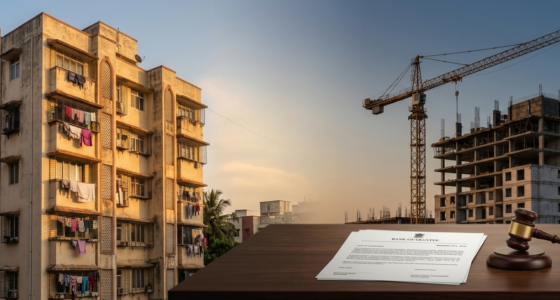
Maharashtra government approves cluster redevelopment through a developer agency, with mandatory rehabilitation and infrastructure upgrades.
Mumbai, October 16, 2026: The Maharashtra government has approved the cluster redevelopment of buildings in the Ramakrishna Nagar MHADA layout in Khar (West), Mumbai, through a Construction and Development Agency (C&DA) appointed by the Maharashtra Housing and Area Development Authority (MHADA).
The decision, issued by the state Housing Department on October 16, 2026, covers the layout at CTS Nos. 872 A/1 and 872 A/2. It aims to bring the redevelopment of the ageing buildings under a unified plan, rather than allowing individual buildings to pursue redevelopment independently.
The approval excludes Plot No. 18 and Amenity-1, identified as Office Building No. 1, from the proposed cluster redevelopment. The government has also specified conditions governing the appointment of the developer, rehabilitation of existing residents, construction potential, infrastructure development and the formation of housing societies.
Why the government has opted for cluster redevelopment
The government resolution notes that MHADA developed several housing colonies between 1950 and 1960 to provide affordable housing to middle- and lower-income groups in Mumbai and its suburbs.
Some buildings in these colonies have become old and dilapidated, making redevelopment necessary to improve residents’ living conditions.
However, the government observed that redevelopment has progressed faster in buildings located along main roads and at commercially attractive locations. Buildings situated within housing layouts or in less prominent locations have not seen the same pace of redevelopment.
According to the government, this uneven progress has limited the success of the existing redevelopment policy.
The unified redevelopment approach is intended to facilitate better planning of infrastructure and amenities across the entire layout, while enabling the construction of improved buildings and common facilities.
Developer to be appointed through a tender process
MHADA will appoint the Construction and Development Agency through a competitive tender process.
The government has approved cluster redevelopment under Regulation 33(5) of the Development Control and Promotion Regulations (DCPR) 2034 for the eligible plots. Plots Nos. 5, 7 and 8 will be redeveloped under Regulation 30, Table 12, subject to the conditions specified in the resolution.
The layout covers more than 4,000 square metres. The government has stipulated that a floor space index (FSI) of 4.00 may be considered, subject to the applicable conditions, including the requirement for an adjoining road with a width of 18 metres and prior government approval.
The resolution also states that the approved layout must remain the basis for future planning. MHADA will have to ensure that individual plots are not considered independently when controlling development permissions and the distribution of permissible FSI within the approved layout.
MHADA to receive 9,016.85 sq m of housing space
One of the key conditions concerns the housing stock that MHADA will receive from the redevelopment.
The resolution specifies that, from the 4.00 FSI permissible under Regulation 33(5), the first 3.00 FSI will be considered on a premium basis. The additional 1.00 FSI above 3.00 FSI will form the basis for a housing-sharing arrangement with MHADA.
Under this arrangement, MHADA is to receive 9,016.85 square metres of construction area, including fungible area, as a minimum benchmark.
The authority has been directed to appoint a developer that offers the maximum housing stock to MHADA while meeting the financial and technical conditions of the tender.
The allocation of this housing stock is a significant part of the project because it determines the public housing component arising from the redevelopment.
Existing residents must be rehabilitated
The appointed agency will be responsible for rehabilitating existing residents in accordance with the applicable provisions of Regulation 33(5).
The developer must also arrange transit rent or alternative accommodation for residents during the redevelopment process. In addition, the agency will be responsible for providing corpus funds and developing the layout’s infrastructure.
The resolution makes it mandatory for existing eligible members to be rehabilitated in flats corresponding to the rehabilitation area they are entitled to under the applicable regulations.
The developer will also bear the full burden of any cost escalation during implementation. This condition places the responsibility for increases in project costs on the appointed agency rather than allowing such escalation to be passed on automatically to the redevelopment project.
Existing consent letters not required, but society resolutions are mandatory
The government resolution provides that individual resident consent letters will not be required for this project under the specified provision of Regulation 33(5), since the redevelopment agency will be appointed by MHADA through a tender.
However, this does not eliminate the requirement for housing societies to formally approve the arrangement.
The appointed agency must submit valid resolutions demonstrating the consent of all the cooperative housing societies in the layout, in accordance with the Maharashtra Cooperative Societies Act, 1960.
The distinction is important: the government has removed the requirement for individual consent letters under the cited provision, but has retained the requirement for valid society-level resolutions.
Plots Nos. 5, 7 and 8 may be relocated by mutual agreement
Plots Nos. 5, 7 and 8 were allotted on an ownership basis to the Ramakrishna Nagar Cooperative Housing Society.
The government has recognised the society’s in-principle willingness to participate in cluster redevelopment. It has allowed the possibility of relocating these plots within the layout, provided their existing plot areas are retained and the arrangement is mutually agreed upon by the society and the appointed agency.
The final redevelopment terms and conditions will have to be settled between the agency and the society after the tender process. The society must then submit its final consent to MHADA.
The redevelopment of these plots will be governed by Regulation 30 of DCPR 2034.
Height restrictions and construction sequencing
The government has also addressed restrictions arising from the height limits imposed by the Airports Authority of India.
The appointed agency must first load the construction potential available under the 4.00 FSI permitted under Regulation 33(5), before loading the remaining permissible construction potential arising from fungible development rights.
The agency must transfer the housing stock committed in its tender to MHADA, including the fungible component, even where height restrictions affect the construction potential available at the site.
The resolution also provides that reserved plots within the layout will be developed in accordance with the applicable provisions of Regulation 17(3)(A) of DCPR 2034.
Separate rehabilitation and sale components permitted
The government has allowed the rehabilitation component and the sale component of the redevelopment to be planned as separate land portions or separate buildings, where permitted.
However, if separate subdivisions are proposed, MHADA must ensure that there is no imbalance in FSI calculations between the respective land parcels when approving the layout and redevelopment.
This provision allows flexibility in planning the project while retaining regulatory control over the distribution of development potential.
Sinking fund and corpus fund arrangements
The resolution also sets out how existing housing societies’ sinking funds and corpus funds will be handled.
As part of the proposed restructuring, the amounts accumulated in these funds will be distributed among the existing members of the respective societies. The existing societies will subsequently be consolidated, with new cooperative housing societies or a federation formed for the redeveloped properties.
The per-square-foot amount to be transferred to the newly formed societies as sinking fund and corpus fund will be determined by the High Power Committee, based on the existing carpet-area calculations used by the societies.
This provision is intended to address the financial arrangements accompanying the merger of the existing societies.
High Power Committee to oversee implementation
A High Power Committee chaired by the Additional Chief Secretary or Principal Secretary of the Housing Department will oversee the project.
The committee will include the MHADA Vice-President and Chief Executive Officer, a relevant Additional Municipal Commissioner of the Brihanmumbai Municipal Corporation, a representative of the Housing Department and the Chief Officer of the Mumbai Housing and Area Development Board.
Its responsibilities will include finalising tender conditions, overseeing the appointment of the development agency, resolving implementation-related issues and obtaining government guidance or approvals where necessary.
MHADA will also establish a grievance redressal committee to address problems raised by residents and housing societies during the redevelopment process.
Individual building redevelopment proposals will not be considered
A significant condition in the resolution is that proposals for the redevelopment or self-redevelopment of individual buildings within the layout will not be considered.
The government has stated that the redevelopment of the entire layout, including its infrastructure, is essential to achieve coordinated planning.
The decision therefore makes a unified approach central to the project rather than permitting individual buildings to proceed separately.
What the decision means for residents
The approval establishes the framework for the redevelopment of Ramakrishna Nagar, but it does not mean that construction will begin immediately. MHADA must still conduct the tender process, appoint the agency and complete the required planning and implementation steps.
For residents, the key issues will be the rehabilitation entitlements under the applicable regulations, transit rent or alternative accommodation, the terms of the final redevelopment agreement and the delivery of common infrastructure.
The government’s decision also makes MHADA responsible for coordinating the project and resolving grievances through the prescribed mechanisms.
The resolution was issued in accordance with a Maharashtra Cabinet decision taken on September 22, 2026. It further states that future MHADA layouts proposed for redevelopment through an appointed Construction and Development Agency will require separate, layout-specific prior approval from the state government.
Also Read: MHADA To Undertake Cluster Redevelopment of Ramkrishna Nagar in Khar West