A homebuyer who accepts delayed possession of a flat and signs an undertaking stating that the property has been received to his satisfaction does not automatically lose the right to claim interest for the delay, the Maharashtra Real Estate Appellate Tribunal (MREAT) has ruled. In a judgment pronounced on October 23, 2026, in an appeal involving Balaji Symphony Phase 2 in Panvel, the Tribunal held that an acknowledgement of possession or satisfaction with the physical condition of a flat does not necessarily amount to a waiver of statutory rights under Section 18 of the Real Estate (Regulation and Development) Act, 2016 (RERA). The Tribunal also rejected the promoter’s attempt to rely on a COVID-19-related extension to reduce its liability, directing it to pay interest for delayed possession and litigation costs to the homebuyer.
Signing a satisfaction undertaking does not automatically end the homebuyer’s claim
The dispute involved Jamir Ibrahim Kazi, who had booked Flat No. F-502, measuring 571 sq ft carpet area, in Balaji Symphony Phase 2, promoted by M/s Balaji Symphony through its proprietor Vinay S. Agarwal.
The total consideration for the flat was ₹51.44 lakh, of which Kazi had paid ₹46.29 lakh, approximately 90% of the agreed amount. The Agreement for Sale was executed on April 27, 2017.
Under the agreement, possession was to be handed over by December 31, 2017, with an additional six-month extension, taking the deadline to June 30, 2018.
However, possession was eventually handed over only on March 19, 2022, following proceedings before MahaRERA.
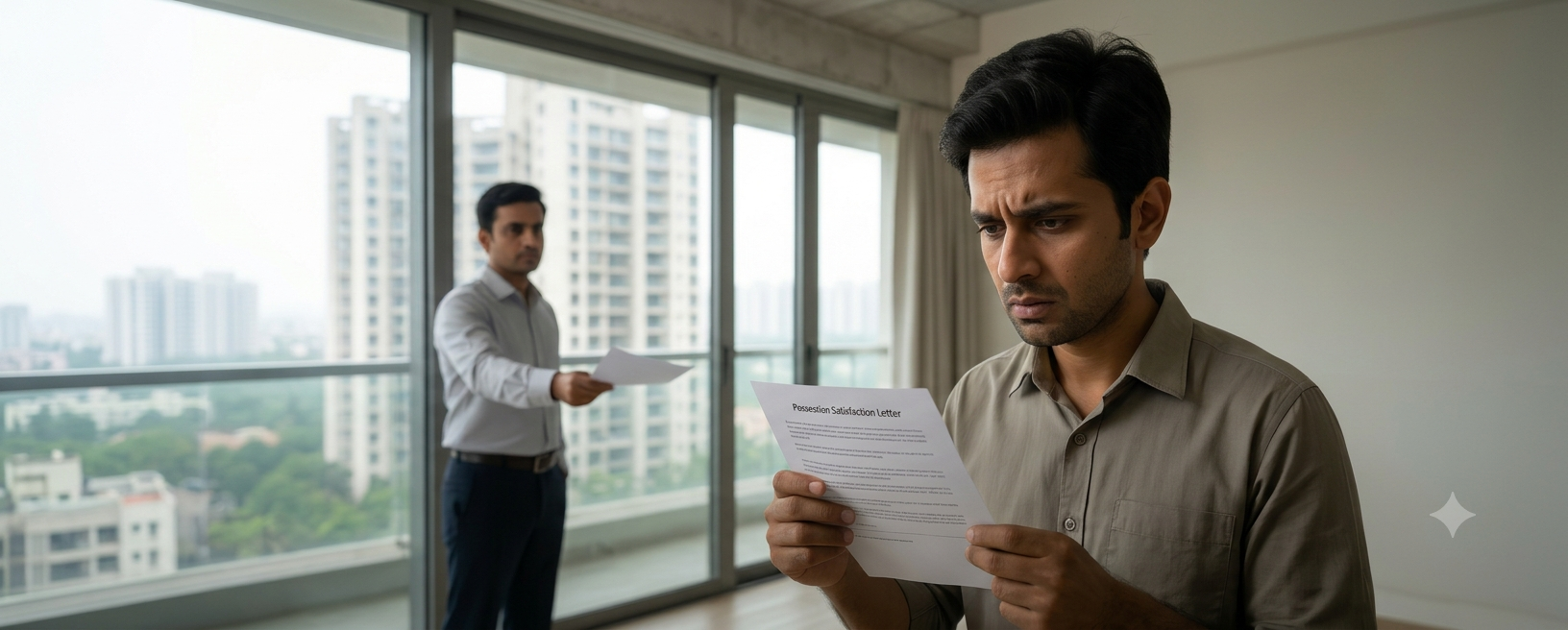
At the time of taking possession, Kazi signed an undertaking stating that he was accepting vacant and peaceful possession of the flat in sufficient compliance with the promoter’s obligations under the Agreement for Sale.
The promoter subsequently relied on this undertaking before the Appellate Tribunal, arguing that Kazi had accepted possession in full satisfaction and had thereby waived his right to claim interest for the delayed handover.
The promoter also relied on an earlier MREAT judgment in M/s Leela Buildcon & Infrastructure v. Macrotech Developers Limited, arguing that acceptance of possession without protest could indicate waiver of the allottee’s right to claim interest.
The Tribunal, however, did not accept this argument.
It observed that an acknowledgement of possession or satisfaction with the physical delivery of a flat does not necessarily amount to a waiver of the right to claim interest for delayed possession.
An important factor in the Tribunal’s reasoning was that Kazi had already approached MahaRERA on November 6, 2020, seeking relief for delayed possession. Therefore, his claim for interest had been raised well before he signed the undertaking on March 19, 2022.
The Tribunal further observed that the promoter had not demonstrated that the undertaking expressly relinquished the homebuyer’s statutory claim for interest.
It consequently held that the undertaking, in the circumstances of this case, did not disentitle Kazi from claiming interest for the delay.
Section 18 of RERA protects homebuyers against delayed possession
The Tribunal examined the homebuyer’s entitlement under Section 18(1) of RERA.
The provision gives an allottee two options when a promoter fails to hand over possession within the agreed contractual period.
The homebuyer can withdraw from the project and seek a refund with prescribed interest. Alternatively, if the homebuyer chooses to continue with the project, the promoter is liable to pay interest for every month of delay until possession is handed over.
In this case, Kazi chose to continue with the project and eventually accepted possession.
The Tribunal relied on the Supreme Court’s judgment in Newtech Promoters and Developers Pvt. Ltd. v. State of Uttar Pradesh (2021), which clarified the statutory rights available to allottees under RERA.
It observed that the entitlement to interest arises when the promoter fails to hand over possession within the period stipulated in the Agreement for Sale. The subsequent offer or acceptance of possession does not automatically extinguish an already accrued right to claim interest.
The Tribunal also referred to the Supreme Court’s judgment in Imperia Structures Ltd. v. Anil Patni (2020), which explained that an allottee who does not wish to withdraw from a project is entitled to interest for every month of delay until possession is handed over.
Promoter cannot automatically use COVID-19 extension to escape interest liability
Another important issue before the Tribunal was the promoter’s attempt to rely on the COVID-19 pandemic and extensions granted by MahaRERA to justify the delay.
The promoter argued that the delay was caused by circumstances beyond its control, including the pandemic, construction difficulties, financial arrangements and project-related extensions.
However, the Tribunal observed that an extension of the project’s registration period does not automatically extend the contractual possession date agreed upon with the homebuyer.
It emphasised that the possession date specified in the Agreement for Sale is binding and cannot be rewritten unilaterally by the promoter or through a regulatory extension.
The Tribunal also pointed out that the contractual possession deadline in this case had expired on June 30, 2018, much before the COVID-19 pandemic began.
Consequently, the promoter’s liability for delayed possession had already arisen before the pandemic.
The Tribunal further noted that the promoter had not specifically sought the benefit of the COVID-19 moratorium before the original MahaRERA Authority. It held that a plea that was neither raised before the Authority nor formed part of the pleadings could not be introduced for the first time at the appellate stage in a manner that deprived the opposite party of an opportunity to respond.
The Tribunal therefore rejected the promoter’s request to use the COVID-19 moratorium to reduce its liability for delayed possession.
Occupancy Certificate alone does not establish that possession was made available
The promoter also argued that the project had received its Occupancy Certificate on July 23, 2020, and that the homebuyer had failed to take physical possession within two months as required under Section 19(10) of RERA.
According to the promoter, Kazi had accepted possession only on March 19, 2022, despite the issuance of the OC and an offer of possession.
The Tribunal rejected this contention.
It observed that the issuance of an Occupancy Certificate does not, by itself, establish that possession was duly offered and made available to the allottee in accordance with the Agreement for Sale.
Kazi had specifically demonstrated that the flat was incomplete and that effective possession was not handed over until March 19, 2022.
The Tribunal therefore held that the promoter could not rely merely on the date of the Occupancy Certificate to argue that the homebuyer had violated Section 19(10).
Tribunal rejects homebuyer’s claim for a parking space
While the Tribunal accepted Kazi’s claim for delayed possession interest, it rejected his request for allotment of a parking space.
Kazi had emailed the promoter on June 20, 2018, seeking allotment of parking. He argued that the applicable development control regulations for Navi Mumbai required parking facilities to be provided based on the size of the tenement.
The promoter countered that the homebuyer had not purchased a parking space and that the Agreement for Sale did not contain a specific commitment to allot one to him.
After examining the agreement, the Tribunal distinguished between the regulatory requirement to provide parking facilities in a project and an individual allottee’s contractual entitlement to a designated parking space.
It noted that although Clauses 5(g) and 5(m) of the Agreement for Sale referred to provisional allotment of parking spaces to purchasers, the agreement did not establish a specific provisional allotment in Kazi’s favour.
The Tribunal therefore concluded that the material on record did not establish a contractual obligation to provide him with a designated parking space.
Promoter directed to pay interest and ₹25,000 as costs
Partly allowing Appeal No. AT006000000053721 of 2022, the Tribunal modified the original MahaRERA order dated February 28, 2022.
It directed M/s Balaji Symphony to pay interest on the actual amount paid by Kazi, at the highest rate of the State Bank of India’s Marginal Cost of Lending Rate (MCLR) plus 2%, as prescribed under Section 18 of RERA and the applicable Rules.
The operative portion of the judgment specifies the interest period as July 1, 2019, to March 19, 2022, the date on which possession was actually handed over.
The promoter was directed to make the payment within four weeks from the date of the judgment. In case of non-compliance, the amount payable would carry further interest at the same rate until realisation.
The Tribunal also directed the promoter to pay ₹25,000 towards litigation costs to the homebuyer within four weeks.
What this judgment means for homebuyers
The ruling carries an important lesson for homebuyers who face pressure to sign possession letters, satisfaction notes or undertakings when accepting flats after years of delay.
Accepting possession and pursuing a claim for delayed possession interest are not necessarily mutually exclusive. A homebuyer who takes possession does not automatically surrender the statutory entitlement to interest under Section 18 of RERA merely by acknowledging receipt of the flat or expressing satisfaction with its physical delivery.
However, the judgment does not mean that every undertaking signed by a homebuyer will be ineffective. The Tribunal examined the specific wording, circumstances and timing of the undertaking in this case, particularly the fact that the homebuyer had already initiated proceedings for delayed possession before signing it.
For homebuyers, the practical lesson is to carefully examine any document presented by a promoter at the time of possession. A general acknowledgement of receiving a flat should not casually be treated as a settlement or surrender of pending legal claims.
The judgment was pronounced by the bench comprising Justice S. S. Shinde, Chairperson, and Dr. Rajagopal Devara, Member (Administrative), on October 23, 2026.
Also Read: MahaRERA Tribunal Holds Ex-Partner as ‘Promoter’, Affirms Allottee’s Rights in RERA Battle