
A co-operative housing society cannot treat a thin attendance as a mandate for redevelopment. The Government Order of 30 September 2026, No. SGRYO-2026/C.R. 108/14-S, fixes how the first Special General Meeting is called, what quorum it needs, and how the yes vote is counted.
The order is under Section 79A of the Maharashtra Co-operative Societies Act, 1960. It supersedes the 4 July 2019 resolution. This part is only the opening meeting, the one that decides whether the society is to be redeveloped at all.
One-fifth of the members must ask for the meeting
The meeting does not start because the committee wants it. Not less than one-fifth of the members must apply to the Secretary. The application goes to the Secretary of the managing committee elected under the bye-laws and constituted in accordance with the law. It must carry the members’ plans and suggestions for redevelopment.
Within 8 days of receiving it, the managing committee must take note of the application in a committee meeting. Within 2 months, the Secretary must convene a Special General Meeting of all members.
The agenda must reach every member 14 days before the meeting. The acknowledgement is kept in the society’s records.
Three quotations before the meeting, one expert chosen in it
Before the meeting is called, the managing committee must obtain quotations from at least three architects, or from Project Management Consultants, for the redevelopment project report.
The architects must be registered with the Council of Architecture under the Architects Act, 1972, and must be on the panel of the Government or the local authority. One expert from those quotations is selected at the Special General Meeting, not by the committee alone.
Suggestions must be in writing, 8 days before
Members may send the committee their plans, suggestions and recommendations in writing. The last day is 8 days before the meeting. The order asks for realistic plans, not a note sent on the day.
Quorum is two-thirds, and a second failure stops the subject
The quorum is two-thirds of the total members. Paragraph 15 of the same order says any fraction is rounded up to the next whole number. In a society of 100 members, two-thirds is 66.66, so the quorum is 67. That is the figure the order itself uses.
If the quorum is not complete, the meeting is adjourned. It is reconvened within the next 1 month, on 7 days’ notice. If the quorum fails again, the order treats the members as not interested in redevelopment. The meeting is cancelled. The subject cannot be brought before a Special General Meeting again for the next 3 months.
The yes vote is 51 per cent of the whole society
The preliminary decision, whether the society is to be redeveloped or not, needs the approval of at least 51 per cent of the total members. It is not 51 per cent of the members who happened to attend.
The order’s own example is a society of 100 members. The quorum is 67. The yes vote still needs 51 or more. If 67 members are present, at least 51 of those 67 must approve. If 75 are present, the floor is still 51 of those 75. A simple majority of the room is not enough. At exact quorum, 51 yes votes out of 67 means roughly three-quarters of the people in the meeting must say yes.
Video call counts, but 51 per cent must be in the room
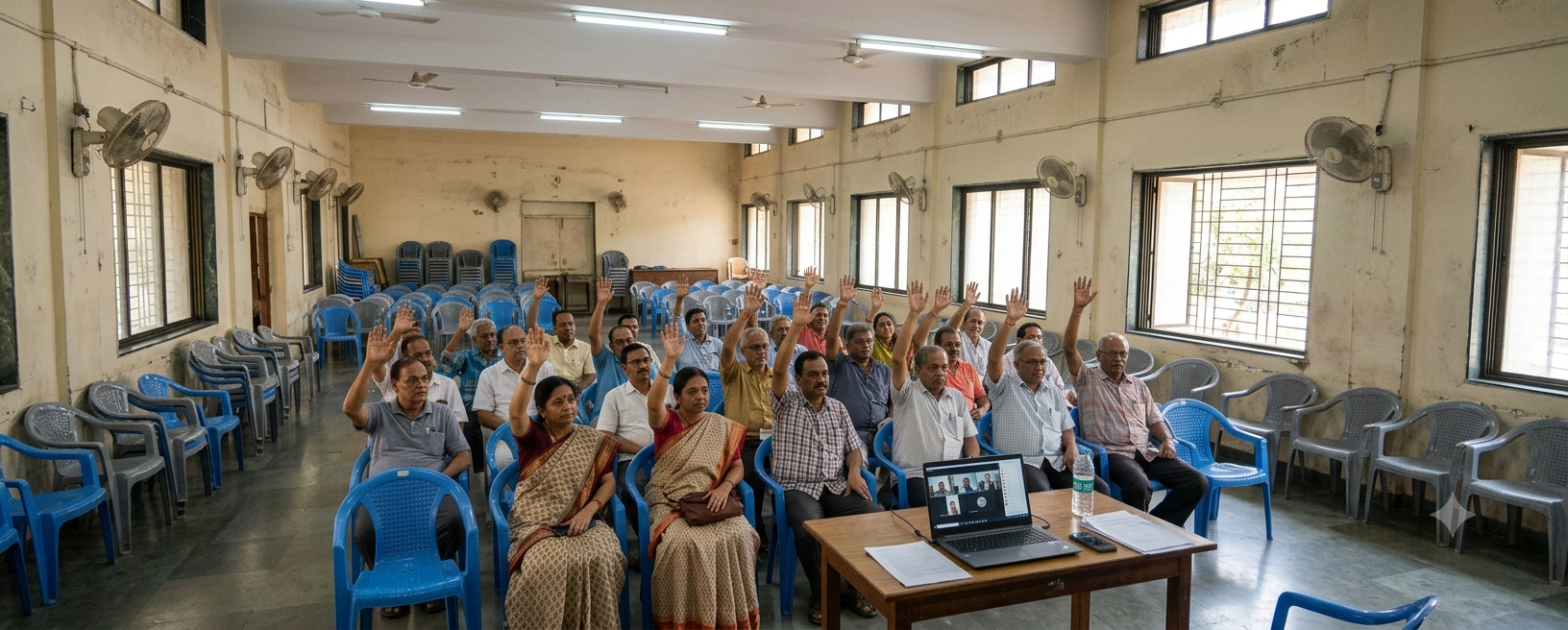
Members who are abroad, bedridden, persons with disabilities, or unable to attend for an unavoidable reason may attend by a remote system or video call. That attendance counts for the two-thirds quorum and for the 51 per cent yes vote.
It does not replace the room. It is mandatory that 51 per cent of the total members are physically present. In a society of 100, at least 51 members must be in the hall. Video call can fill the rest of the quorum, and a yes on video call counts toward the 51. It cannot be used to run the meeting with a thin physical turnout.
An absent member’s letter does not count
After the decision to redevelop, the meeting selects the architect or project management consultant from the panel, fixes the work and the terms, and hears an outline of the redevelopment programme.
Suggestions, recommendations and objections are considered at the meeting. The views of members are recorded in the minutes with their names.
For this decision, no written, oral, or other approval, opinion or view of an absent member is considered. A consent letter from someone who did not attend, in person or on video call, is not a vote.
The written consent letters required after this resolution, from members who voted yes, are the next step in the order. They are not a substitute for being present at this meeting.
Also Read: Part 1 of Society Redevelopment Series: Administrator Cannot Decide Society Redevelopment