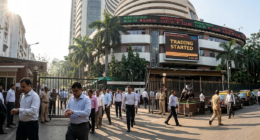

There are days when the market moves on data, and there are days when the market simply waits. Wednesday September 17 is the second kind. The US Federal Open Market Committee announces its interest rate decision today — the most consequential scheduled monetary policy event for India’s rate-sensitive realty sector since the conflict began in February. The Sensex is at its lowest since June 2026, down more than 10% from the same time last year. The Nifty Realty index has lost 9.33% across seven sessions. Brent crude is above $108. India’s August CPI has risen to 4.82%. The Indian 10-year bond yield is near 7% — a three-month high. And in the middle of all this macro noise, India’s homebuyers are preparing for Navratri, Diwali, and Dhanteras — the festive season that has historically been the most powerful demand catalyst the residential real estate sector possesses, and which no central bank rate decision can fully cancel.
The Peg: The Fed Decides Today. India’s Homebuyers Decide This Diwali.
The realty sector is caught between two decision-makers this Wednesday morning. One sits in Washington and will announce its call this afternoon. The other sits in every Indian household that has been saving for a home and watching home loan rates with anxious attention through seven months of war, crude oil volatility, and bond yield pressure.
The Fed’s decision today carries three possible outcomes for the sector. A rate hold — the baseline consensus expectation — would be neutral to mildly positive: it keeps the global monetary tightening cycle from accelerating and removes the tail risk of Fed-driven FII outflows from India. A rate cut — which the weak June US payrolls print and Waller’s dovish Jackson Hole signal had briefly made possible before the August CPI data complicated the picture — would be the most powerful positive the sector could receive: dollar weakens, rupee strengthens, crude import costs fall, RBI rate hike pressure reduces, home loan rates remain stable. A rate hike — which the three hawkish July FOMC dissenting votes and the elevated August US inflation reading have kept on the table — would be the sector’s worst-case outcome: FII selling accelerates, the rupee weakens, crude costs in rupee terms rise, and the RBI is pushed toward its own tightening response at the October MPC meeting.
The market is not waiting passively for that decision. It is positioning for it — and that positioning is expressed in the Sensex at its June 2026 lows, the Nifty Realty index at 814 after seven sessions of selling, and a broader market where defensive sectors are outperforming rate-sensitive ones by the widest margin of CY26.
But the second decision-maker — India’s festive season homebuyer — does not care about the FOMC meeting timetable. Navratri begins in days. Diwali is weeks away. Dhanteras, the single most auspicious day for property transactions in the Indian calendar, is approaching. The festive season homebuying window is not a function of the Fed’s rate call. It is a function of India’s 7.8% GDP growth, its 11 lakh annual household formations, its median homebuyer age of 34, and the cultural and financial tradition of treating property purchases as the most meaningful investment a family can make. That demand exists today as it existed before the Iran war began — and it will express itself through the festive launch pipelines that Prestige Estates Projects, Godrej Properties, DLF, Sobha, and Brigade Enterprises have been preparing through September’s macro turbulence.
How the Realty Sector Is Opening
The Nifty Realty index enters Wednesday at approximately 814 — its lowest level since early July. The broader market at the Sensex’s June 2026 low is the most difficult backdrop the sector has faced since the July crude oil crisis when Brent had briefly crossed $98.68. The difference between July’s crisis and today’s is that July’s crisis arrived in the absence of the festive demand catalyst that September carries. The festive season provides a company-specific demand floor that was not present in July.
Tuesday September 16 had shown the sector’s capacity for recovery — Anant Raj surging 7.11%, Brigade Enterprises gaining 4.12%, Aditya Birla Real Estate up 3.71%, Godrej Properties advancing 2.31%, and DLF adding 1.93% in morning trade. That recovery, however, was partially reversed in the afternoon as bond yields resumed pressure and crude held above $108. The morning’s recovery being sold into through the afternoon is the pattern the sector has been navigating through September — brief positive sessions interrupted by macro headwinds that arrive before gains can consolidate.
Wednesday’s opening tone is cautious ahead of the Fed decision. Across the sector’s ten constituents, the morning is one of measured positioning rather than directional conviction — buyers and sellers both waiting for Washington’s announcement before committing aggressively in either direction.
Godrej Properties, whose ₹27,000 crore FY27 presales target has been the sector’s most ambitious medium-term growth story, opens Wednesday in a holding pattern near ₹1,800–1,850. Lodha Developers, whose record ₹5,620 crore Q1 FY27 presales have been the sector’s most powerful fundamental anchor through every macro headwind of CY26, opens Wednesday as the sector’s most fundamentally resilient name — the stock whose demand story has the most independent validation from actual bookings data. Prestige Estates, which has its largest-ever festive season launch pipeline across Hyderabad, Bengaluru, and Mumbai approaching, opens with cautious buying from investors who see the festive season as the next independent catalyst.
DLF, the index’s largest constituent at a 26.86% weight after index rebalancing, opens Wednesday in a narrow range. The stock’s festive season launch pipeline — DLF’s Gurugram projects including Privana have been among the most successful project launches in the sector’s recent history — gives institutional buyers a company-specific positive to hold through the macro uncertainty of the Fed decision day.
Sobha, Phoenix Mills, Brigade Enterprises, Anant Raj, Aditya Birla Real Estate, and Oberoi Realty all open Wednesday with a cautious flat to marginally positive bias — the sector collectively in a holding pattern ahead of the day’s most important scheduled event.
What Is Working
The festive season demand pipeline is the sector’s most powerful domestic positive heading into Wednesday’s session — and it is entirely independent of the Fed’s rate decision. Navratri, Diwali, and Dhanteras together constitute the six-to-eight-week window that generates the highest single-period homebuying volumes of any time in the Indian calendar. Developers have been actively preparing festive launches — Prestige Estates across Maharashtra and South India, Godrej Properties in the NCR, DLF with its Gurugram pipeline, Sobha in Bengaluru, and Brigade Enterprises across its Bengaluru and Chennai projects. These launches are ready. The projects are registered with RERA. The bookings infrastructure is in place. The homebuyers are saving and watching. When the festive season formally opens, it will generate demand signals that are genuinely independent of crude oil, bond yields, and Fed decisions.
HDFC Bank’s submission of two CEO candidates to the RBI — which had pushed the stock up 1.3% on September 15 — is the banking sector positive that most directly sustains the home loan market’s stability through the macro turbulence. HDFC Bank’s leadership transition concern had been the most worrying secondary negative for the sector’s credit market through August and early September. The submission of candidates to the RBI for approval signals that the transition is being managed constructively and that the home loan disbursement machine at India’s largest private sector housing financier is not at risk.
The FCNRB deposit surge to over $120 billion — confirmed in Wednesday’s market context — continues to be the domestic financial instrument that is fighting the crude cost story from the currency side. FCNRB inflows that strengthen the rupee reduce India’s effective crude import cost in local currency terms without requiring either a rate hike or a diplomatic resolution. That mechanism is working in the background even as the market focuses on the Fed decision.
DII buying has been the sector’s structural floor through every Iran-shock session of CY26 — and it is expected to remain active on Wednesday given that the Nifty Realty index at 814 is approaching levels last seen before the June recovery began. The distance between where the sector is trading and where its presales momentum and festive season demand pipeline say it should be is, at current levels, the widest it has been since the April low of 638.65 on the index.
What Isn’t Working
The Sensex at its June 2026 lows — down more than 10% year-on-year — is the broader market context that keeps institutional buyers cautious about committing aggressively ahead of the Fed decision. A market at its lowest since June 2026 is a market pricing in a deteriorating macro environment. For rate-sensitive sectors like real estate, the market-level selldown creates a gravity that individual sector strength cannot easily overcome.
India’s August CPI at 4.82% is the domestic inflation reading that has placed the most direct pressure on the RBI’s October MPC meeting. The central bank’s 4% target has now been breached for two consecutive months — June at 4.38%, August at 4.82% — and the trajectory is upward, driven primarily by energy cost pass-through from crude above $100. A continued inflation trajectory above 4.5% makes a rate hike from the RBI increasingly difficult to avoid at the October meeting, even if the central bank has been signalling its preference for holding.
The Indian 10-year bond yield near 7% — its highest level in three months — is the fixed income market’s verdict on the rate hike probability, and it is directly damaging for the realty sector. When the benchmark bond yield crosses 7%, home loan rates follow upward — lenders re-price fixed and floating rate products in response to the higher cost of funds. A home loan market where rates are rising is a market where buyer affordability is declining, monthly EMIs are increasing for the same loan amount, and the marginal homebuyer — the one on the edge of qualifying for a loan — is pushed back into renting.
Brent crude above $108 means that the construction cost pressures that have been the sector’s most concrete operational headwind since crude crossed $100 in September are not easing. Every session above $108 adds to the gap between what developers priced their Q1 FY27 bookings at and what it costs to deliver on those bookings in Q2 and Q3 FY27.
What to Watch Through the Day
The Fed’s rate decision is the session’s most important scheduled event. A hold with a dovish tone — signalling that the committee is leaning away from further hikes — would be the most positive outcome the market can realistically hope for today. Watch for the post-decision press statement language: any reference to the possibility of cuts “if inflation moderates” would be taken as a significant dovish signal. Any language about “remaining vigilant” or “not ruling out further action” would be taken as hawkish.
The rupee’s immediate response to the Fed decision will be the currency market’s real-time verdict. A rupee that strengthens to 93.50–94.00 on a dovish Fed hold would signal that the currency market is reading the decision as unambiguously positive. A rupee that weakens past 95.50 on any rate hike signal would compress India’s import cost relief and add to inflationary pressure in a way that would accelerate the RBI’s October rate decision in the hawkish direction.
Crude oil’s response to the Fed decision is the energy market variable to watch. A dovish Fed weakens the dollar — which typically pushes commodity prices higher, including crude. That perverse relationship means that even a positive Fed outcome for rate-sensitive sectors can temporarily push crude higher through the dollar channel. Watch whether crude’s response to the Fed is dominated by the dollar weakening effect or by the demand destruction effect of a more accommodative global rate environment.
Within the sector, watch for any festive season launch announcement from any of the sector’s ten constituents through Wednesday. Even a formal launch circular or RERA-registered project launch notification from Prestige, Godrej Properties, DLF, or Sobha would give institutional investors a demand-side signal to hold through the Fed decision’s uncertainty — the festive season bookings that arrive will provide the sector’s next independent catalyst regardless of what Washington decides today.
September 17 is the day the sector’s most important external variable is resolved. Seven sessions of losses, a Nifty at June 2026 lows, crude at $108, bond yields at three-month highs, and a festive season approaching with the most ambitious launch calendar the sector has assembled in CY26 — all of it converges on one FOMC announcement. By tonight, the market will know whether the macro headwind that has been the sector’s most persistent constraint through September has eased, held, or intensified. The festive season will give its own answer in the weeks that follow — and that answer, built on the structural demand of a 7.8% growth economy, will outlast any single rate decision.
Also Read: Realty Stocks Open in the Red as Crude Climbs Again and Muscat Talks Await a Second Round