
A Borivali housing society cannot disturb or reallocate a specific open parking slot allotted to a member couple when, on the present record, that slot does not even appear to lie within the society’s own premises. The Maharashtra State Co-operative Appellate Court, Mumbai, has dismissed the society’s appeal and confirmed an interim injunction protecting the parking till the main dispute is decided.
The order was passed on 3 September 2026 by President Sau. S.S. Sapatnekar in Appeal No. 8 of 2026. It upholds the 12 December 2025 order of Co-operative Court No. 4, Mumbai, in Dispute No. 118 of 2025.
How the allotment began
Mrs. Rakhi J. Mahey and Mr. Janakraj N. Mahey own Flat C-111 in Veena Santoor-1, Sai Baba Extension Road, opposite Kamla Vihar Sports Club, Borivali (West). They purchased the flat from Veena Developers Pvt. Ltd. by a registered agreement dated 24 March 2009 for ₹9.81 lakh.
The builder had already issued them an allotment letter dated 14 May 2008 for open car parking slot GO/26 and a parking sticker. The society, Veena Santoor Co-operative Housing Society Ltd., was registered later, on 26 July 2012. A share certificate for the flat was issued in December 2014.
The project was built in phases. Wings A to G formed the first phase (Veena Santoor-1). Wings H, I and the proposed J wing formed Phase-2, which later became a separately registered society in 2018.
Society first accepted the old allotments
After the managing committee was nominated, a special general body meeting on 28 July 2013 validated 85 existing car parking allotments on a “first come, first served” basis under bye-law 78(a) and (b), noting that the parking area was already fully occupied. Later AGMs in September 2013, 2014 and 2015 treated those allotments as final. In the 27 September 2015 AGM the society resolved that the 85 allotments did not require cancellation or reallocation.
Nine other members later challenged those resolutions. A city civil court suit was dismissed for want of jurisdiction. They then filed Co-operative Court Dispute No. 567 of 2019, which is still pending. In that case they also asked the society to frame a parking policy.
New committee tries to change the policy
A newly elected managing committee issued notice on 25 October 2024 for a special general body meeting on 10 November 2024. One agenda item was to frame a fresh four-wheeler parking policy. The developer objected to several items, including the parking agenda.
After the meeting, the Maheys said the draft minutes were manipulated. A member shown as having seconded the parking resolution later denied doing so on the society WhatsApp group. Another member whose name appeared as seconder on a different resolution was, they said, not even present.
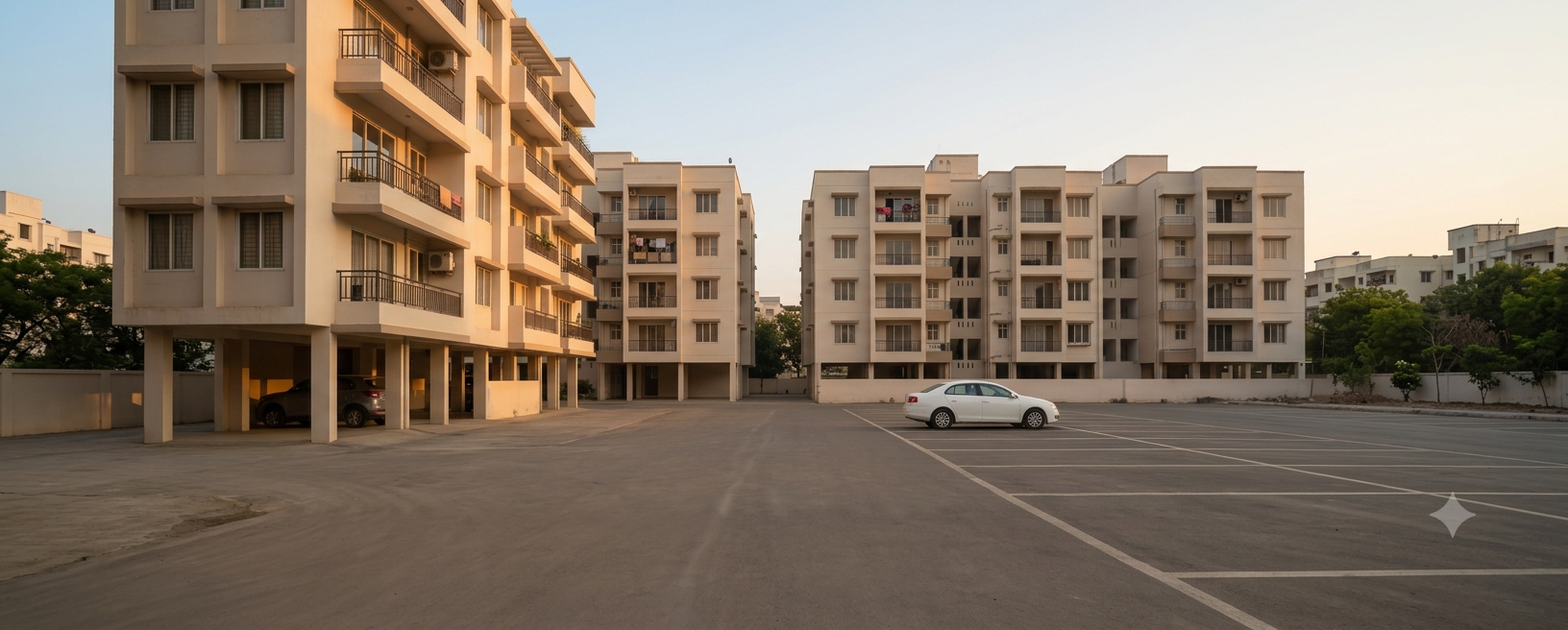
The couple’s main legal point was sharper: slot GO/26 falls in the Phase-2 (H and I wings) area, not in Veena Santoor-1’s common space. Therefore their own society had no authority to cancel, revalidate or reallocate that particular slot. They sought, among other reliefs, that the 10 November 2024 resolution be set aside, and they asked for an interim injunction so that the society could not dispossess them of GO/26 or block ingress and egress of their car.
What the society argued
The society admitted the Maheys are bona fide members but denied that the builder had validly allotted GO/26. It relied on the Supreme Court’s Nahalchand Laloochand ruling that a promoter cannot sell parking as a separate unit because parking forms part of the common amenities. It said the 2009 agreement is silent on the parking number, the allotment letter is unreliable, and the open space belongs to Veena Santoor-1 as per occupancy plans.
The committee said it had only asked members to produce original allotment letters for verification and that “fixed” parkings without validation were being removed. It offered to allot the couple some parking space, but insisted it had the right under the model bye-laws to reframe policy. Granting an injunction, it said, would cause the society irreparable loss.
What the appellate court found
The appellate court stressed that interference with a trial court’s interim discretion is limited. On the documents, it held that a prima facie case, balance of convenience and irreparable injury all favoured the flat owners.
The society’s own maps showed parking numbers including GO/26 in the layout of proposed building No. 2 on wings H and I. Agenda No. 3 of the society’s own 10 November 2024 minutes recorded that open parking reserved for A–G wings was being used by Veena Santoor-2, while Phase-2 members claimed they had been legally allotted that area. The society had even resolved to consider legal action against Phase-2 for “encroachment.”
Letters on record added to the picture. In 2019 the developer asked Veena Santoor-1 to vacate recreation-ground area so that it could be developed as per the approved layout, and noted that residents of D, E, F and G wings were parking there. In March 2025 the society itself wrote to Phase-2 alleging unlawful occupation of 18 parking slots and an illegal gate, and demanded documents of ownership.
The District Deputy Registrar had already rejected Veena Santoor-1’s application for unilateral deemed conveyance, citing conflicting area claims, a Bombay High Court restriction on construction of J wing, and the need for those disputes to be decided by a competent court.
Against that background, the appellate court held that it could not be said, even prima facie, that GO/26 falls inside Veena Santoor-1. A society may frame parking rules for space that belongs to it. It cannot apply a new policy to a slot it has not first shown is its own. If the injunction were refused, the society would in effect gain control over a space whose location and title are still in dispute. That would cause irreparable harm to the members who have used the slot since the builder’s 2008 allotment.
The appeal was therefore dismissed with costs. The trial court’s order stands: the society and anyone acting for it are restrained from disposing of or obstructing the Maheys’ use of parking GO/26 and from interrupting ingress and egress of their car until the main dispute is finally decided.
The order does not finally declare who owns the land or the slot. It only keeps the status quo. The larger fight between Veena Santoor-1, the developer and Phase-2 over recreation ground, layout and conveyance remains open. What the court has made clear at the interim stage is simpler: a housing society cannot start reallocating a parking space that, on its own papers, may not even form part of its premises.
Also Read: Parking space expensive than cars in Mumbai