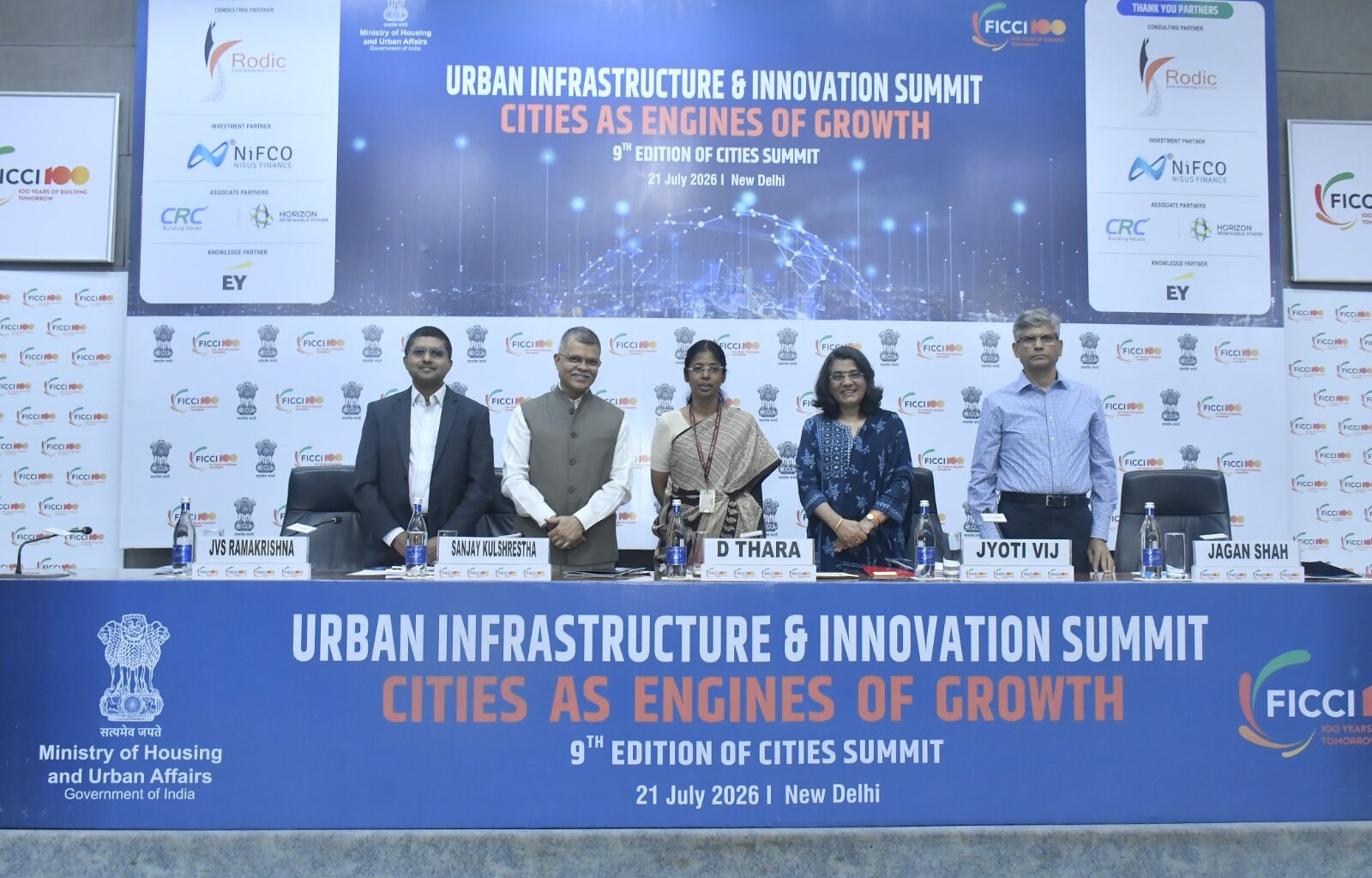

India’s Urban Challenge Fund has approved projects worth ₹31,000 crore within just 20 to 25 days of the scheme’s operational guidelines being finalised, highlighting the government’s push to accelerate urban infrastructure development across the country.
The announcement was made by D Thara, Additional Secretary, Ministry of Housing and Urban Affairs (MoHUA), during the ninth edition of the FICCI Urban Infrastructure and Innovation Summit held in New Delhi on July 21, 2026.
Speaking at the summit, Thara said the rapid approval of projects demonstrates strong interest from both public and private stakeholders in the newly launched Urban Challenge Fund. She also highlighted the diversified financing model being adopted for the approved projects.
According to her, non-banking financial companies (NBFCs) are contributing the largest share of funding, accounting for 44% of the approved project financing. Public-private partnerships (PPPs) contribute 22%, while municipal and other bonds account for around 5% to 7%. The remaining funding is being provided by commercial banks.
The Urban Challenge Fund was introduced to encourage innovative, investment-driven urban development projects while reducing dependence on traditional government subsidies. The financing model is designed to attract greater participation from financial institutions and private investors.
Addressing the summit, Sanjay Kulshrestha, Chairman and Managing Director of Housing and Urban Development Corporation (HUDCO), underlined the growing importance of Indian cities in the country’s economic landscape.
He noted that urban centres generate between 60% and 70% of India’s Gross Domestic Product (GDP) while occupying only about 3% of the country’s land area. Kulshrestha described the Urban Challenge Fund as a major policy shift from conventional subsidy-based urban development programmes to a competitive challenge-based funding model.
Under the scheme, viability gap funding can cover up to 50% of a project’s total cost. This financial support is equally shared by the Central Government and the respective State Government, while the remaining project cost is expected to be mobilised through banks, financial institutions and private investors.
Experts at the summit also emphasised the need for greater private sector participation in shaping India’s urban future.
Jagan Shah, Professor of Practice at IIT Delhi’s Transportation Research and Injury Prevention Centre, said the private sector should play a larger role in driving innovation and imagination behind urban renewal initiatives. He pointed out that many Tier-II and Tier-III cities continue to face institutional and capacity constraints, making private sector expertise increasingly important.
JVS Ramakrishna, Lead of FICCI’s Core Group on Urban Development and CEO of ParadigmIT Cybersecurity, said 2026 could become a defining year for India’s urban transformation. He argued that future economic planning should move beyond municipal boundaries and instead focus on larger city economic regions capable of attracting investments, creating employment opportunities, fostering innovation and generating sustainable economic growth.
FICCI Director General Jyoti Vij highlighted that urban development today extends beyond roads, housing and physical infrastructure. She said governance reforms, technology adoption, innovative financing mechanisms and institutional capacity-building are becoming equally important components of sustainable urbanisation.
The Urban Challenge Fund forms part of the government’s broader strategy to promote modern, investment-led urban development by encouraging cities to compete for funding based on project quality, innovation and financial viability. With ₹31,000 crore worth of projects already approved within weeks of the framework being notified, the initiative has witnessed a strong start and is expected to play a key role in shaping India’s next phase of urban growth.
Also Read: India’s GCC Boom: 2,400 Centres, 2.8 Million Jobs by 2030