
In a decisive move that fundamentally reshapes redevelopment governance in Maharashtra, the State Housing Department has issued a fresh Government Resolution (GR) on 15 December 2025, tightening accountability in redevelopment projects and empowering authorities to remove errant builders if senior citizens are made to suffer due to delays.
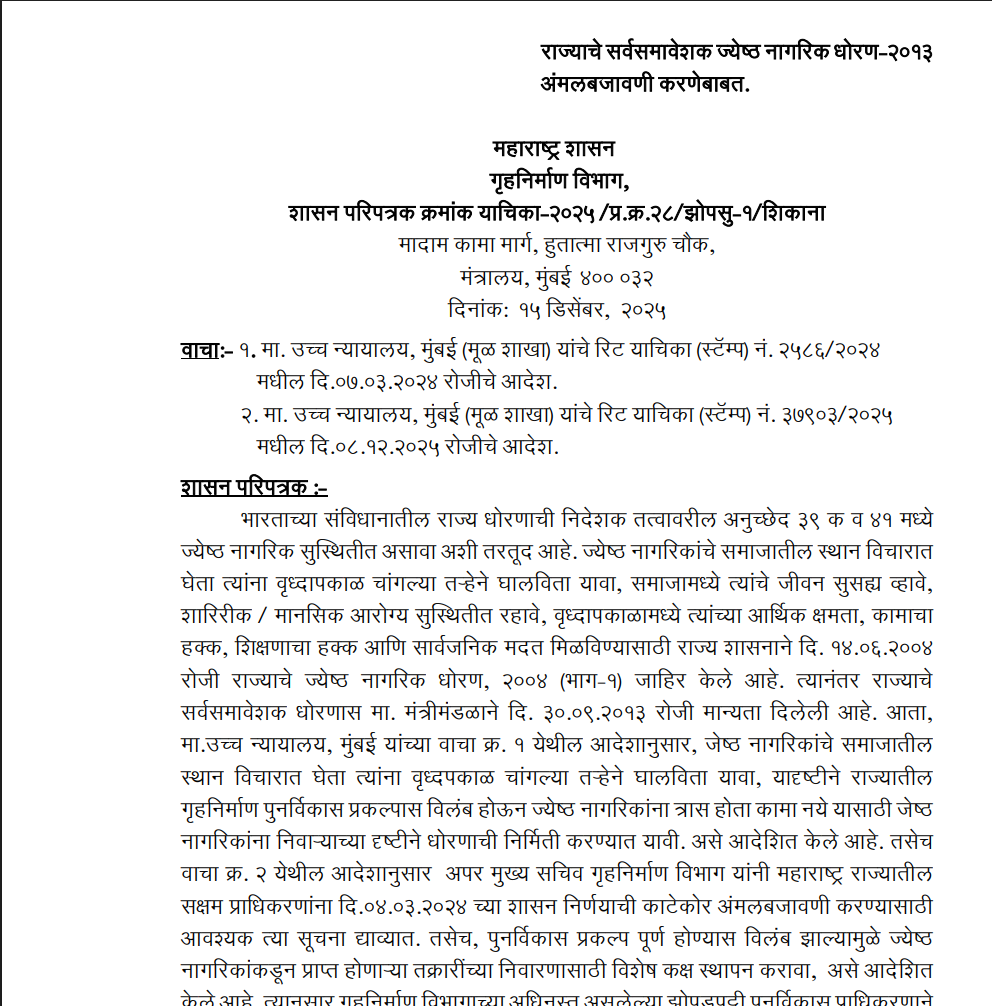
The latest GR — issued in compliance with binding directions of the Bombay High Court — operationalises a statewide senior-citizen protection framework across redevelopment projects, with immediate effect for projects under the Slum Rehabilitation Authority (SRA). Importantly, the Court has made it clear that the principles laid down apply to all redevelopment projects, irrespective of the planning authority involved.
The Judicial Trigger: A Senior Citizen Left Roofless
The policy shift traces its origin to a deeply disturbing case heard by the Bombay High Court earlier in March 2024, where a senior citizen petitioner informed the Court that she had been rendered homeless for over four years due to a stalled redevelopment project.
In its landmark 7 March 2024 order (Writ Petition (L) No. 2586 of 2024), the High Court held that:
- Senior citizens cannot be left roofless at the last stage of their lives
- Delayed or failed redevelopment directly violates Articles 14, 21 and 300A of the Constitution
- The State cannot remain a passive spectator when elderly citizens suffer due to redevelopment paralysis
The Court emphatically observed that fundamental rights do not get suspended in the name of redevelopment and directed the State Government to put in place an enforceable policy to ensure that redevelopment involving senior citizens is monitored, expedited and, if necessary, forcibly corrected.
March 2024: First GR Issued for MHADA Projects
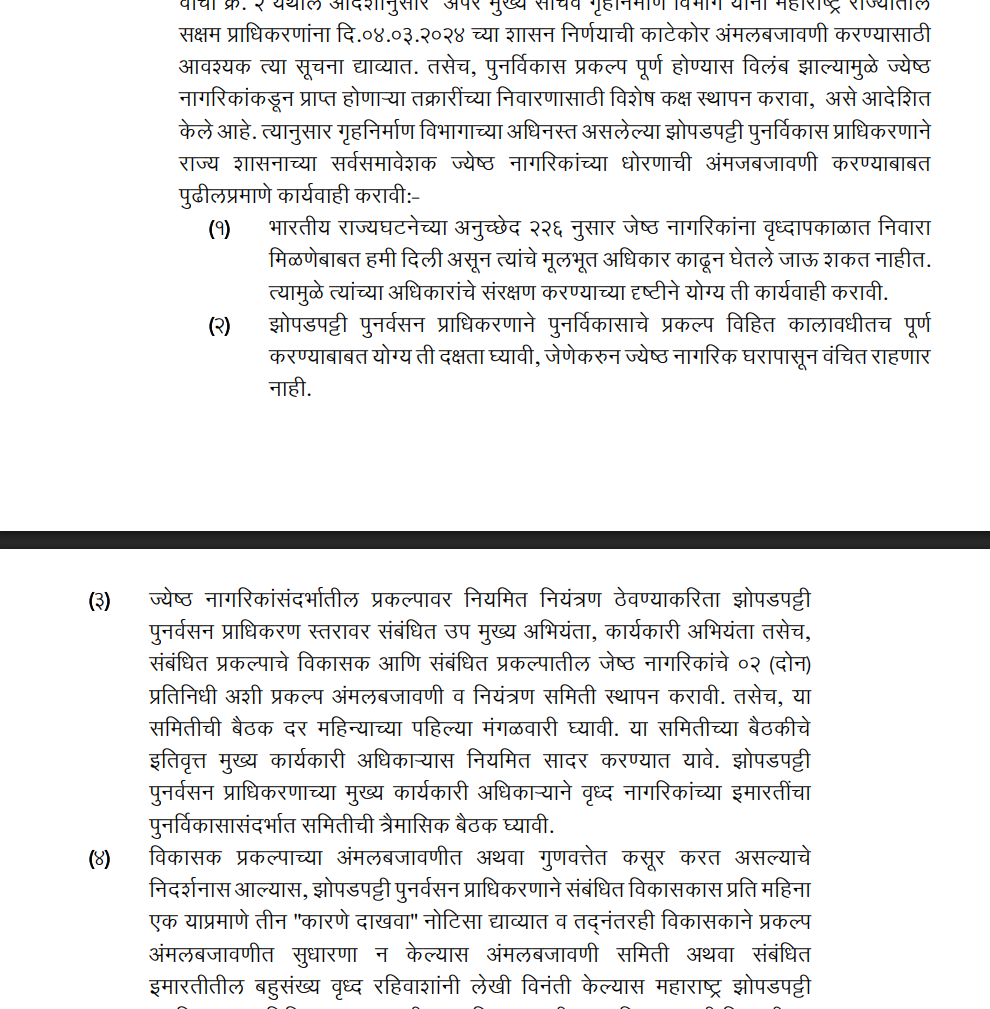
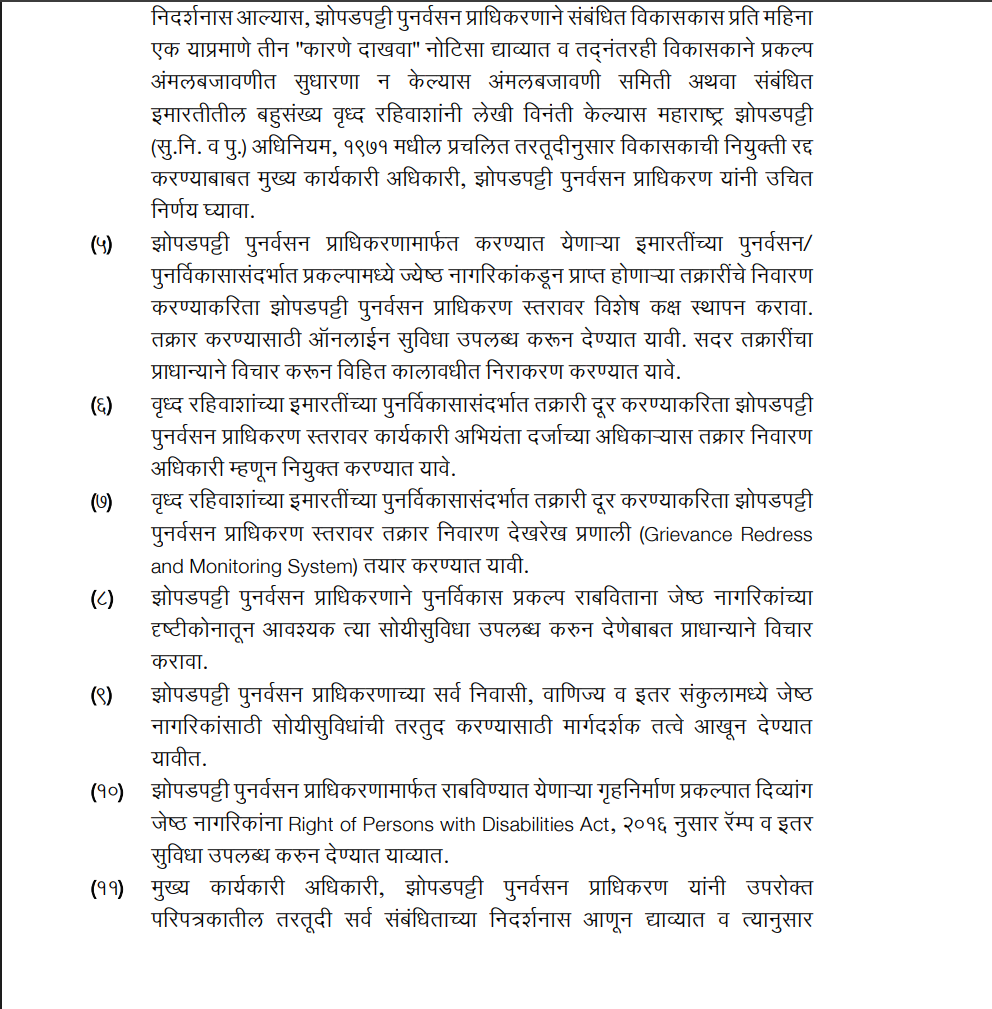
Acting swiftly on the High Court’s directions, the Housing Department issued a Government Circular dated 4 March 2024, primarily addressing redevelopment projects under MHADA.
This GR introduced, for the first time, a structured monitoring and enforcement mechanism, including:
- Monthly Project Monitoring Committees, meeting on the first Tuesday of every month
- Mandatory participation of:
- MHADA engineers
- Developers
- Two senior citizen representatives
- Three consecutive show-cause notices to defaulting developers
- Cancellation of developer appointment if defaults continue
- Appointment of Grievance Redressal Officers
- Creation of a Grievance Redress and Monitoring System
- Priority provision of senior-friendly amenities
- Accessibility infrastructure under the Rights of Persons with Disabilities Act
The High Court subsequently recorded its satisfaction with the policy but made it clear that strict, humane and proactive enforcement was non-negotiable.
December 2025 GR: The Big Expansion to SRA Projects
The 15 December 2025 GR, however, marks a turning point.
Issued after further judicial scrutiny and follow-up orders (including directions dated 8 December 2025), the Housing Department has now extended the same enforcement architecture to SRA redevelopment projects, which constitute a large share of Mumbai’s stalled and sensitive redevelopments.
With this GR:
- SRA projects are now subject to:
- Mandatory monthly monitoring
- Dedicated grievance cells
- Formal complaint mechanisms for senior citizens
- Developers can be:
- Penalised
- Issued show-cause notices
- Removed and replaced if complaints by senior citizens are found genuine
This brings SRA projects firmly within the High Court-mandated senior-citizen protection net.
Court’s Clear Message: Applies to All Redevelopment Authorities
Crucially, the Bombay High Court has gone beyond MHADA and SRA.
In its orders, the Court has categorically stated that all authorities involved in redevelopment must comply, including:
- BMC
- MHADA
- SRA
- MMRDA
- Other statutory and planning authorities executing or monitoring redevelopment projects
The Court has directed these bodies to:
- Maintain a list of redevelopment projects involving senior citizens
- Proactively monitor progress
- Set up special cells to address senior citizen grievances
- Act decisively where disputes, delays or developer defaults harm elderly residents
The judiciary has also encouraged drastic measures, including heavy penalties and developer replacement, where required — stressing that bureaucratic inertia cannot override constitutional rights.
A New Power Equation in Redevelopment
For decades, senior citizens displaced by redevelopment delays have found themselves trapped — dependent on rent compensation, caught in society disputes, and powerless against stalled projects.
That equation has now changed.
For the first time:
- Senior citizens have a direct grievance channel
- Monthly monitoring is mandatory
- Developers face real consequences, not symbolic warnings
- Authorities are judicially bound to intervene
As the High Court put it, officers must act with sensitivity, humanity and urgency, recognising the “pain and agony” of elderly citizens left in limbo.
What This Means Going Forward
The December 15 GR transforms the High Court’s constitutional concerns into day-to-day administrative obligations. It also sends an unambiguous signal to developers and societies alike:
If senior citizens are made to suffer, redevelopment will not be allowed to continue on autopilot. Builders can — and will — be shown the door.
With this, Maharashtra has set a precedent that redevelopment is not merely a real-estate exercise, but a human-rights obligation.
Also Read: Senior Living with over 65% projects South India leads