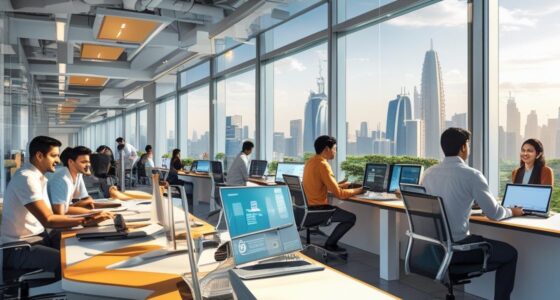

India’s office market is witnessing a structural shift as Tier-2 cities emerge as strong growth engines, driven by cost advantages and expanding infrastructure. According to a recent report by Vestian, flex office stock in Tier-2 cities has reached around 8.8–9 million sq ft, now contributing over 9% of the total flex space across India.
This marks a notable evolution in the country’s commercial real estate landscape, where businesses are increasingly moving beyond metros in search of scalable and cost-efficient alternatives.
Tier-2 Cities Gain Ground in Flex Office Market
The report highlights that Tier-2 cities collectively account for:
- 575+ flex workspace centres
- ~29% share of total flex centres in India
- 8.8 Mn sq ft of flex stock (~9% pan-India share)
This growth reflects a broader decentralisation trend, as companies look to reduce dependence on saturated metro markets.
City-wise Flex Space Distribution
Among Tier-2 cities, flex space supply is led by:
- Ahmedabad – 22.7% share
- Kochi – 10.2%
- Indore – 10.1%
- Jaipur – 8.5%
- Coimbatore – 8.3%
- Lucknow – 7.6%
- Mangaluru – 6.3%
- Chandigarh – 4.9%
- Bhubaneswar – 4.3%
- Dehradun – 4.0%
- Other cities (Vadodara, Surat, Vizag, etc.) – 13.1%
This spread indicates that flex workspace demand is no longer limited to a handful of cities but is broad-based across emerging urban corridors.
Cost Advantage Driving GCC Expansion
One of the biggest drivers of this shift is cost arbitrage, with Tier-2 cities offering:
- Up to 50% lower occupancy costs compared to metro cities
- Access to skilled talent pools
- Reduced operational expenses
As a result:
- 200+ companies have established
- 300+ Global Capability Centres (GCCs) across Tier-2 cities
Key sectors driving this demand include:
- IT-ITeS
- Consulting services
- BFSI
- Engineering & manufacturing
Flex Spaces Becoming Preferred Choice for GCCs
While GCCs are not the dominant occupiers of flex spaces, their presence is steadily increasing:
- ~9% of flex centres in Tier-2 cities cater to GCC-led operations
- 16% of GCC bases operate out of flex workspaces
This signals a growing preference for flexible, scalable office models among global firms entering smaller cities.
Quality & ESG Shift in Tier-2 Office Market
Interestingly, the report highlights a quality gap and opportunity in Tier-2 markets:
- Only 60% of flex centres are in dedicated office buildings
- Just 26% are in Grade-A assets
However, GCC occupiers are setting higher benchmarks:
- 53% of GCC-occupied flex centres are in Grade-A buildings
- 19% operate from green-certified spaces
This indicates that demand for premium, ESG-compliant office spaces will be a key growth driver going forward.
The Bigger Trend: Decentralisation of India’s Office Market
According to Shrinivas Rao, CEO of Vestian:
“The rise of Tier-2 cities is a defining shift in India’s expansion strategy. As infrastructure improves and flex ecosystems mature, the decentralization of GCCs will become a cornerstone of the Viksit Bharat 2047 vision.”
What This Means for Real Estate
For developers, investors, and occupiers, this trend has clear implications:
- New investment hotspots emerging beyond metros
- Rising demand for Grade-A office assets in Tier-2 cities
- Flex operators scaling aggressively in non-metro markets
- Strong linkage between infrastructure growth and commercial real estate demand
As metros face saturation, Tier-2 cities are not just alternatives anymore—they are becoming core to India’s office market expansion story.
Also Read: Flex Spaces to Play Major Role in Office Expansion, Survey Reveals