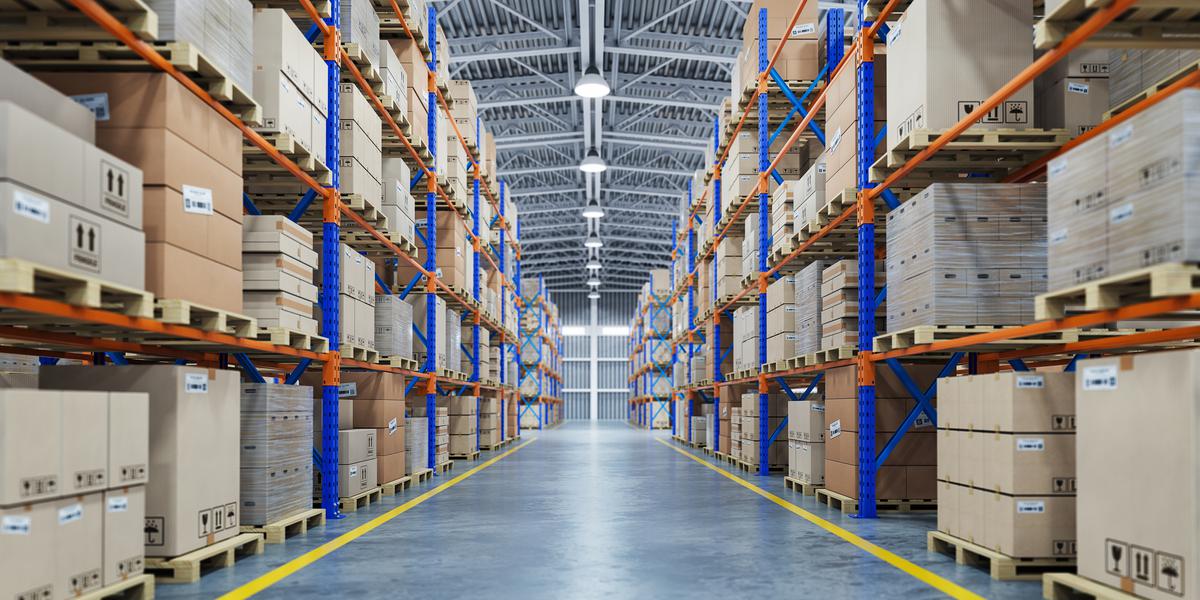

India’s industrial and warehousing real estate market has crossed a significant milestone, with total stock reaching 514 million square feet across eight major cities in the first quarter of 2026, according to fresh data from JLL. Gross absorption — the total space leased or occupied — stood at 18.3 million square feet between January and March, marking a 13% year-on-year growth. If current projections hold, India’s warehousing footprint will balloon to 850 million square feet by 2030, growing at a compounded annual rate of 11.4%.
These are impressive numbers. But they exist inside a broader economic story that directly affects what you pay for goods, where jobs are created, and critically — what happens to land and housing costs in cities like Mumbai, Pune, and Delhi.
What Is Driving This Boom?
Three forces are converging to power this growth.
- India’s Production-Linked Incentive (PLI) schemes are encouraging manufacturers — particularly in engineering and automobile components — to set up or expand operations domestically. Manufacturing accounted for 28% of all absorption in Q1 2026, with engineering transactions leading at 47% of that share and auto and ancillaries at 32%.
- E-commerce is expanding its physical infrastructure at a pace that requires constant addition of last-mile and fulfilment warehouse space. E-commerce companies, alongside FMCG, FMCD, and retail chains, are among the top occupiers of warehousing space.
- India’s emerging role in global supply chain diversification — as multinationals reduce dependence on China — is creating demand for export-ready industrial zones in well-connected cities.
Together, warehousing accounted for 72% of all leasing activity in Q1 2026, or 13.2 million square feet.
Mumbai and Pune: The Industrial Heartland
Mumbai and Pune together commanded 43% of all absorption in Q1 2026 — Mumbai at 22% and Pune at 21%. NCR Delhi followed at 20%, with Bengaluru and Chennai accounting for 13% and 12% respectively. These five cities represent 88% of India’s entire industrial real estate activity.
For Maharashtra, this is a double-edged reality. On one side, it signals sustained investor confidence in the state’s infrastructure, port connectivity, and skilled workforce. Pune’s dominance in manufacturing absorption reflects its deep-rooted industrial ecosystem — from Tata Motors to Bajaj Auto to a growing pharma belt. Mumbai’s lead is driven by its logistics advantage: proximity to JNPT, the country’s busiest container port, and the growing e-commerce fulfilment demand from one of India’s largest consumer markets.
But on the other side, this industrial momentum is now competing with residential land use in a state where land has never been cheap.
The Common Citizen’s Problem: This Affects Your Wallet
Here is where the story becomes personal.
- Land prices will not come down. Industrial and logistics developers are now competing with residential builders for peripheral urban land — in corridors like Bhiwandi, Taloja, and Panvel around Mumbai, and Chakan, Ranjangaon, and Talegaon around Pune. When warehouses and factories occupy land that might otherwise house apartment complexes, it reduces residential supply and puts upward pressure on prices. This dynamic is already visible in Pune’s peripheral markets.
- Construction costs are under pressure. Grade A warehousing — which grew roughly 20% year-on-year to 293 million square feet — uses the same raw materials as residential construction: steel, cement, aggregates, and labour. A warehouse boom drives up demand for these inputs across the board, contributing to higher construction costs for homes. This is especially significant given Maharashtra’s Sand Policy-2025 amendment, which had already flagged material cost pressures in the construction pipeline.
- Rent and lease costs will pass through. The companies leasing warehouses — whether it is a Flipkart fulfilment centre or an auto parts manufacturer — will eventually price logistics costs into consumer goods. More expensive warehouse space means higher rent expenses, which get absorbed into the final price of everything from refrigerators to groceries.
- Jobs are being created — but not necessarily near you. The boom in manufacturing absorption does create employment, particularly blue-collar and semi-skilled jobs in logistics, assembly, and warehousing. But the geographic concentration of this growth — largely in industrial corridors on the city periphery — means workers often face long commutes, inadequate housing near employment zones, and rising rents in areas like Bhiwandi or Khopoli.
- Flexible models signal a new stress point. JLL notes that companies are increasingly adopting lease-to-buy arrangements, built-to-suit leasing, and development management models to cope with rising land acquisition and construction costs. The fact that occupiers are turning to creative financing structures to afford industrial real estate is itself a warning sign: land and development costs have risen to a level where traditional outright ownership is no longer practical. That same stress — in a different form — is what India’s homebuyers have been dealing with for years.
The Quality Gap Is Widening
Of the total 514 million square feet of industrial stock, 293 million square feet — or 57% — now qualifies as Grade A. This Grade A segment grew approximately 20% year-on-year. Institutional occupiers, particularly multinationals and large domestic conglomerates, are clustering in Grade A parks that offer better fire safety, higher floor load capacity, and ESG compliance. This quality differentiation mirrors what has happened in commercial office real estate over the past decade: a two-speed market where Grade A commands premium rents and Grade B stagnates.
For the common citizen, this bifurcation matters because Grade A industrial parks are often the ones attracting formal, regulated employment — the kind with provident fund deductions, health coverage, and fixed-term contracts.
What Happens After 2026?
The projection to 850 million square feet by 2030 — a near-doubling of the current base — assumes that PLI momentum holds, e-commerce penetration deepens, and India’s role in global supply chains continues to expand. These are not unreasonable assumptions, but they are not guaranteed either. Policy reversals, global trade disruptions, or a slowdown in manufacturing investment could temper growth.
What is less uncertain is the structural consequence: as industrial real estate occupies more of India’s best-connected peripheral land, the squeeze on housing — particularly affordable housing — in these corridors will intensify. For city planners, state governments, and homebuyers in Mumbai and Pune, the warehousing boom is not just an investor’s story. It is a land-use story, and increasingly, a cost-of-living story.
Also Read: Robust Investments Bolster Warehousing & Logistics Sector in 2024