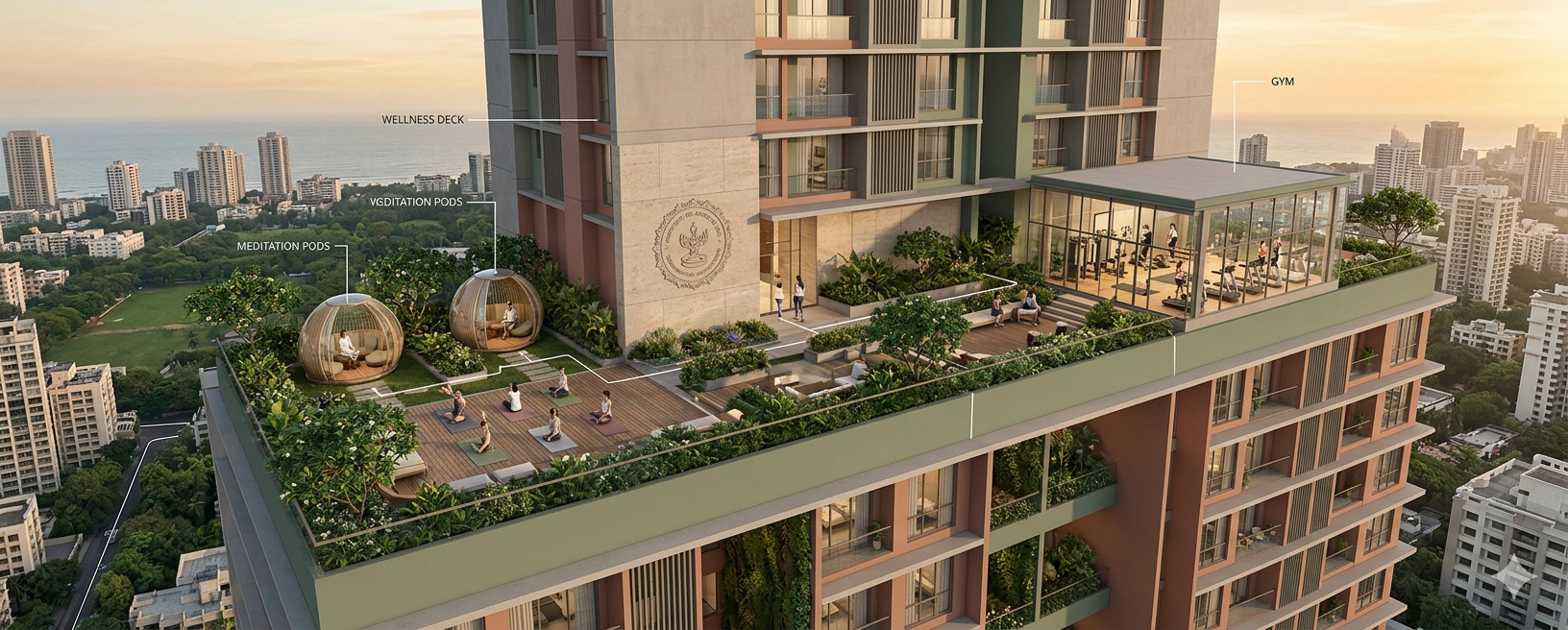

The Brihanmumbai Mahanagarpalika has notified fresh procedural guidelines that significantly expand the scope and size of Yogalaya, Fitness Centre, Meditation Centre and Recreational Activity spaces that housing societies and commercial premises associations can build free of Floor Space Index (FSI), a move that directly benefits residents by allowing larger, more well-rounded wellness amenities within their buildings at no additional FSI cost.
The circular, issued by the Chief Engineer (Development Plan) vide No. ChE/DP/10927/GEN dated 30 July 2026, communicates the approval granted by the Municipal Commissioner under No. MCP/2290 dated 28 July 2026. The guidelines operationalise modifications sanctioned by the Urban Development Department, Government of Maharashtra, through Notification No. TPB-4326/03/C.R.53/2026/UD-11 dated 6 May 2026, which amended Regulation 31(1)(xvii) and Regulation 37(28), and introduced an entirely new Regulation 37(28A) under DCPR-2034.
What has changed
Until now, buildings could set aside space for fitness and yoga amenities free of FSI only up to 2% of the total Built-Up Area. The amended regulations widen both the scope and the quantum of this benefit. Meditation Centres and Recreational Activities have now been formally brought into the same free-of-FSI bracket as Yogalaya and Fitness Centres, and the admissible area itself has been doubled, from 2% to 4% of the total proposed Built-Up Area, computed as per the prevailing policy circular dated 2019-20.
For residents of cooperative housing societies, apartment complexes and condominiums, this effectively means buildings can now offer twice the amenity space, or a combined mix of gym, yoga, meditation and recreational zones, without consuming any of the plot’s chargeable FSI, keeping construction costs and unit pricing more favourable while enhancing lifestyle amenities.
Who can avail the benefit
The BMC guidelines clarify that the provisions of Regulations 37(28) and 37(28A) apply to Cooperative Housing Societies, Apartment Owners Associations, Condominiums, Commercial Cooperative Societies, Commercial Condominiums and Commercial Premises Owners Associations, as well as residential quarters of BMC, State, Central Government bodies and PSUs. Individual residential holdings and standalone bungalows have been explicitly excluded from this benefit.
Residential versus commercial treatment
In residential buildings, the cumulative built-up area for Yogalaya, Fitness Centre, Meditation Centre and Recreational Activities is permitted free of FSI up to 4% of the total proposed Built-Up Area; any area beyond this cap will be counted towards chargeable FSI.
In office and commercial buildings, such amenities can be permitted exclusively for members or owners of the concerned Commercial Cooperative Society, Commercial Condominium or Commercial Premises Owners Association. Here, the free-of-FSI benefit up to 4% of total proposed Built-Up Area comes with a cost: developers must pay a premium equivalent to 100% of the land rate applicable for FSI 1 as per the Annual Statement of Rates. This commercial fitness area must be located within the commercial wing, preferably on upper floors with common access, and clearly earmarked for commercial users of the building.
Rules for existing and upcoming projects
For existing buildings already holding an Occupation Certificate or Building Completion Certificate, proposals for these amenities must be submitted by the registered Cooperative Housing Society, Apartment Owners Association or Condominium itself. For projects still under construction or proposed, the Owner or Developer may apply, but only along with a registered undertaking confirming that the amenity premises will be formally handed over to the society, association or condominium once the development is complete.
Usage and ownership safeguards
The guidelines are firm on how these spaces can be used. The premises must be utilised exclusively for Yogalaya, Fitness Centre, Meditation Centre and Recreational Activities, including ancillary toilet facilities, and strictly for the intended use of residents only. A covered swimming pool has been permitted as part of the Fitness Centre, provided its area is counted within the overall 4% cap.
Crucially, these premises cannot be diverted for any commercial activity or any purpose other than what is specified in the regulations. Ownership of the amenity space, in both residential and commercial buildings, must vest with the concerned Society, Association or Condominium, and the guidelines explicitly bar sub-leasing, renting out, or third-party commercial use of these spaces, closing a loophole that in the past allowed some “recreation” areas to be quietly commercialised.
Distribution and size norms
The BMC has also laid down how this area can be spread across a project. For a standalone building, the amenity area may be split across a maximum of three locations. For buildings with multiple wings, or for layouts with multiple buildings, the area may be distributed across a maximum of two locations per wing. However, at least one such location must have a contiguous area of not less than 30 square metres, and must conform to the minimum width and height norms prescribed for habitable rooms under Regulation 37(2) and 37(3) of DCPR-2034. Any height exceeding 4.2 metres will be treated as consuming an additional 50% FSI of that floor area. For commercial users in mixed-use developments where the 4% cap works out to less than 30 square metres, the project proponent must still provide the full 30 square metre area.
Layouts with a Club House
Where a layout already has, or proposes, a Club House within the Recreational Ground permissible under Regulation 27, the guidelines cap the combined free-of-FSI built-up area of the Club House and the Yogalaya/Fitness/Meditation/Recreational spaces together at 4% of the total proposed Built-Up Area. Any area beyond this combined 4% limit will be counted in FSI.
For mixed layouts comprising both residential and commercial buildings, the 4% free-of-FSI entitlement is computed only on the residential component of the layout, and may be distributed among one or more residential buildings within that layout. This benefit is not available against the built-up area of commercial buildings in such layouts; any commercial fitness facility must separately comply with Regulation 37(28A) and its own conditions.
Relaxation provision
In cases of demonstrable hardship, and for reasons recorded in writing, the Municipal Commissioner has been given the power to relax the minimum dimension norms, drawing on powers vested under Regulation 6(b) of DCPR-2034.
The circular directs all Zonal Deputy Chief Engineers (Building Proposal), including City, Western Suburbs I and II, Eastern Suburbs and the Special Cell, to circulate the policy among officers and staff and ensure strict compliance while scrutinising and processing development proposals going forward.
Also Read: Housing Societies Get Double the Free Space for Gyms & Wellness Centres