
A housing society cannot use a general body resolution to collect more than the government-prescribed transfer premium of Rs 25,000 from an incoming member, the Co-operative Court No. 3, Mumbai, has held. Calling the extra money a “non-refundable car parking deposit” does not make it legal if, in substance, it was taken because the flat was changing hands.
Judge V. R. Kulkarni, deciding Dispute No. CC/III/463/2022 on 22 September 2026, directed RNA Regency Park Tower CHS Ltd., Kandivali West, to refund Rs 50,000 to two members, with simple interest at 6 per cent a year from 30 January 2022 until the money is paid. The dispute was partly allowed, with costs.
The members are Jignesh Khiraiya, 47, a businessman, and his mother Kusum K. Khiraiya, 72. They bought Flat No. 1302 in Building No. 3 of the society under a registered agreement dated 23 March 2017. The share certificate was endorsed in their names on 8 October 2017. The builder, East and West Builders, had earlier allotted them stilt parking No. 1 by a letter dated 8 October 2003. That parking space is in the adjoining RNA Regency Park society, part of the same complex.
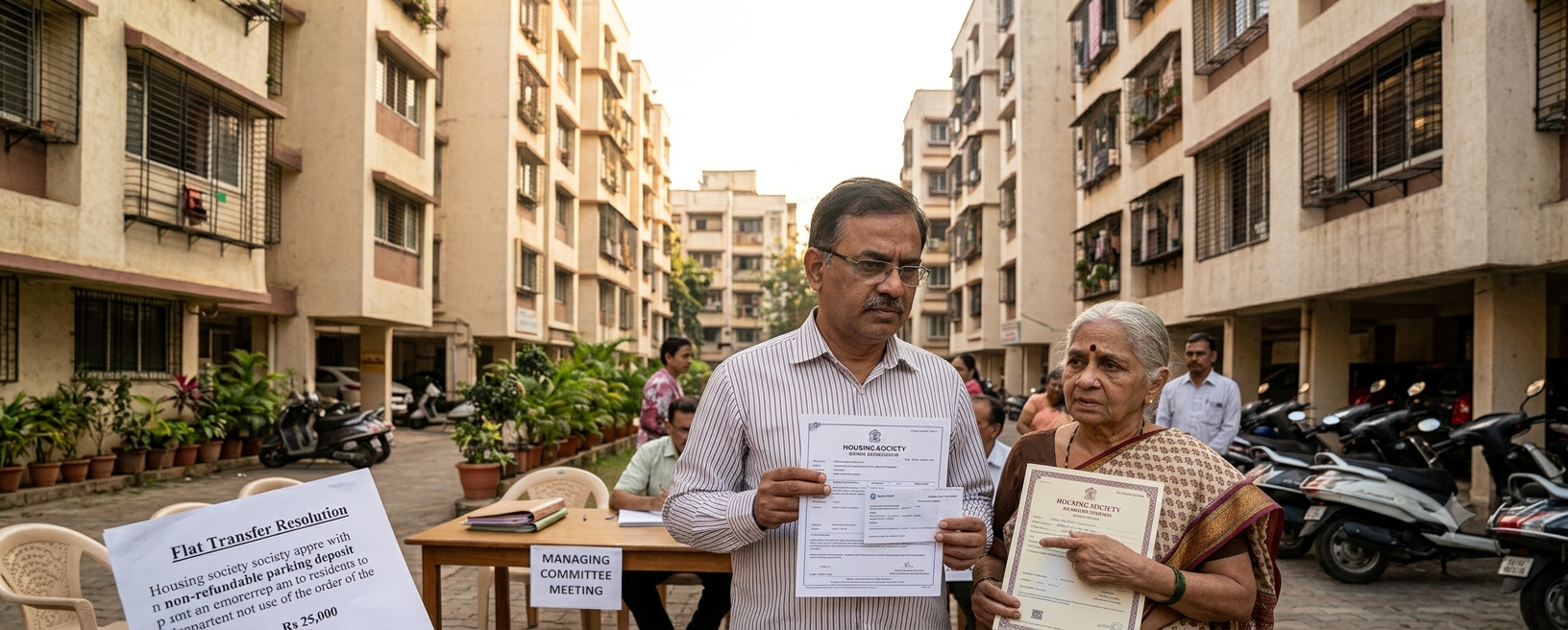
When they became members, the society demanded Rs 75,000 as a non-refundable car parking deposit. The demand came from a Special General Body resolution of 10 June 2012, which fixed Rs 75,000 for stilt parking and Rs 50,000 for open parking from an incoming member. They paid by cheque No. 143777 dated 20 June 2017, drawn on Punjab National Bank, Andheri West. The society’s own receipt No. 136 separately recorded Rs 25,000 as transfer premium and Rs 75,000 as the parking deposit. The members say the society insisted on the payment when a no-objection certificate was needed for a bank loan, and also obstructed the shifting of belongings.
They later complained to the Deputy Registrar that this was an extra collection on top of the transfer premium. The society credited back Rs 25,000 in the maintenance account, after an Annual General Meeting on 15 September 2019 decided that eligible stilt-parking members could get an adjustment of up to Rs 25,000 if they produced a receipt of payment to the adjoining society. The remaining Rs 50,000 was not returned. Notices from January 2022 also failed. The dispute was filed on 26 August 2022 under Section 91 of the Maharashtra Co-operative Societies Act, 1960, for Rs 50,000 plus interest of Rs 52,500 calculated at 21 per cent, and further interest until payment.
The society admitted membership, the 2012 resolution and the later credit of Rs 25,000. It said the two societies were part of one complex, that the developer had arranged parking across both buildings, and that members were bound by the resolution. It also said about Rs 9 lakh of major repairs were carried out from parking collections, without a separate repair contribution. It relied on the Supreme Court ruling in Nahalchand Laloochand that a builder cannot separately sell stilt and open parking, and raised a limitation objection. Nobody appeared for the society at the final hearing. Its right to cross-examine was forfeited after it stayed away on 7 November 2025. It led no evidence.
The court first held that the Rs 75,000 payment was proved, from the cheque, the receipt and the society’s own written statement. It then rejected the repair defence. No officer deposed. There were no proved bills, vouchers, payment records or audited statements linking Rs 9 lakh of repairs to the parking collections. A 2012 discussion about proposed leakage repairs and an estimate was not proof that the work was done or paid for from this money.
On limitation, the claim was held to be within time. Section 92(1)(b) gives six years for a dispute of this kind. The money was collected in June 2017 and the dispute was filed in 2022. It was not treated as a delayed challenge to the 2012 resolution itself.
The decisive finding is on the character of the collection. The court said a general body cannot authorise a levy that the Act, rules or government directions do not permit. The 9 August 2001 directive, issued under Section 79A, caps the transfer premium at Rs 25,000 in municipal corporation areas, including Mumbai. The receipt itself showed that Rs 25,000 had already been taken as transfer premium. The extra Rs 75,000 was demanded only because an outgoing member was leaving and an incoming member was being admitted. The resolution did not identify any new facility, any period of parking use, or any assessed repair share in return.
The court relied on two Bombay High Court rulings. In Alankar Sahakari Grihrachana Sanstha, the High Court ordered repayment of money collected above the permissible premium even though it was called a donation. In Tirthankar Darshan Co-operative Housing Society, decided on 14 August 2025, the High Court rejected a welfare fee demanded over and above the transfer fee, calling it a way around the government directive. A different accounting label, the court said, cannot legalise an additional transfer collection.
The Nahalchand judgment was not used to decide who owns the parking slot. The adjoining society was not a party, and no declaration of title was required. The claim was decided only on the money taken and the absence of lawful authority for that particular levy. The court also made it clear that the order does not ban every parking charge. Regular, lawful parking charges that are not extracted as a condition of transfer can still be collected if they have a proper basis.
The Rs 25,000 already credited was deducted, so the recoverable principal is Rs 50,000. Attendance at a meeting and receipt of that credit were not treated as a full and final settlement. The members had objected in writing on 5 October 2018, before the credit, and continued to demand the balance.
Interest at 21 per cent was refused. No agreement bound the society to that rate, and the interest printed on maintenance bills for member arrears does not create a matching obligation on the society. Under the Interest Act, 1978, pre-suit interest was allowed only from 30 January 2022, the date the written notice demanding repayment with interest was received. From the filing of the dispute until payment, the same 6 per cent simple interest applies. Interest is only on the outstanding principal and cannot be compounded. The claim of Rs 52,500 as a separate lump sum was rejected.
The operative order is in five parts. The dispute is partly allowed with costs. The society must pay Rs 50,000 with simple interest at 6 per cent from 30 January 2022 until realisation. Interest before that date, and any rate above 6 per cent, is rejected. Costs of the proceeding, as taxed, are also payable. An award is to be drawn accordingly.
For flat buyers and society members, the message is direct. In a municipal corporation area, the one-time transfer premium cannot cross Rs 25,000. A resolution that adds a parking deposit, donation or welfare fee at the time of transfer will not protect the society if the extra sum is really another transfer charge. If the society wants to keep such money, it must show a separate lawful basis and records. A later claim that the money was spent on building repairs is not enough.
Also Read: Society Must Repair Flat Damage from Terrace Leakage, Rules Mumbai Co-op Court