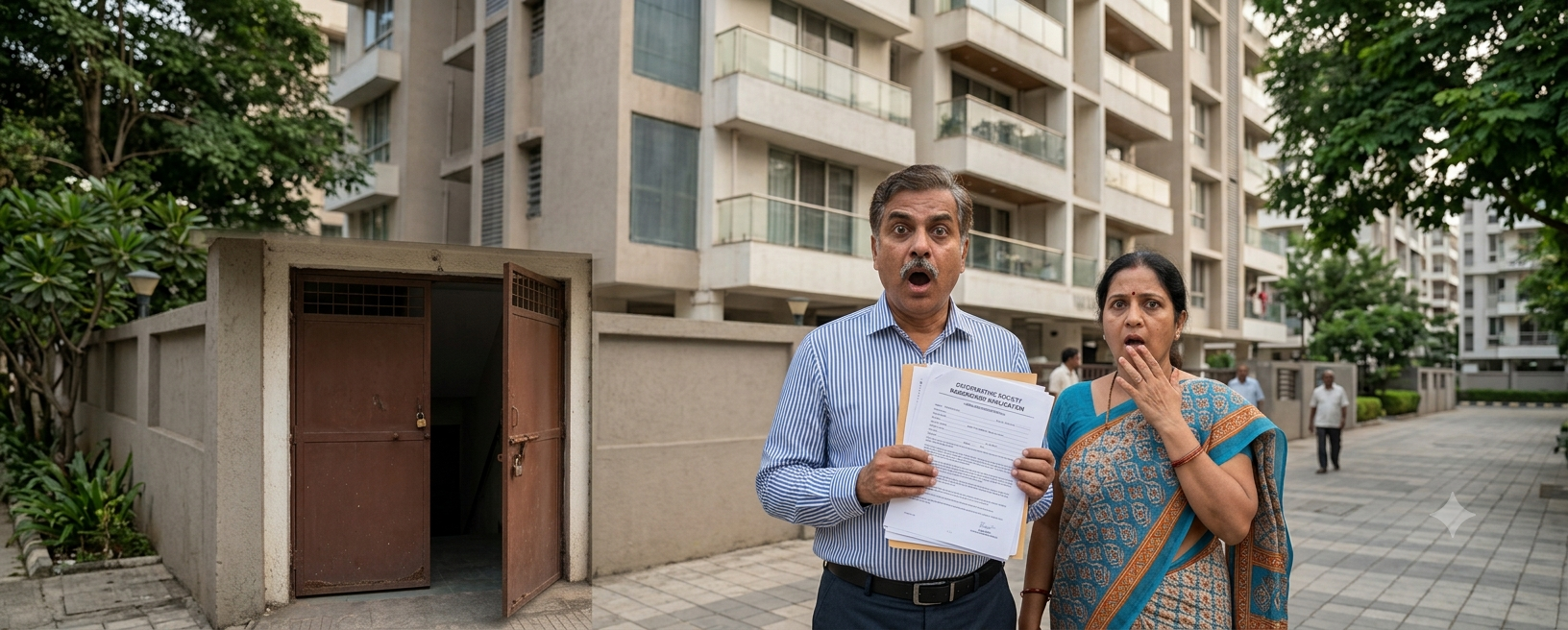

In a significant ruling that will impact cooperative housing societies across Maharashtra, the Bombay High Court has held that a basement godown qualifies as a “flat” under the Maharashtra Cooperative Societies Act and directed a Pune society to grant membership to its buyers.
Justice Sandeep V. Marne dismissed Writ Petition No. 2241 of 2024 filed by Ashwini Heights Cooperative Housing Society Ltd. on 20 August 2026. The Court upheld the order of the Divisional Joint Registrar, Cooperative Societies, Pune, which had directed the society to admit Jyoti Nitin Lunia and Nitin Balchandji Lunia as members in respect of a basement godown.
The judgment reinforces that membership in a cooperative housing society is governed by the sanctioned plan and the statutory definition of “flat”, not by the society’s internal convenience or the manner in which the original owner purchased the premises.
Background of the Dispute
The building of Ashwini Heights Cooperative Housing Society was developed by M/s Ashwini Constructions. Before the society was formed, the developer sold Shop No. 8 on the ground floor (admeasuring about 192 sq.ft.) and a godown in the basement (admeasuring about 272 sq.ft.) to Prakash Balkrishna Daphalapurkar under a single registered agreement dated 6 August 1994.
The society later issued only one share certificate (No. 45) in the name of Daphalapurkar for both the shop and the godown.
In 2005, Daphalapurkar sold only the godown to Ramchandra Maruti Bandal and Savita Bandal through a Deed of Assignment, without obtaining the society’s No Objection Certificate. The Bandals were never admitted as members. In 2010, the Bandals transferred the same godown to Jyoti Nitin Lunia and Nitin Balchandji Lunia, again without the society’s NOC.
The Lunias applied for membership in 2013 and again in 2017. The society refused, primarily on the ground that Daphalapurkar had neither surrendered his share certificate nor obtained the society’s permission for the transfers. The society later contended that the godown was part and parcel of Shop No. 8 and could not be treated as an independent unit for membership.
What the Lower Authorities Decided
The Deputy Registrar, Cooperative Societies, Pune City-2, rejected the Lunias’ application under Section 23(2) of the MCS Act on 6 March 2019, holding that the purchases were made without the society’s consent.
The Lunias filed a revision. On 12 May 2022, the Divisional Joint Registrar allowed the revision, set aside the Deputy Registrar’s order, and directed the society to grant membership to the Lunias qua the godown.
The society challenged this order in the High Court. The High Court had stayed the Divisional Joint Registrar’s order in February 2024.
Society’s Key Arguments
Advocate for the society argued that:
- The godown does not qualify as a “flat” within the meaning of Section 154B-1(13) of the MCS Act.
- It is part of Shop No. 8 and was purchased as a composite unit.
- There is no independent access; the godown can be reached only through the shop.
- Membership cannot exceed the number of flats as per the sanctioned plan under Section 154B-5.
- The “personal occupation certificate” and revised commencement certificate obtained by the Lunias were doubtful and could not be relied upon as they were not produced before the Deputy Registrar.
Court’s Detailed Reasoning
The Court first examined the statutory definition of “flat”.
Section 154B-1(13) of the Maharashtra Cooperative Societies Act defines “Flat” as follows:
“Flat” means block, chamber, dwelling unit, apartment, office, showroom, shop, godown, premises, suit, tenement, unit or by any other name, means a separate and self-contained part of any immovable property, including one or more rooms or enclosed spaces, located on one or more floors or any part thereof, in building or on a plot of land, used or intended to be used for any residential or commercial use such as residence, office, shop, showroom or godown or for carrying on any business, occupation, profession or trade, or for any other type of use ancillary to the purpose specified.
Justice Marne observed that the definition is expansive and expressly includes a godown. Going strictly by this definition, the godown purchased by the Lunias can be treated as a flat.
However, the Court clarified that the wider definition operates within the larger statutory framework. The sanctioned plan remains the decisive filter.
Relying heavily on its earlier judgment in Uday Dalal and Others v. Divisional Joint Registrar, the Court reiterated that:
- The sanctioned plan is the first and most important document for deciding membership.
- A structure may physically exist, but unless the sanctioned plan recognises it as a separate and self-contained unit, it cannot be treated as a flat for membership purposes.
- Section 154B-5 imposes a strict limit: a housing society cannot admit more members than the number of flats available for allotment as per the sanctioned plan.
- Artificial bifurcation of a single flat is not permissible unless the planning authority sanctions the bifurcation.
What the Sanctioned Plan Actually Showed
The Court examined the original sanctioned plans of the Pune Municipal Corporation dated 25 June 1993.
- On the ground floor plan, Shop No. 8 is shown separately with a loft.
- On the basement floor plan, a godown “for non-combustible material” is shown separately beneath Shop No. 8.
- No internal staircase connecting the shop to the godown is indicated in the plan.
- Access to the godown is through the common staircase leading to the basement.
The Court noted that an adjacent godown beneath Shop No. 1 (which also does not carry a separate number in the original plan) already has independent membership, and the owners of Shop No. 1 and that godown are different persons. There was no valid reason to treat the godown under Shop No. 8 differently.
The Court rejected the society’s claim of lack of independent access, observing that the sanctioned plan does not show any internal staircase through the shop.
Later Documents and Late Change in Society’s Stand
The Lunias had obtained a separate Occupation Certificate dated 10 March 2021 for the godown and a revised Commencement Certificate dated 6 July 2021 that specifically numbered it as Godown No. 1. The Court held that these documents only confirmed what was already clear from the original plan.
Importantly, the Court observed that throughout the proceedings before the Deputy Registrar and the Divisional Joint Registrar, the society’s primary objection was only the absence of NOC and the fact that Daphalapurkar still held the share certificate. The argument that the godown and shop formed a composite unit was raised seriously only in the High Court.
Final Holding
The High Court concluded that the statutory requirement of the flat being sanctioned in the development permission was clearly met. The godown is a separate unit as per the sanctioned plan and qualifies as a “flat”.
Justice Marne also made a practical observation: creating two memberships (one for the shop and one for the godown) actually benefits the society, as it can collect two sets of service charges instead of one.
The Court found the Divisional Joint Registrar’s order unexceptionable and dismissed the writ petition with no order as to costs.
Implications of the Judgment
This ruling sends a clear message to cooperative housing societies:
- Ownership of a shop and an adjacent or basement godown by the same person under a single agreement does not automatically make them one indivisible unit for membership purposes.
- The sanctioned plan, and not the society’s internal practice of issuing a single share certificate, determines how many independent memberships can exist.
- Godowns, shops, and other commercial premises can qualify as “flats” if they are shown as separate self-contained units in the sanctioned plan.
- Societies cannot refuse membership solely on the ground of absence of NOC when the premises otherwise satisfy the statutory requirements.
The judgment is particularly relevant for older buildings in Pune, Mumbai and other cities where shops and basement storage units were often sold together but later transferred separately.
Also Read: Cooperative Court Can’t Decide Family Property Dispute