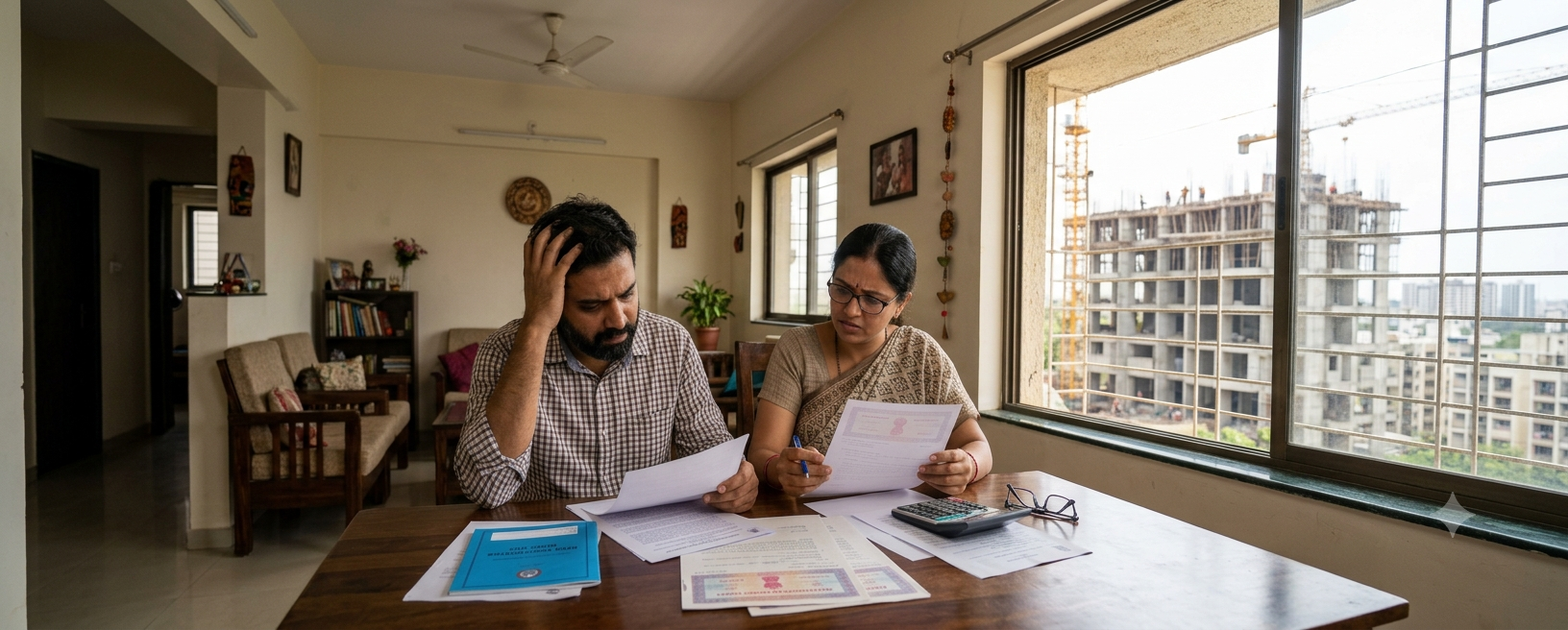

The Maharashtra Real Estate Regulatory Authority (MahaRERA) has once again drawn a clear line between what a homebuyer can recover from a builder and what falls outside a promoter’s liability, this time in an order involving a stalled Vasai project where the buyer sought refund of stamp duty and registration charges along with the consideration amount, only to have that portion of the claim rejected.
The Complaint
M/s India Connection Impex Pvt. Ltd. had booked Flat No. 1203 in Building No. 2, Wing “I” of the project “Bharat Arcade” in Vasai, Palghar district, developed by M/s Kartik Realtors. A registered Agreement for Sale was executed on 24.12.2013 for a total consideration of Rs. 22,00,000. The complainant paid Rs. 20,65,000 towards this consideration, along with Rs. 1,55,000 towards stamp duty and registration charges and Rs. 67,980 towards service tax, taking the total amount paid to Rs. 22,87,980.
With the project remaining incomplete years after the agreement was signed, the complainant sought withdrawal from the project and refund of the entire Rs. 22,87,980, along with interest at 18 percent per annum as stipulated under Clause 42 of the agreement.
Why The Refund Was Allowed On The Consideration Amount
The Agreement for Sale did not specify a date for handing over possession. MahaRERA applied the principle from the Supreme Court’s ruling in Fortune Infrastructure v. Trevor D’Lima, treating three years from the agreement date as a reasonable period for completion. This period expired on 24.12.2016, yet the project remained ongoing even at the time of the order.
The authority noted that the promoter’s own submission, stating that “almost all construction work has been completed” and that possession would be handed over “as expeditiously as possible,” itself confirmed that the project was still incomplete years after the reasonable completion period had lapsed.
Citing the Supreme Court’s decision in Newtech Promoters and Developers Pvt. Ltd. v. State of U.P., MahaRERA held that this continued non-completion amounted to a failure by the promoter to fulfil its obligation, entitling the complainant to withdraw under Section 18(1) of the RERA Act and claim refund with interest.
Why Stamp Duty, Registration Charges And Service Tax Were Excluded
This is where the order becomes instructive for homebuyers pursuing refund claims. MahaRERA held that the statutory entitlement under Section 18 extends only to refund of the amount received by the promoter in respect of the apartment. Since stamp duty, registration charges and service tax are not amounts received by the promoter, but payments made to government authorities and tax departments, they could not be directed to be refunded by the promoter under Section 18.
The order draws a distinction between two categories of payment: money that flows to the builder as consideration for the flat, and money that flows to the state or central government as statutory levies. A promoter’s liability under Section 18 is confined to the first category, because the provision speaks of refunding “the amount received by the promoter.” A builder cannot be made to answer for charges it never collected or retained.
Accordingly, the refund was restricted to Rs. 20,65,000, the amount actually paid to and received by Kartik Realtors, and the claims for Rs. 1,55,000 towards stamp duty and registration and Rs. 67,980 towards service tax were rejected.
Interest At 18 Percent Also Declined
The complainant’s claim for interest at 18 percent per annum, based on Clause 42 of the agreement, was also not accepted in full. MahaRERA held that the rate of interest payable under Section 18 is governed by the statutory framework, not by a contractual clause. Interest was instead directed at the State Bank of India’s Highest Marginal Cost of Lending Rate (MCLR) plus 2 percent, as prescribed under Rule 18 of the Maharashtra Real Estate (Regulation and Development) (Registration of Real Estate Projects, Registration of Real Estate Agents, Rates of Interest and Disclosures on Website) Rules, 2017.
The Final Order
MahaRERA Member Ravindra Deshpande directed Kartik Realtors to refund Rs. 20,65,000 to the complainant, along with interest at SBI’s Highest MCLR plus 2 percent from the date of each payment till actual realisation, within 30 days of the order. No order was made as to costs.
The Larger Takeaway For Homebuyers
This order reinforces a pattern seen across MahaRERA rulings: while Section 18 gives allottees a strong right to exit a delayed project and recover their money with interest, that right is tied strictly to what the promoter actually received. Stamp duty and registration charges go to the government exchequer, and service tax or GST goes to the tax department, not the builder’s account. Homebuyers seeking full recovery of these statutory costs may need to pursue separate remedies with the relevant government authority, since MahaRERA’s refund jurisdiction under Section 18 does not extend to money the promoter never held.