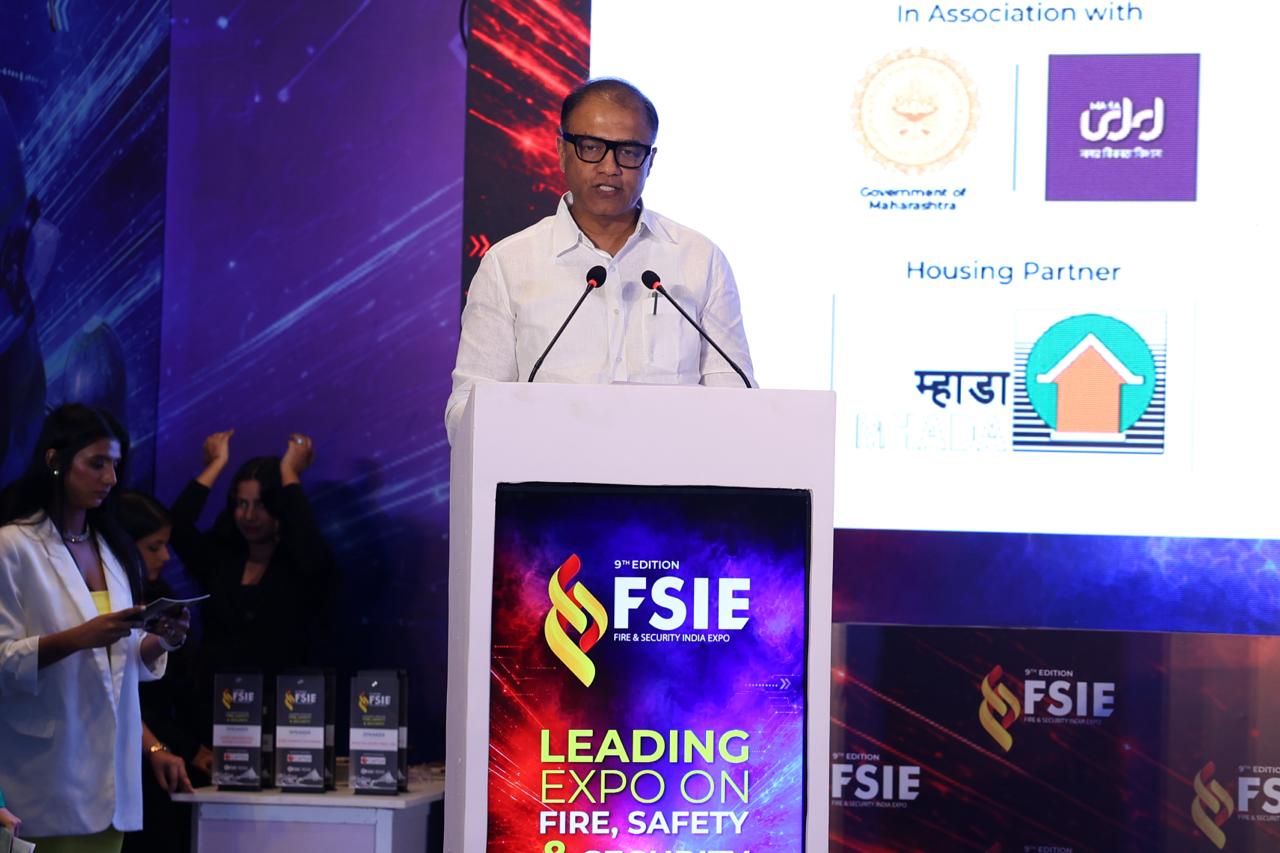
Fire safety in Mumbai’s rapidly growing built environment must go beyond obtaining approvals and Fire NOCs, with regular inspections, testing and maintenance becoming an integral part of a building’s lifecycle, Maharashtra Minister of State Pankaj Bhoyar said at the ninth edition of the Fire & Security India Expo (FSIE) 2026 in Mumbai.
The minister’s remarks come at a time when Mumbai and the wider Mumbai Metropolitan Region are witnessing rapid redevelopment, high-rise construction and increasing urban density, making fire prevention, evacuation preparedness and functioning safety systems critical to the resilience of buildings and public spaces.
The FSIE 2026 is being held from September 3 to 5 at the Jio World Convention Centre in Mumbai and brings together stakeholders from the fire protection, life safety, security and building automation sectors.
Development and Safety Must Go Hand in Hand
Addressing the inaugural session, Dr Pankaj Bhoyar, Minister of State, Government of Maharashtra, stressed that India’s infrastructure and urban development must be accompanied by stronger safety preparedness.
“Development and safety must always go hand in hand,” Bhoyar said, emphasising that buildings, workplaces and public spaces must be designed with the safety and security of citizens as a priority.
He also called for greater investment in indigenous fire and security technologies. According to Bhoyar, India should move beyond simply adopting technologies developed elsewhere and build solutions domestically that can eventually be exported to global markets.
He urged entrepreneurs, manufacturers, startups and technology companies to invest and manufacture in Maharashtra, linking fire-safety innovation with the broader Make in India and Startup India initiatives.
Fire NOC Cannot Be the End of the Safety Process
A key message from the event was that obtaining a Fire NOC should not be treated as the final measure of a building’s fire-safety preparedness.
Madhuri Misal, Minister of State for Urban Development, Government of Maharashtra, said fire safety must be incorporated from the design and construction stage itself rather than being treated as a post-construction compliance exercise.
Her approach covers several aspects of a building, including structural design, electrical and water systems, evacuation planning, firefighting installations and the regular testing and maintenance of safety equipment.
Misal called for a shift from a “certificate-based” approach to one based on continuous safety and preparedness. In practical terms, this means that fire-safety systems need to remain operational throughout the life of a building rather than simply being compliant when an approval or certificate is obtained.
“Fire safety cannot be limited to installing fire extinguishers or obtaining a fire NOC,” Misal said, stressing the importance of regular inspection, testing, maintenance and compliance.
Why Continuous Fire Safety Matters for Mumbai
For Mumbai, the issue has particular relevance because the city is undergoing extensive redevelopment while simultaneously adding new high-rise residential and commercial buildings.
As older structures are replaced and development becomes increasingly vertical, fire-safety planning has to account not only for firefighting equipment but also for evacuation routes, access for emergency services, electrical infrastructure, water availability and the continued functioning of installed systems.
The Maharashtra Fire & Emergency Services itself provides dedicated guidance covering high-rise residential buildings, malls, schools and industrial premises, while the state has a statutory framework under the Maharashtra Fire Prevention and Life Safety Measures legislation.
This makes the emphasis on ongoing maintenance particularly significant for housing societies, commercial establishments, developers and building managers.
From Reactive Response to Proactive Prevention
The broader objective emerging from FSIE 2026 is to move the fire-safety ecosystem from responding to incidents towards preventing them and ensuring that buildings remain prepared to deal with emergencies.
Rakhi Deepak, National President of the Fire & Security Association of India (FSAI), described safety as a collective responsibility involving government, industry, professionals and technology providers.
The expo is showcasing technologies covering fire protection, life safety, security, surveillance, building automation and emergency response. AI, IoT, smart sensors, advanced fire detection and integrated command-and-control systems are among the technologies being highlighted.
Such technologies can potentially improve the speed at which fires are detected and emergency responses are initiated, but the effectiveness of these systems ultimately depends on proper installation, regular testing, maintenance and trained personnel.
Push for Maharashtra-Made Safety Technology
Bhoyar also used the platform to push for a stronger domestic fire and security technology ecosystem.
He said Maharashtra should become a base for manufacturing and innovation in the sector, with locally developed safety solutions being taken to international markets.
The emphasis is significant as India’s urbanisation creates a growing requirement for fire detection, emergency response, surveillance, building automation and integrated safety systems.
The minister’s message was therefore not limited to regulatory compliance. It also linked urban growth with technology, manufacturing, skilled professionals and preparedness.
FSIE 2026 Brings Industry and Government Together
The ninth edition of FSIE 2026 features more than 240 exhibiting brands and over 70 speakers, bringing together government representatives, architects, engineers, consultants, manufacturers, technology companies and other industry stakeholders.
The event is supported by the Government of Maharashtra and its Urban Development Department, highlighting the focus on fire prevention, emergency preparedness and safer built environments.
For Mumbai’s increasingly dense urban landscape, the central takeaway from the event is clear: fire safety cannot end with a certificate.
Buildings need systems that work when they are required, evacuation plans that can actually be implemented, trained personnel who know how to respond, and regular inspections and maintenance to ensure that safety infrastructure remains functional throughout the building’s life.
The shift from obtaining a Fire NOC to maintaining continuous preparedness could therefore become an increasingly important part of how Mumbai approaches the safety of its existing and rapidly expanding building stock.
Also Read: Rising Fire Incidents & the Need for a Right Combating Tool