Seven members of a Mulund housing society have won a significant victory in the State Consumer Disputes Redressal Commission. The Commission has ordered their society to introduce annual rotational parking and pay compensation, holding that members who pay maintenance are consumers and the society is a service provider.
The Parking Dispute at Mulund Society
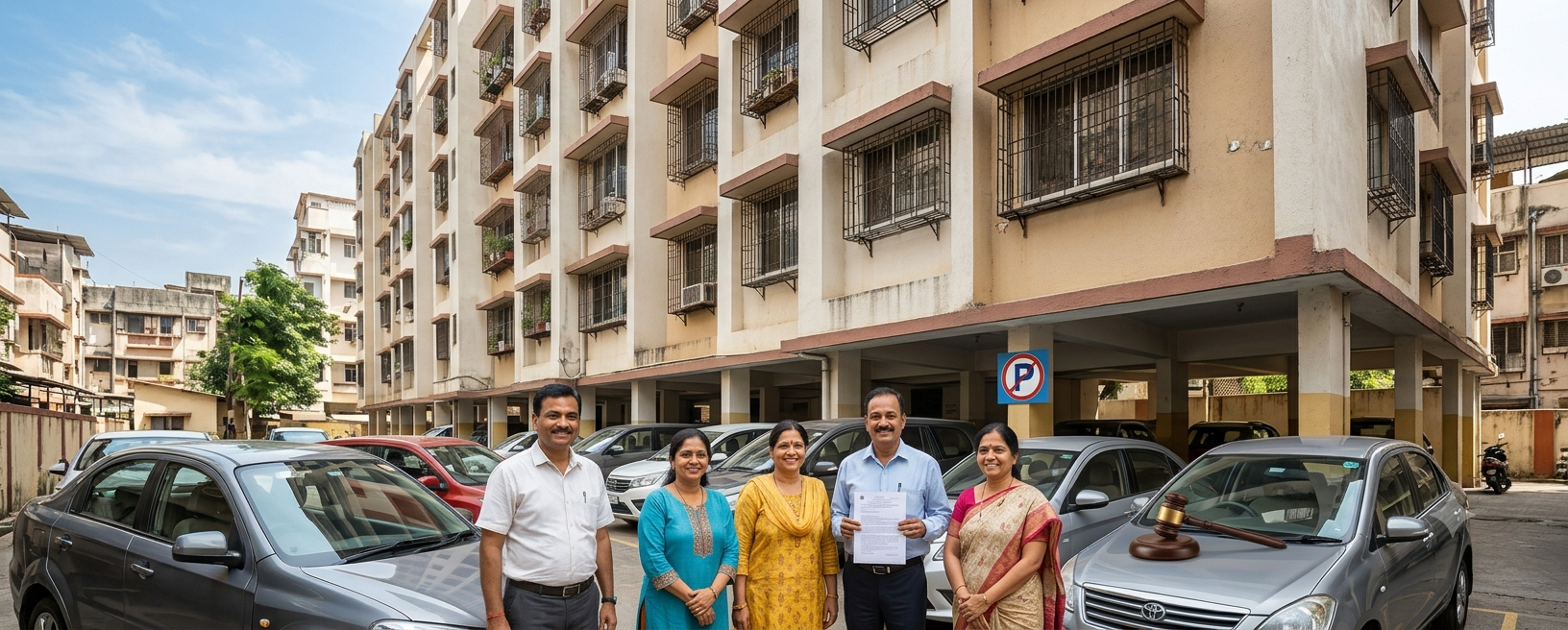
The case involved Mulund Shree Mahalaxmi Co-operative Housing Society, which has 68 flats but only 45 parking spaces (stilt and open). The society had permanently allotted all 45 spaces to selected members, leaving 23 flats without any parking.
The seven complainants approached the State Commission in 2019 as a class action. They alleged that despite being eligible members and vehicle owners, they had been systematically denied parking. They pointed out that the society had collected deposits from some flat purchasers years earlier and then froze the allotments.
Residents first raised the demand for rotational parking in the Annual General Meeting in September 2017. The society later passed an Extraordinary General Meeting resolution on 3 June 2018 maintaining “status quo.” The complainants challenged this as arbitrary and discriminatory.
Society Members Are Consumers, Society Is Service Provider
The society and some members who already had permanent parking argued that the complainants were not “consumers” under the Consumer Protection Act because they had not paid any separate consideration specifically for parking. They also contended that the dispute fell exclusively under the jurisdiction of the Cooperative Court under the Maharashtra Co-operative Societies Act, 1960, and that the complaint was time-barred.
The Commission rejected these arguments. It held that the complainants are lawful flat owners who regularly pay maintenance charges to the society. The maintenance and administration of common areas, including parking spaces, constitutes “service” under the Consumer Protection Act.
The Commission emphasised that Section 3 of the Consumer Protection Act provides an additional remedy. This remedy is not barred by the provisions of the Co-operative Societies Act. In simple terms, when a housing society collects maintenance from its members and manages common amenities, the members stand as consumers and the society stands as a service provider. Deficiencies in the management of those amenities can therefore be taken to the consumer forum.
Permanent Parking Monopoly Struck Down
The Commission noted that under the Maharashtra Ownership Flats Act and the Supreme Court’s 2010 judgment in Nahalchand Laloochand Pvt. Ltd. vs. Panchali Co-operative Housing Society Ltd., stilt and open parking spaces form part of the common areas and facilities. No member can claim exclusive, permanent ownership of a parking space to the detriment of others.
The society had relied on Model Bye-Law No. 78, which speaks of “first come, first served” allotment. The Commission held that this bye-law cannot be read in isolation to create a permanent monopoly. When the number of eligible members exceeds the available parking spaces, Model Bye-Law No. 81 mandates that the managing committee must allot parking slots on an annual basis through a fair, transparent and rotational process.
By permanently freezing the 45 parking slots for 45 members and passing a resolution to maintain status quo, the society had created two classes of members — one enjoying permanent parking privileges and the other perpetually deprived of a common amenity. This amounted to deficiency in service and unfair trade practice.
What the Commission Ordered
The State Commission partly allowed the complaint and directed:
- The society must implement an annual rotational parking policy strictly in accordance with Model Bye-Law No. 81, ensuring all eligible vehicle-owning members get an equitable opportunity to use the 45 available parking spaces.
- The rotational policy must be framed, adopted and commenced within 60 days from the date of receipt of the order.
- The society must pay a consolidated compensation of ₹1,00,000 towards mental agony and physical hardship, to be distributed equally among the seven named complainants.
- The society must also pay ₹50,000 as litigation costs.
The order was passed by a bench comprising Presiding Member Poonam V. Maharshi and Member Dr. Nisha Amol Chavhan.
Why This Judgment Matters for Housing Societies
Parking remains one of the most frequent sources of friction in cooperative housing societies across Mumbai and Maharashtra. Societies often continue old permanent allotments even when demand far exceeds supply, citing past practice or majority resolutions.
This judgment clarifies two important points. First, members who pay maintenance can approach the consumer commission against their own society for deficiencies in the management of common amenities. Second, when parking spaces are fewer than the number of eligible members, permanent allotment is not sustainable; Model Bye-Law No. 81 requires annual rotational allotment.
Societies that have frozen parking for years may now face similar challenges. The ruling reinforces that general body resolutions cannot override the model bye-laws, and that fairness in the distribution of limited common facilities is a service obligation under consumer law.
Also Read: Real Estate cases comprise of 10% of the total cases in Consumer Commissions