You Can’t Lock the Door When Water Is Coming From Your Flat
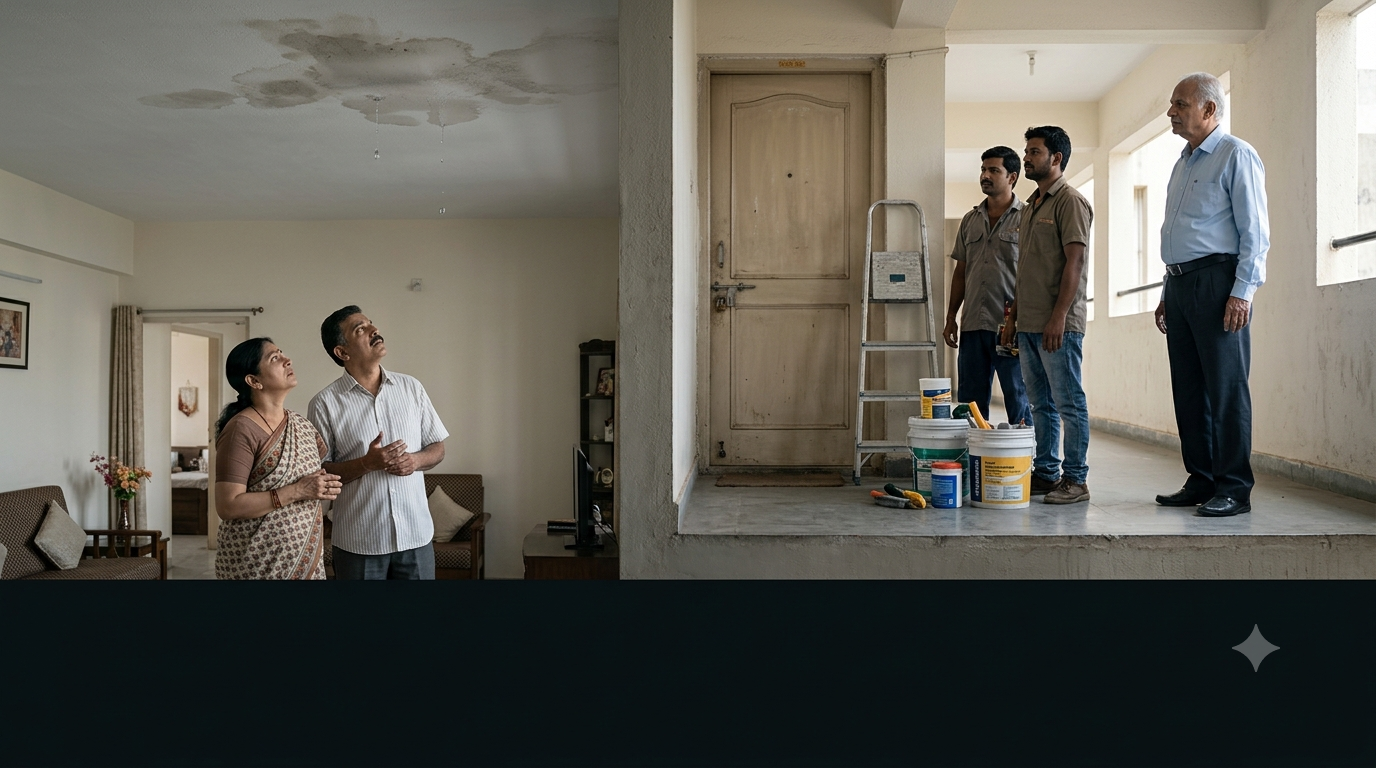
A 14-year ceiling leak in a Kalyan co-operative housing society has produced a blunt message from the Maharashtra State Co-operative Appellate Court: if seepage is coming from your flat into the flat below, you cannot refuse the neighbour’s repairmen entry. Privacy, family inconvenience and past damage claims are not enough to stop a supervised repair.
The order, delivered on 4 September 2026 by Member-1 Dr. Srishty Neelkanth in Appeal from Order No. 40 of 2026, upholds a March 2026 interim direction of the Co-operative Court, Thane. Workers appointed by the lower-floor owners must be allowed into the upper flat with tools and materials. The society must supervise the work.
The ruling does not decide who finally pays or whether earlier drilling damaged the slab. It only settles the immediate question that stalls most such disputes: can the upper occupant simply say no?
Two flats, one slab, 14 years of water
The building is Madhav Sankalp KP Co-operative Housing Society Ltd. at Khadakpada, Kalyan (West).
Mangla Vithal Bari and Jitendra Vithal Bari live in Flat C-1/904. Directly above them, in C-1/1004, live Manish Jairam Talreja and Maya Jairam Talreja.
Leakage in the Baris’ common toilet and master bedroom began in July 2012, when the upper flat still belonged to a previous owner. The Baris say civil work — changing floor tiles — started the seepage. They approached the society. Little happened.
The Talrejas moved in around September 2014. By 2015 the leak had worsened. In May 2016 a repair costing ₹4,500 was done; the Baris paid. In 2018 another contractor job costing ₹36,750 was done; again the Baris paid. That year the annual general meeting resolved that future leakage-repair expenses would be shared equally by both flats.
The water did not stop. The Baris filed Dispute No. CCT 14/2025 before the Co-operative Court, Thane, and sought urgent interim access so their workers could enter the upper flat and stop the source.
What the trial court ordered
On 20 March 2026 the trial judge partly allowed the interim application (Exhibit 5). The upper-flat owners were directed to permit entry of workers appointed by the Baris, with necessary materials and tools, to carry out leakage repair. The society was ordered to supervise.
That limited order is what the Talrejas challenged.
Why the upper flat appealed
Their case, in short:
- Earlier repair work had already dismantled flooring and tiles inside 1004. They claimed roughly ₹1.85 lakh spent on refilling drilled holes and replacing tiles.
- They alleged the Baris had carried out illegal drilling into the common RCC slab without permission.
- Unrestricted access would hit privacy and peaceful occupation. Elderly family members and a minor child live in the flat.
- Structural repairs and certain leakages, they said, are the society’s job under Model Bye-laws 159(X) and 159(XIV).
- An independent structural auditor or architect appointed by the society should first examine the premises.
They asked that the March order be set aside.
The Baris answered that they have lived with seepage for more than a decade, that they cannot occupy their own home freely, and that further delay risks the building’s structural stability. They said they were ready to bear the cost of the present repair. The society told the appellate court it was trying to mediate.
The engineer the appellants themselves suggested
During arguments the court tried an amicable route. Because the Talrejas did not trust the society, an engineer was to be chosen from names they suggested. The society appointed that engineer. He visited both flats. His sealed report was opened in court.
The report accepted that there is leakage in the lower flat. It was silent on the exact source. That silence did not help the appellants. The court still treated the long history, the photographs and the earlier paid repairs as enough for a prima facie finding that water is coming from above.
The Talrejas then repeated that they would not allow work inside their home.
Bye-laws, AGM resolution, and who pays
The court restated a basic rule most society members miss. Under the model bye-laws, repairs other than those listed in Bye-law 159(a) are to be carried out by members at their own cost. Structural work of the building is a society responsibility; internal leakage originating in one flat and damaging the flat below is not automatically dumped only on the managing committee.
A 2018 AGM resolution said both flats would share leakage-repair expenses equally. That resolution binds both sides. The Baris, however, told both courts they would pay the entire bill this time. The appellate court noted that concession.
Cost-sharing and any claim for past tile damage remain issues for the main dispute. They were not enough to block access.
The three tests the court applied
Interim relief in such matters turns on three familiar questions. The court answered all three in the Baris’ favour:
- Prima facie case — yes. Leakage in 904 originating from 1004 is made out on the record.
- Balance of convenience — yes. The lower occupants cannot live normally; the upper occupants face temporary, supervised entry.
- Irreparable injury — yes. Continued seepage damages property and can affect structural stability of the building.
The March 2026 order was held legal and correct. No interference was required. The appeal was dismissed. Parties were left to bear their own costs.
What the order does — and does not — do
It does not decide final liability. It does not award damages. It does not hold that the society is free of all duty. It does not authorise demolition or unsupervised drilling.
It does this: workers chosen by the lower-flat owners may enter the upper flat with tools and materials to carry out leakage repair and waterproofing, and the society must stand there and supervise.
Privacy is acknowledged. It does not defeat the neighbour’s right to stop water entering their home from above.
Why this matters beyond one Kalyan building
Inter-floor leakage is one of the most common fights inside Maharashtra co-operative housing societies. Typical pattern: lower flat complains for years; society issues notices; upper flat cites privacy, family, previous botched repairs or “the society should do it”; work never starts.
This order tells managing committees and members that once a prima facie case of seepage from the upper flat is shown, courts will not treat the upper occupant’s door as a veto. Supervised, time-bound access can be forced. An AGM resolution on cost-sharing helps. Willingness of the lower owner to pay the current bill helps more.
Societies that stay “neutral” while a slab leaks for a decade are expected to facilitate, not watch.
The main dispute in CCT 14/2025 will still decide money, alleged illegal drilling, and any longer-term waterproofing plan. Until then, the legal position on the landing is simple: if the leak is coming from your flat, you cannot stop the person downstairs from sending repairmen in.
Also Read: Maharashtra Forms High-Level Committee to Amend Cooperative Societies Act, 1960