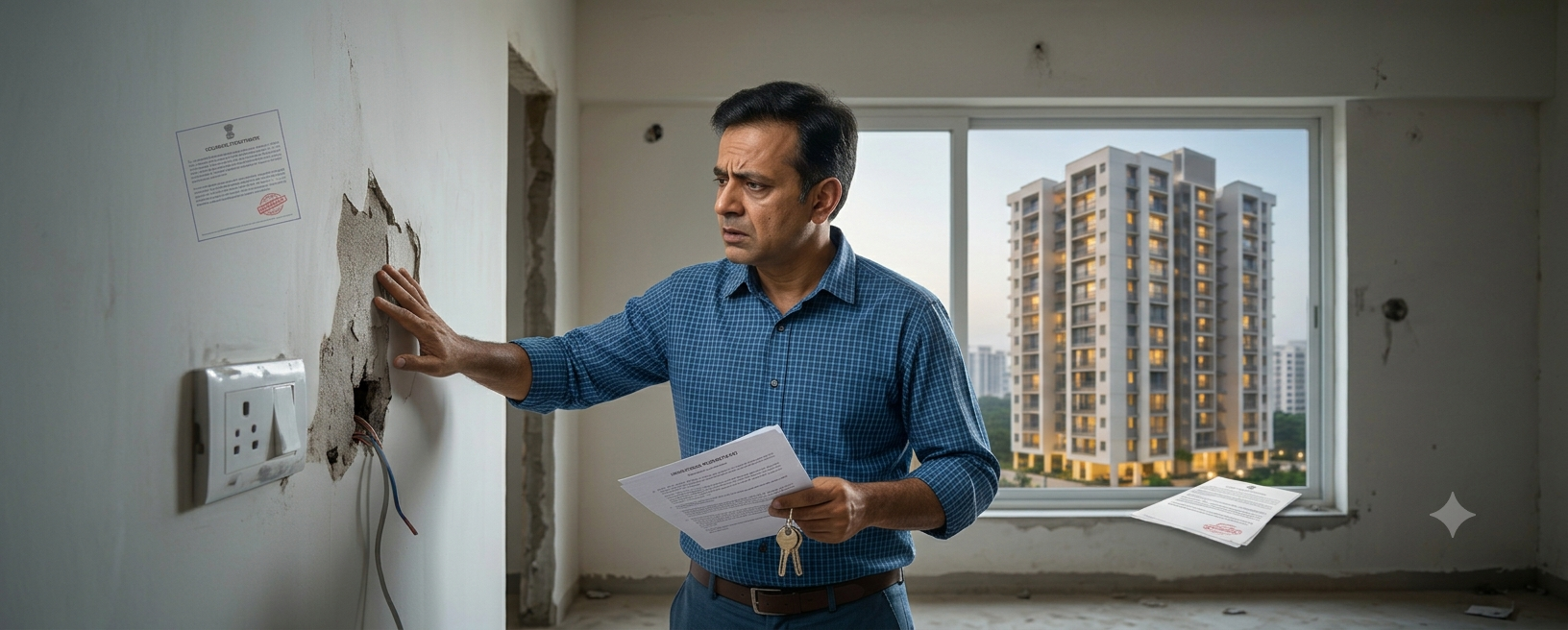

MahaRERA has ruled that the five-year defect liability period under Section 14(3) of the Real Estate (Regulation and Development) Act, 2016, begins from the actual date of handing over possession and not merely from the date of the Occupancy Certificate (OC). In an order dated October 22, 2026, in Complaint No. CC12500643, Member II Ravindra Deshpande directed Gundecha Construction Pvt. Ltd. to hand over possession of a flat in its Gundecha Woods project at Nandore, Palghar, within 30 days, arrange a technical inspection and rectify defects attributable to the developer within 60 days. The ruling came after a homebuyer alleged that the developer was relying on a 2019 OC to claim that the five-year defect liability period had already expired, even though he had purchased the flat in 2024 and had not received actual possession.
Why the date of possession matters more than the OC date
The order addresses an important concern for homebuyers purchasing flats in completed projects where the Occupancy Certificate was obtained several years before the actual sale.
Under Section 14(3) of RERA, a developer is responsible for rectifying structural defects and other defects relating to workmanship, quality, provision of services or other obligations under the Agreement for Sale, if they are brought to its notice within five years from the date of handing over possession.
The promoter is required to rectify such defects without charging the allottee within 30 days of the defect being brought to its notice. If the promoter fails to do so, the allottee becomes entitled to appropriate compensation under the Act.
The crucial question in this case was whether the five-year period could be calculated from the date on which the building received its OC, rather than the date on which the individual homebuyer actually received possession.
MahaRERA ruled that the two dates cannot be treated as interchangeable.
The Authority observed that an Occupancy Certificate establishes that the building or premises has received the requisite occupancy approval. However, it does not, by itself, establish that possession has actually been handed over to a particular allottee.
Consequently, a developer cannot rely solely on an old OC date to claim that the statutory defect liability period applicable to a subsequent purchaser has expired.
Homebuyer purchased a 1 BHK flat for ₹15.50 lakh
The complaint was filed by Mitesh Shyamsunder Varshney against Gundecha Construction Pvt. Ltd. concerning Flat No. A-3 on the ground floor of the Palm building at Gundecha Woods, Nandore, Palghar.
The project is registered with MahaRERA under registration number P99000003314.
According to the complainant, he came across an advertisement for a 1 BHK flat priced at approximately ₹17 lakh, inclusive of GST and registration charges.
In September 2024, his sister visited the project on his behalf. During the visit, the developer’s representative allegedly informed her that the project had received its Occupancy Certificate in November 2023.
After inspecting several flats, she was informed that Flat No. 3 on the ground floor was not attracting buyers and that its price had consequently been reduced to ₹15.50 lakh.
The complainant decided to purchase the flat.
The total transaction amount came to ₹16,24,090, including the flat consideration, society maintenance, corpus fund, other society charges and applicable GST.
The developer accepted an advance payment of ₹1.55 lakh on October 5, 2024. The Agreement for Sale was executed on October 29, 2024, and registered on November 4, 2024. The complainant also obtained a home loan through Axis Bank.
Buyer discovers that the OC was issued in September 2019
The dispute over the defect liability period emerged when the complainant subsequently discovered that the project’s Occupancy Certificate was actually dated September 9, 2019, and not November 2023, as he alleged he had initially been informed.
This meant that the OC had been issued approximately five years before he entered into the transaction.
The complainant argued that the developer was attempting to use this earlier date to avoid its statutory responsibility for defects.
According to him, if the five-year period was calculated from September 2019, it would have expired before he had even purchased the flat.
He maintained that Section 14(3) of RERA specifically provides that the five-year period begins from the date of handing over possession to the allottee.
The developer, however, maintained that the OC had been obtained on September 9, 2019, and that the flat was ready for occupation. It also claimed that it had repeatedly called upon the complainant to take possession through communications sent between October 2024 and February 2025.
Developer allegedly insisted on an additional possession agreement
The dispute was not limited to the OC and defect liability period.
The complainant alleged that when he visited the flat on December 9, 2024, to take possession, he found that the premises were not ready for occupation.
He claimed that the painting was incomplete, window grills were rusted, sanitary fittings had been changed and the flat contained spitting marks and alcohol bottles. He also alleged that the developer’s workers had been using the premises.
He further raised concerns about incomplete amenities, electrical wiring, earthing, plumbing, cracks and leakage.
Another issue arose when the developer allegedly insisted that he sign an additional document titled ‘Possession Letter’ before handing over the keys.
The complainant objected to several clauses in this document, particularly those requiring him to acknowledge that the flat had been inspected, all work was completed satisfactorily and there was no deficiency in service.
He argued that he could not be compelled to declare that the flat was defect-free when he had already raised complaints about its condition.
The developer maintained that the possession letter was a standard document applicable to all flat purchasers and denied withholding possession.
The complainant also alleged that the developer threatened to cancel the Agreement for Sale and sell the flat to another purchaser if he failed to sign the possession letter and take possession by March 1, 2025.
Apprehending cancellation of the agreement, he approached MahaRERA.
MahaRERA: Developer cannot make possession conditional on surrendering statutory rights
While examining the dispute, MahaRERA considered whether the developer could insist on an additional possession document containing declarations that were not part of the registered Agreement for Sale.
The Authority observed that contractual obligations under an Agreement for Sale cannot be exercised in a manner that defeats the statutory rights available to an allottee under RERA.
It specifically noted that the developer could not insist that the buyer acknowledge that the flat was free from defects or that no deficiency of service existed when the buyer had specifically disputed the condition of the premises.
The Authority observed that a declaration acknowledging satisfactory completion of work cannot be compelled as a precondition for handing over possession if its effect is to prejudice the allottee’s lawful rights.
Accordingly, MahaRERA directed the developer to hand over actual and peaceful possession by issuing a proper possession letter recording delivery of possession.
The developer was also restrained from insisting on an additional declaration or undertaking that purported to record unconditional satisfaction regarding the condition of the flat, waiver of existing grievances or relinquishment of statutory rights.
The complainant, however, was required to cooperate with legitimate possession formalities consistent with the registered Agreement for Sale and applicable law.
What did MahaRERA say about the five-year defect liability period?
In examining the legal issue, the Authority reproduced Section 14(3) of RERA and emphasised that the provision specifically links the five-year period to the date of handing over possession.
The Authority observed that although the developer relied on the OC and its repeated communications offering possession, the complainant disputed actual delivery of possession and maintained that the keys were withheld unless he signed the additional possession letter.
MahaRERA held that the developer could not automatically treat the date of the OC as the date on which the statutory defect liability period commenced or expired.
It consequently ruled that the developer’s liability under Section 14(3) would be governed by the five-year statutory period commencing from the actual date of handing over possession to the complainant.
Importantly, the Authority clarified that this finding did not mean that every defect alleged by the complainant had been conclusively established.
Instead, the developer was directed to arrange a technical inspection of the flat. If defects attributable to the developer were identified, it would have to rectify them without charging the buyer, in accordance with its statutory obligations.
MahaRERA does not accept every allegation of construction defects
While the Authority accepted the complainant’s arguments concerning actual possession and commencement of the defect liability period, it did not conclusively establish every allegation concerning the quality of construction.
The complainant had raised concerns about electrical wiring, earthing, fire-safety arrangements, sanitary fittings, leakage, cracks and incomplete amenities.
The developer denied these allegations.
MahaRERA observed that the parties were at variance regarding the condition of the premises and the completion of certain works. However, in the absence of an independent technical assessment or sufficient evidence establishing the precise nature and extent of the alleged structural defects, it would not be appropriate to conclude that every alleged defect had been proved.
Nevertheless, the Authority clarified that this would not absolve the developer of its obligations under the Agreement for Sale or Section 14(3) of RERA.
It also directed the developer to provide the amenities, electrical wiring, earthing, fire-safety arrangements and sanitary fittings as promised under the Agreement for Sale.
Buyer not granted ₹47.68 lakh compensation claim
The complainant had also sought substantial monetary reliefs.
He claimed that cancellation of the agreement would cause him financial losses of approximately ₹47.68 lakh, including the advance payment, loan-related expenses, processing charges and interest payable over the 20-year home loan period.
He also sought reimbursement of EMIs and pre-EMIs paid despite not receiving possession, compensation for the alleged use of the flat by the developer’s workers and resolution of an alleged ₹35 lakh society maintenance demand.
However, MahaRERA did not grant these monetary claims in the present proceedings.
The Authority observed that compensation and reimbursement could not be awarded merely on the basis of amounts asserted by the complainant without adequate proof of entitlement and the necessary causal connection.
It held that the complainant was at liberty to approach the adjudicating officer in a separate proceeding for compensation.
Therefore, the order should not be interpreted as an award of ₹47.68 lakh or as a ruling resolving the alleged society maintenance dues.
What has MahaRERA directed the developer to do?
In its final order dated October 22, 2026, MahaRERA partly allowed Complaint No. CC12500643 and issued the following directions:
1. Gundecha Construction Pvt. Ltd. must hand over actual and peaceful possession of Flat No. A-3, Ground Floor, Gundecha Woods Palm CHS Ltd., Nandore, Palghar, within 30 days from the date of the order.
2. The developer must issue a proper possession letter recording delivery of possession and cannot insist on additional declarations that waive the buyer’s existing grievances or statutory rights.
3. The developer must arrange an inspection of the flat through a qualified technical expert to ascertain the alleged defects.
4. If the inspection identifies defects attributable to the developer’s acts or omissions, the developer must rectify them without charging the buyer within 60 days from the date of the order.
5. The five-year defect liability period under Section 14(3) will commence from the actual date of handing over possession, subject to the requirements of the provision.
The Authority made no order as to costs.
What should homebuyers learn from this order?
The ruling is particularly relevant to buyers purchasing flats in completed projects where the OC was obtained several years before the transaction.
There are three important lessons.
1. Check the actual possession date, not just the OC date
An Occupancy Certificate establishes the building’s occupancy approval. It does not automatically establish that a particular buyer has received possession.
Homebuyers purchasing flats in older projects should understand this distinction, particularly when developers refer to the OC date while discussing defect liability.
2. Do not sign away your rights while accepting possession
A buyer should carefully examine additional possession documents, declarations and undertakings.
If a document requires the buyer to certify that there are no defects or complaints despite unresolved issues, the buyer should raise objections in writing rather than blindly signing it.
The order makes it clear that possession cannot be made conditional upon surrendering statutory rights under RERA.
3. Record defects and raise complaints in writing
Photographs, videos, emails, inspection reports and written complaints can help establish the condition of a flat and the date on which defects were brought to the developer’s notice.
For structural defects and technical issues, independent expert assessments can be particularly useful.
The five-year protection under Section 14(3) is not an automatic guarantee that every complaint will be accepted. The nature of the defect, the applicable statutory requirements and the evidence submitted remain important.
For homebuyers purchasing flats in older projects, the central takeaway from this MahaRERA order is clear: the developer cannot use the date of an old Occupancy Certificate to automatically claim that the buyer’s five-year statutory defect liability protection has expired before actual possession is handed over.
Also Read: Buyer Ghosts Builder After Paying ₹49k: MahaRERA Orders Agreement Cancellation