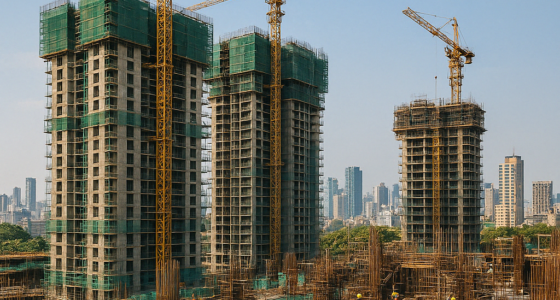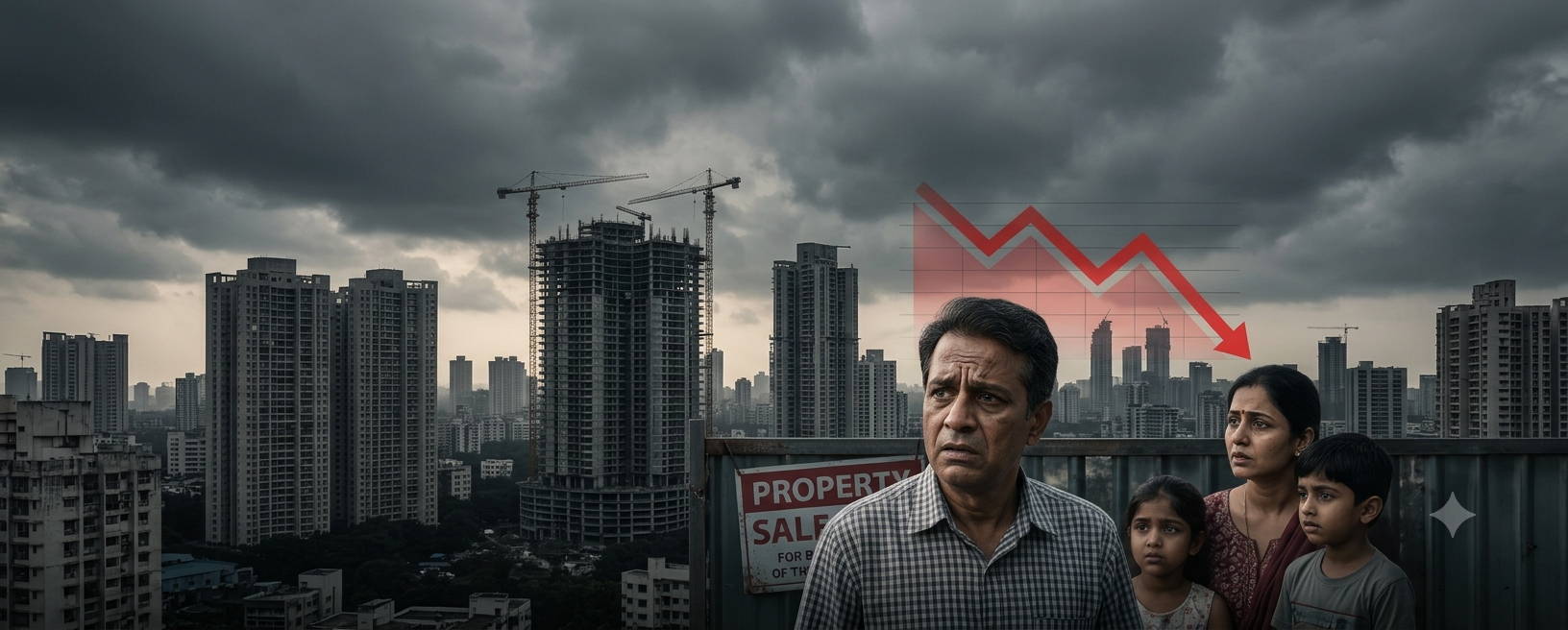
The news is not good for Mumbai’s real estate market. It may be uncomfortable for developers, investors and the industry to accept, but the numbers are telling a story that can no longer be brushed aside. Mumbai recorded 12,690 property registrations in October 2026, generating stamp duty revenue of ₹1,172 crore, according to the Inspector General of Registrations (IGR), Maharashtra government. Compare this with October 2024, when the city recorded 12,958 registrations and ₹1,205 crore in revenue, and the picture becomes worrying. In two years, Mumbai has lost 268 property registrations, a decline of 2.07%, while stamp duty revenue has fallen by 2.74%. Add to this the substantial unsold housing inventory across the Mumbai Metropolitan Region, the growing supply of new homes and mounting economic uncertainties, and the warning becomes difficult to ignore. The good days may be behind Mumbai’s real estate market. The industry may not like this reality, but it is time to face it.
Two years later, Mumbai has fewer property registrations
The most worrying aspect of the October 2026 figures is what they reveal when compared with the corresponding month two years ago.
In October 2024, Mumbai recorded 12,958 property registrations, generating ₹1,205 crore in stamp duty revenue. In October 2026, registrations stood at 12,690, while revenue came down to ₹1,172 crore.
The comparison is revealing:
- October 2024: 12,958 registrations and ₹1,205 crore revenue.
- October 2026: 12,690 registrations and ₹1,172 crore revenue.
- Fall in registrations: 268 transactions, or 2.07%.
- Fall in stamp duty revenue: ₹33 crore, or 2.74%.
In two years, Mumbai’s property market has not managed to improve upon its October 2024 registration performance.
This is particularly concerning for an industry that has consistently projected strong demand, rising property values and an expanding base of homebuyers.
A city where property prices have continued to remain elevated should ideally be witnessing an increase in the number of transactions. Instead, the latest comparison shows fewer properties being registered and lower stamp duty collections.
The decline may appear modest in percentage terms, but the larger question is why the market has failed to move forward despite two years of growth in the wider economy and continued additions to the city’s housing supply.
July to October: The numbers show a loss of momentum
The monthly figures for 2026 also deserve attention. July was a relatively stronger month, with 13,824 property registrations and stamp duty revenue of ₹1,255 crore.
However, the following months did not sustain that performance.
- July 2026: 13,824 registrations, ₹1,255 crore revenue.
- August 2026: 12,580 registrations, ₹1,130 crore revenue.
- September 2026: 12,614 registrations, ₹1,220 crore revenue.
- October 2026: 12,690 registrations, ₹1,172 crore revenue.
Between July and October, registrations declined by 1,134, or approximately 8.2%. Stamp duty revenue also declined by ₹83 crore, or approximately 6.6%.
August witnessed a sharp fall from July’s numbers. September and October brought only a marginal improvement in registration volumes, with neither month returning to July’s level.
October, which included Navratri and Dussehra, traditionally considered auspicious periods for property purchases, recorded 12,690 registrations. While the month performed better than October 2025, it remained below October 2024.
The important point is that the market has not demonstrated sustained growth in monthly transaction volumes. Instead, registrations have remained within a relatively narrow range, with the July performance yet to be matched.
For an industry accustomed to celebrating every new sales record, this lack of meaningful improvement should be a reason to pause.
Over 2.6 lakh unsold homes in MMR: A warning developers cannot ignore
The registration figures become more concerning when viewed alongside the housing inventory situation in the Mumbai Metropolitan Region.
According to research compiled by Liases Foras and reported in October 2026, MMR had 2,60,629 unsold residential units at the end of the second quarter of FY2026-27. This accounted for approximately 30% of India’s total unsold housing inventory, which stood at over 8.65 lakh units.
During the quarter, unsold inventory in MMR increased by 0.4%. Housing sales stood at 34,552 units, registering a marginal decline of 0.1%, while developers increased new residential launches by 18.7% to 30,262 units.
This is an uncomfortable combination. Sales have remained virtually flat, but developers have continued to introduce more homes into the market.
The historical comparison is equally important.
At the end of FY2022-23, MMR’s unsold housing inventory had reached a peak of 3,77,152 units. Although the present inventory is lower than that peak, more than 2.6 lakh unsold homes remain a substantial overhang.
The market therefore cannot be judged simply by the number of new projects launched or the value of properties sold. What matters is how quickly the existing inventory is being absorbed.
When new supply continues to enter the market while sales remain stagnant, developers may eventually find themselves competing more aggressively for the same pool of buyers.
And that competition could change the bargaining power of homebuyers.
Housing launches are increasing, but is demand keeping pace?
The broader Indian housing market is also showing signs of moderation.
The September 2026 India Housing Report, prepared by CRE Matrix and the National Association of Realtors-India, found that primary housing sales across India’s Tier-1 cities stood at approximately ₹3.63 lakh crore in the first half of 2026, virtually unchanged from the corresponding period in 2025.
However, the number of homes sold declined by approximately 2% to 2.58 lakh units. At the same time, developers launched nearly 2.98 lakh homes, an increase of approximately 7%.
In simple terms, more homes were launched than sold.
The report also highlighted that the average ticket size increased by only around 2% year-on-year, the slowest increase in three years.
There is an important distinction when examining MMR specifically. The same report found that the region’s primary housing sales increased by approximately 9% in volume during H1 2026, with around 83,600 homes sold. However, Mumbai city itself recorded broadly flat volumes of approximately 24,500 units, while new launches increased by around 40% to approximately 22,400 units.
This suggests that growth across the wider metropolitan region is not necessarily translating into stronger transaction momentum within Mumbai city.
It also raises questions about the increasing supply pipeline and whether all these new homes will find buyers at the prices developers are currently demanding.
Global uncertainty could make things worse
Real estate does not operate in isolation. It is closely linked to economic confidence, employment, household savings, interest rates and the availability of finance.
The global economic environment has become increasingly uncertain. Geopolitical tensions, the West Asia crisis, disruptions to energy supplies, inflationary pressures and volatility in financial markets can all affect the property sector.
CBRE’s September 2026 India Mid-Year Market Outlook specifically identified geopolitical tensions and disruptions in the Strait of Hormuz as risks to energy security, supply chains and inflation.
For the real estate industry, these developments can have consequences on multiple fronts.
Higher energy prices can increase the cost of construction materials and transportation. Supply-chain disruptions can affect the availability and pricing of essential building materials. Inflation can reduce the disposable income available to households, while uncertainty about employment and future earnings can make families postpone major financial decisions.
Real estate is particularly vulnerable to such uncertainty because purchasing a home is one of the largest financial commitments an individual or family makes.
A buyer who is uncertain about the economy may postpone purchasing a home. An investor facing volatility in equity markets may become more cautious about putting additional money into property. A developer facing rising costs and slower sales may find it increasingly difficult to maintain margins.
The impact could be particularly significant in the luxury and ultra-luxury segments, where purchasing decisions are often influenced by investment returns, wealth creation and financial-market sentiment.
Can developers continue increasing property prices?
This is perhaps the biggest question confronting Mumbai’s real estate industry.
For several years, developers have been able to command higher prices, supported by infrastructure development, redevelopment projects, improved connectivity and demand for premium housing.
But there is a fundamental limitation to this model: the buyer’s ability to pay.
Mumbai’s property prices have reached levels where even financially stable salaried families struggle to purchase a home without taking on substantial long-term debt.
A developer may face higher land acquisition costs, construction expenses, financing costs and regulatory charges. However, these costs cannot automatically be passed on to homebuyers.
There comes a point when the asking price and the buyer’s willingness to pay stop matching.
The recent unsold inventory data also indicates that developers cannot assume that every new project will find buyers simply because it is located in Mumbai or the surrounding metropolitan region.
If sales remain stagnant and supply continues to increase, developers may have to reconsider their pricing strategies.
The pressure may first become visible through discounts, flexible payment plans, waived charges and other incentives. In projects where inventory remains high, developers may eventually have to consider more meaningful price adjustments.
Is a property price correction imminent?
A widespread fall in property prices cannot be declared on the basis of registration figures alone. Nor does a decline in monthly registrations automatically mean that developers will immediately reduce their prices.
However, the conditions that can create pressure for a price correction are becoming increasingly relevant: slower transaction momentum in Mumbai city, substantial unsold inventory across MMR, new supply entering the market, affordability concerns and global economic uncertainty.
The more important question is whether the market can continue absorbing homes at today’s prices.
If buyers begin postponing purchases, developers will have to compete harder for transactions. If inventory remains high and cash-flow requirements increase, the pressure to negotiate could become more pronounced.
A price correction may not happen uniformly across Mumbai. Prime locations with limited supply may remain relatively resilient, while projects in locations with competing developments, high inventory and weaker buyer demand could face greater pressure.
But the possibility of better deals is something homebuyers should not ignore.
Homebuyers should wait, compare and negotiate
For prospective homebuyers, this may be a period to exercise patience rather than rush into a purchase.
The numbers do not guarantee that prices will fall over the next six months or one year. But they do suggest that buyers should not assume that developers will always have the upper hand.
Those looking to purchase a home should compare similar projects, examine unsold inventory, assess the developer’s financial position and negotiate the final price rather than focusing only on advertised discounts.
Ready-to-move-in properties and projects nearing completion may offer opportunities, particularly where developers are carrying unsold inventory.
Buyers should also examine the total cost of ownership, including parking, floor-rise charges, maintenance deposits and other additional costs. A seemingly attractive offer may not necessarily translate into a genuinely lower purchase price.
Most importantly, homebuyers should not allow festive offers, limited-period discounts or claims of prices rising soon to push them into making a decision they cannot comfortably afford.
For families who have spent years saving for a home, the difference between buying at the right price and overpaying can have consequences for decades.
Mumbai’s property market needs a reality check
The October 2026 registration figures are not proof that Mumbai’s real estate market has collapsed. The city continues to record thousands of property transactions every month, and parts of the wider MMR market continue to demonstrate demand.
But the figures do expose a worrying lack of progress.
Two years after October 2024, Mumbai has recorded 268 fewer property registrations in the corresponding month. Stamp duty revenue is also lower by ₹33 crore. Compared with July 2026, October registrations are down by more than 8%.
At the same time, MMR continues to carry over 2.6 lakh unsold homes, and developers are adding fresh supply even as quarterly sales remain virtually flat in the latest Liases Foras assessment.
The real estate industry may continue to highlight the value of homes sold, premium launches and infrastructure-led growth. But the more important question is whether ordinary buyers can afford the homes being built and whether the market can absorb the supply coming into it.
For thousands of families in Mumbai, owning a home is not an investment strategy or a luxury purchase. It is a lifelong aspiration. Many have watched prices move further away from their reach with every passing year.
If the market is finally beginning to lose some of its pricing power, perhaps this is an opportunity for that imbalance to correct itself.
The good days of effortless price increases may be behind some developers. The coming period could be far more difficult, with greater competition, tighter margins and buyers demanding value for every rupee they spend.
And for the homebuyer who has waited patiently, this may be the moment to stop chasing the market and start making the market compete for their money.