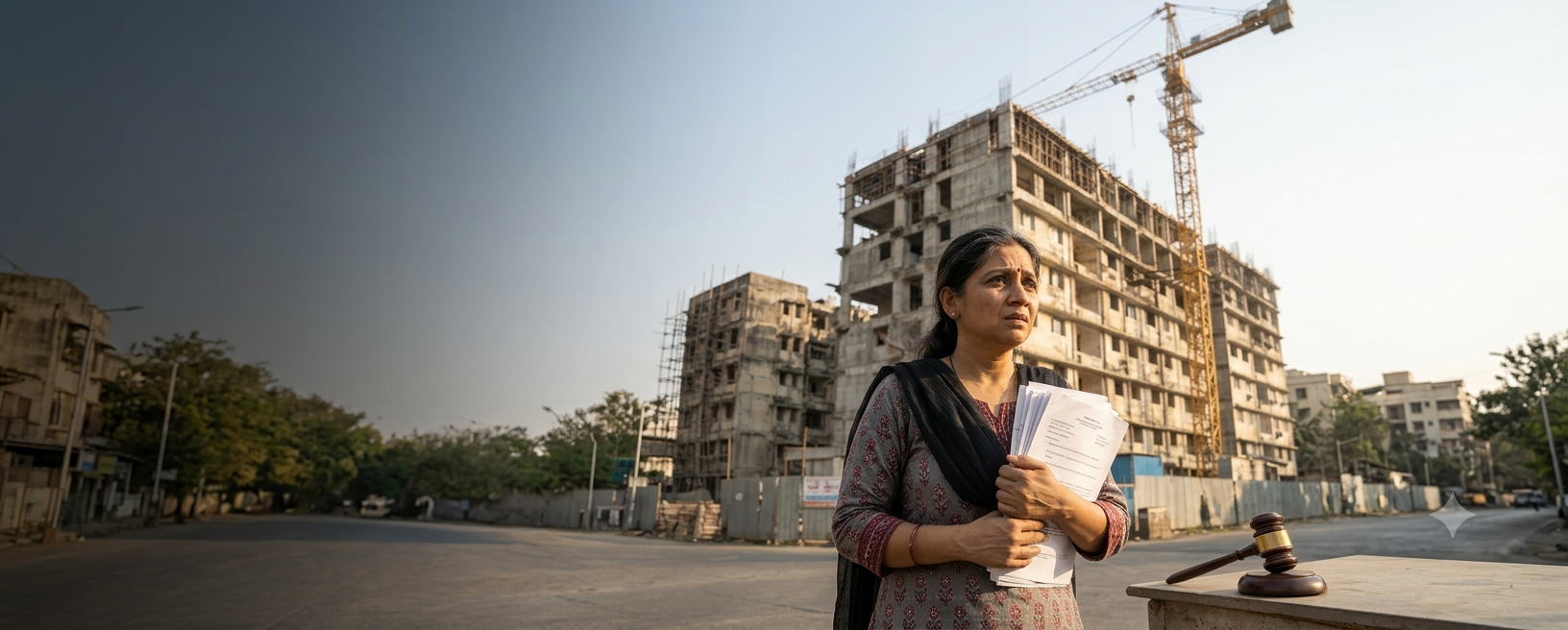
The Maharashtra State Co-operative Appellate Court has held that a single member cannot ordinarily stall a housing society’s majority-approved redevelopment merely by opposing the decision, while directing the society to protect a disputed passage claimed under tenancy rights in the redeveloped building.
In a judgment dated October 23, 2026, the appellate court dismissed an appeal filed by Varashree Narayan against Empire Guide Co-operative Housing Society Ltd., located at Guide Building on L.D. Ruparel Marg, Malabar Hill, Mumbai. The court upheld the Co-operative Court’s refusal to grant an interim injunction against the society’s redevelopment process.
However, the court also acknowledged that the member’s apprehension concerning her studio and the disputed passage was not baseless. It directed the society to secure the passage outside Narayan Studio in the proposed redeveloped building, subject to the decision of the Small Causes Appellate Court, Mumbai.
The ruling draws a distinction between an individual member’s attempt to halt an entire redevelopment project and the protection of specific property or tenancy rights that could be affected by the project.
The dispute: A member challenges the society’s redevelopment decision
The case, Appeal No. 91 of 2026, arose from a dispute pending before Co-operative Court No. 2, Mumbai, in which Narayan had challenged resolutions passed by Empire Guide Co-operative Housing Society on May 21, 2023, October 15, 2023, and April 14, 2024.
The resolutions concerned the redevelopment of the society’s building.
Narayan is an associate member of the society and has interests in Flat No. 21 on the sixth floor of Guide Building. Her dispute also concerns Room A on the ground floor, known as Narayan Studio, where she practises as a sculptress, and a passage outside the studio over which her father was recognised as having tenancy rights by the Small Causes Court.
The society had challenged the Small Causes Court’s decision concerning the passage before the Small Causes Appellate Court.
Narayan approached the Co-operative Court seeking to prevent the society from implementing the redevelopment resolution dated April 14, 2024, until the final disposal of her dispute.
The Co-operative Court rejected her application for interim relief on October 6, 2026. She subsequently approached the Maharashtra State Co-operative Appellate Court, seeking to overturn that decision and obtain protection against the redevelopment process.
Allegations of illegal resolutions and non-compliance with redevelopment guidelines
Narayan alleged that the society’s redevelopment resolutions were illegal and void because they had been passed in breach of the Maharashtra Government’s redevelopment guidelines dated July 4, 2019.
She contended that the society had not complied with the prescribed requirements concerning the meeting quorum, members’ participation and consent.
According to her, the special general body meeting held on May 21, 2023, did not have the required participation and majority support. She claimed that only 24 members out of 86 were present and that 44 members had not consented to redevelopment.
She also questioned the subsequent meetings and the appointment of a project management consultant, alleging that the prescribed requirements had not been followed.
Narayan further argued that the society continued to be governed by its 2014 model bye-laws and had not expressly amended or modified them following changes to the Maharashtra Co-operative Societies Act in 2019. She contended that the redevelopment resolutions were therefore legally defective.
These were allegations raised by Narayan. The appellate court did not finally determine the legality of the resolutions in this appeal.
Member claimed that the building did not require redevelopment
Narayan also questioned the necessity of demolishing the existing building.
She relied on a structural audit report dated April 2023 prepared by structural auditor Nanak Shah. According to her interpretation of the report, the building required maintenance repairs to address vegetation, seepage and leakage rather than demolition and redevelopment.
She claimed that the society had already undertaken two major structural repairs and that the building’s structural condition did not justify demolition.
Narayan further alleged that the redevelopment decision had been taken with an ulterior motive to displace her and her family from their residential and commercial premises.
The appellate court’s decision, however, did not amount to a final ruling on whether the building required redevelopment or whether the society’s decision was motivated by improper considerations.
Studio and disputed passage missing from the proposed redevelopment plan
A central aspect of Narayan’s case was the potential effect of redevelopment on her interests in Narayan Studio and the passage outside it.
She told the court that the proposed building plan prepared by the structural auditor did not show Room A or the disputed passage. She apprehended that once the society executed a development agreement and the project proceeded, her existing rights could be jeopardised.
The dispute over the passage had a separate legal history. The Small Causes Court, Mumbai, had recognised the tenancy rights of Narayan’s father over the passage, but the society had challenged that decision before the Small Causes Appellate Court. Narayan also referred to earlier proceedings before the Bombay High Court concerning the passage.
She argued that the society should not be permitted to proceed with redevelopment in a manner that prejudiced her claims before those proceedings were decided.
The society, on the other hand, maintained that the redevelopment decision did not take away her rights over the flat or studio. Its advocate also submitted that the passage could be secured in the redevelopment process, subject to the outcome of the pending litigation.
Society argued that one member could not stall a majority decision
The society opposed the injunction application, contending that redevelopment had the support of the majority of its members.
It also argued that the appellant had raised a similar issue in another proceeding and questioned the maintainability of her challenge to the redevelopment process.
The society relied on a Bombay High Court judgment in Anil Keshav Vanjpe v. Shri Krishna Govind Prasad Co-operative Housing Society Ltd. and Others, decided on April 2, 2024, in Writ Petition No. 13527 of 2022.
In that case, the High Court had considered a challenge by an individual member to a housing society’s decision to redevelop its building.
The High Court observed that the general body is the supreme body under Section 73 of the Maharashtra Co-operative Societies Act, 1960, and that a minority member’s disagreement with a majority decision does not ordinarily justify challenging it. It also recognised that a challenge based on a breach of mandatory provisions of the Act, Rules or bye-laws stands on a different footing.
The High Court further observed that the effect of a majority decision to redevelop cannot ordinarily be stalled at the instance of a single member.
Relying on this ruling, the society argued that Narayan could not stop the redevelopment process merely because she disagreed with the decision taken by the majority.
Why the appellate court refused to grant an injunction
President of the Maharashtra State Co-operative Appellate Court Sau. S.S. Sapatnekar examined whether the appellant had established the grounds required for interim relief.
The court noted that the appeal concerned the trial court’s exercise of discretion while deciding an interim injunction application. Its task was to determine whether the lower court had exercised that discretion judiciously, rather than finally adjudicating all the underlying disputes.
The appellate court observed that Narayan’s allegations concerning the May 21, 2023 redevelopment resolution, including the alleged non-compliance with government guidelines and quorum requirements, required adjudication on merits after evidence was recorded.
The court examined the meeting records produced before it. The draft minutes of the special general body meeting dated May 21, 2023, which had been confirmed by the society’s letter dated July 24, 2023, indicated that 50 out of 58 members had consented to redevelopment.
The court also noted that 28 members were present at the annual general meeting held on October 15, 2023, and that 44 members attended the special general body meeting on April 14, 2024. It observed that the minutes reflected decisions taken with majority support.
The court concluded that the material before it did not justify an interim injunction that would halt the redevelopment process.
It held that the appellant had not established a prima facie case or a balance of convenience in her favour. It also concluded that granting the injunction would cause irreparable loss to the society’s majority by stalling redevelopment.
The appellate court therefore found no reason to interfere with the Co-operative Court’s order rejecting interim relief.
Importantly, this did not amount to a final decision that every redevelopment resolution was legally valid. The court expressly recognised that the allegations concerning compliance with the applicable requirements needed to be examined on merits.
Court acknowledges the member’s concern but orders protection of the passage
While refusing to stop redevelopment, the appellate court separately examined Narayan’s concerns about the studio and passage.
The court noted a society letter dated June 13, 2016, which acknowledged the rights of Narayan’s mother concerning Flat No. 21 and Room A, identified as Narayan Studio.
It also observed that the proposed redevelopment plan was silent about Room A and the disputed passage.
The court expressly held that the appellant’s apprehension could not be said to be baseless. However, it considered that the concern could be addressed through a specific direction rather than by stopping the entire redevelopment project.
The society’s advocate had also submitted that the passage could be secured in the redevelopment process, subject to the decision of the Small Causes Appellate Court.
Consequently, the appellate court directed the society to secure the disputed passage outside Room A, or Narayan Studio, in the proposed redeveloped building, subject to the decision of the Small Causes Appellate Court, Mumbai.
This direction is significant because it distinguishes the continuation of redevelopment from the final determination of the appellant’s individual rights.
The court did not conclusively decide the ownership or tenancy rights over the studio and passage in this appeal. Nor did it finally determine the legality of the redevelopment resolutions.
What the final order says
In its October 23, 2026 judgment, the Maharashtra State Co-operative Appellate Court passed the following directions:
- The appeal filed by Varashree Narayan was dismissed.
- The Co-operative Court No. 2, Mumbai, order dated October 6, 2026, rejecting her interim relief application, was confirmed.
- Empire Guide Co-operative Housing Society was directed to secure the disputed passage outside Room A, or Narayan Studio, in the proposed redeveloped building, subject to the decision of the Small Causes Appellate Court, Mumbai.
The additional reliefs sought for the first time in the appeal, including broader injunctions concerning the flat, demolition and appointment of a court commissioner, were not granted.
What the judgment means for housing society members
The ruling reinforces the principle that an individual member’s opposition does not automatically entitle them to stop a redevelopment project approved by the majority. A member seeking an injunction must establish legally sustainable grounds for that relief, and courts will consider the consequences of stopping the project for the other members.
At the same time, the judgment demonstrates that allowing redevelopment to proceed does not necessarily dispose of separate claims concerning a member’s property or tenancy rights.
Where an existing legal dispute could be affected by redevelopment, a court may consider a specific protective direction instead of halting the entire project.
The judgment does not give housing societies unrestricted authority to ignore mandatory legal requirements. Nor does it mean that every individual objection is invalid. The court left the underlying challenge to the redevelopment resolutions to be adjudicated on merits and specifically protected the disputed passage pending the decision of the competent appellate court.
The key distinction in this case is that the court refused to stall majority-supported redevelopment while requiring the society to secure the disputed passage. The final determination of the passage rights remains subject to the pending proceedings before the Small Causes Appellate Court.
Also Read: Part 1 of Society Redevelopment Series: Administrator Cannot Decide Society Redevelopment